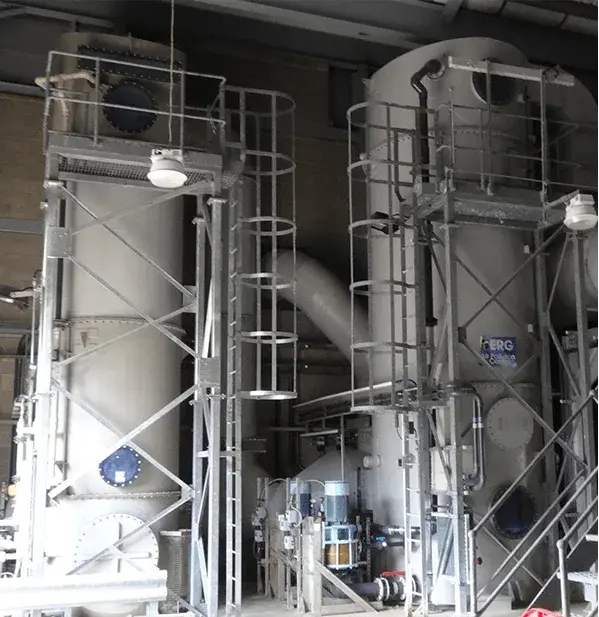
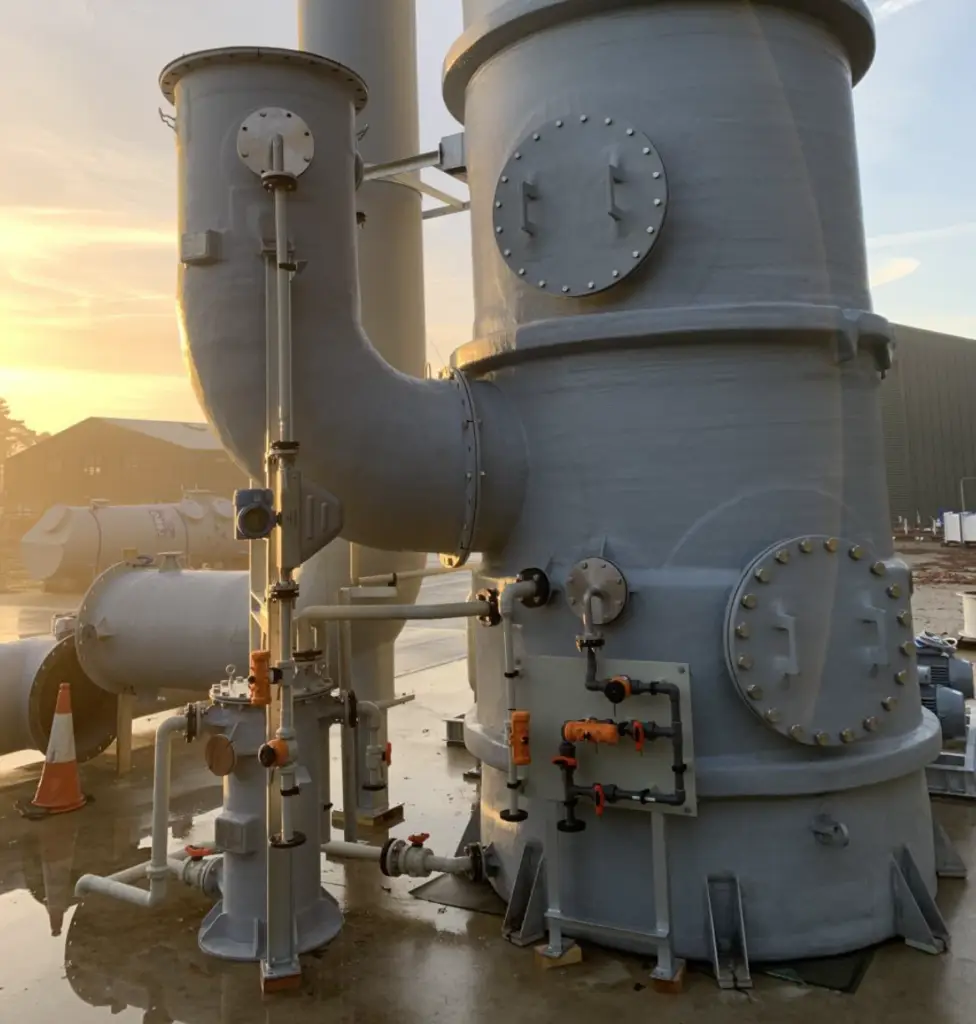
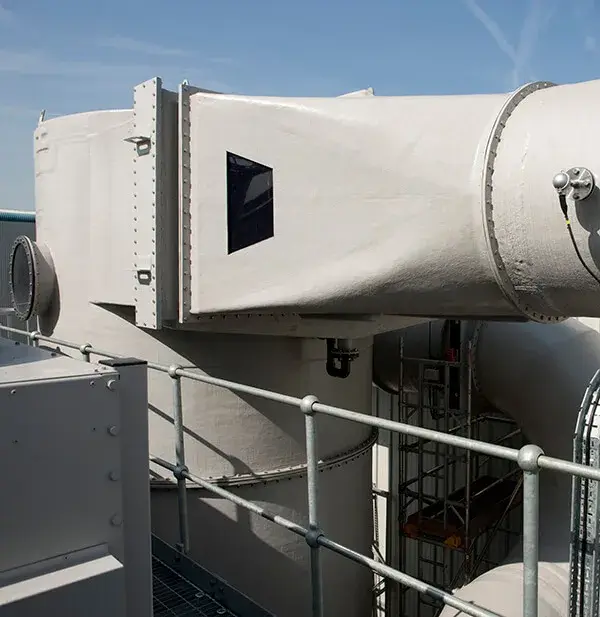
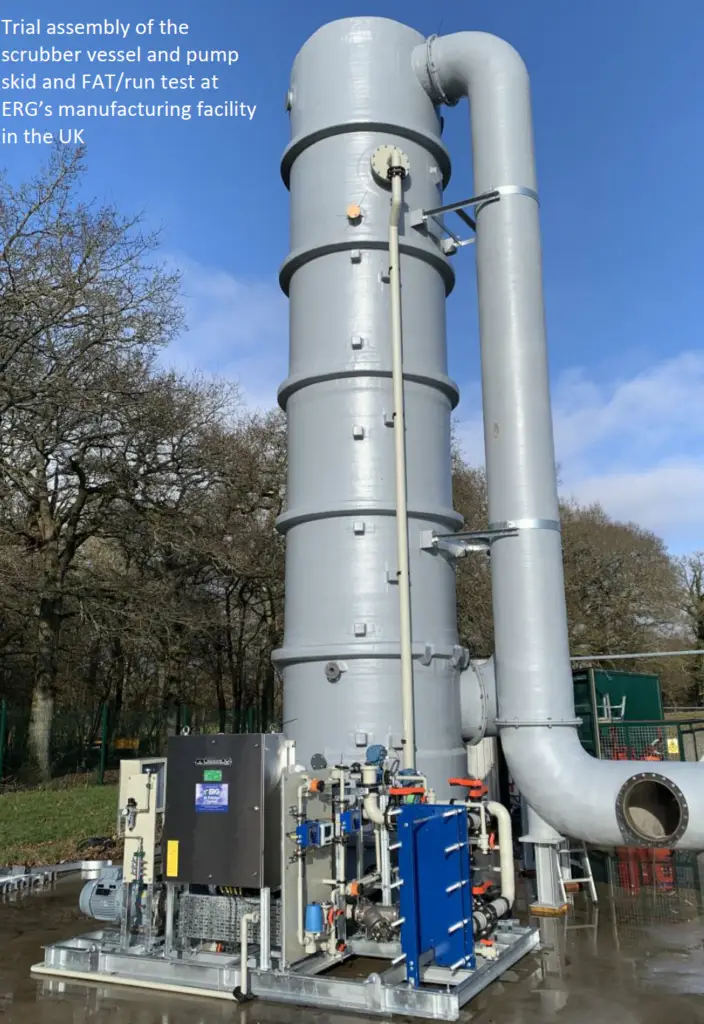
ERG wet chemical scrubbers provide high‑efficiency removal of hydrogen sulphide (H₂S), odour and other soluble contaminants from odorous airstreams, using packed tower scrubbing technology tailored to each application.
Chemical scrubber duty and performance
All designs are bespoke and matched to the detailed requirements of the application specification, using industry‑standard random packing to optimise scrubbing efficiency, pressure drop and equipment size. Each package carries a performance guarantee and is engineered to provide robust operation at the lowest practicable capital and operating costs.
Chemical scrubbers are applied to odorous air containing H₂S, acid gases, ammonia and selected soluble VOCs, and are often used as the bulk‑removal stage upstream of polishing carbon filters or other VOC abatement equipment. Design parameters are selected to meet defined outlet concentrations and odour limits with appropriate safety margins under variable flow and load conditions.
Chemical scrubber technology and operation
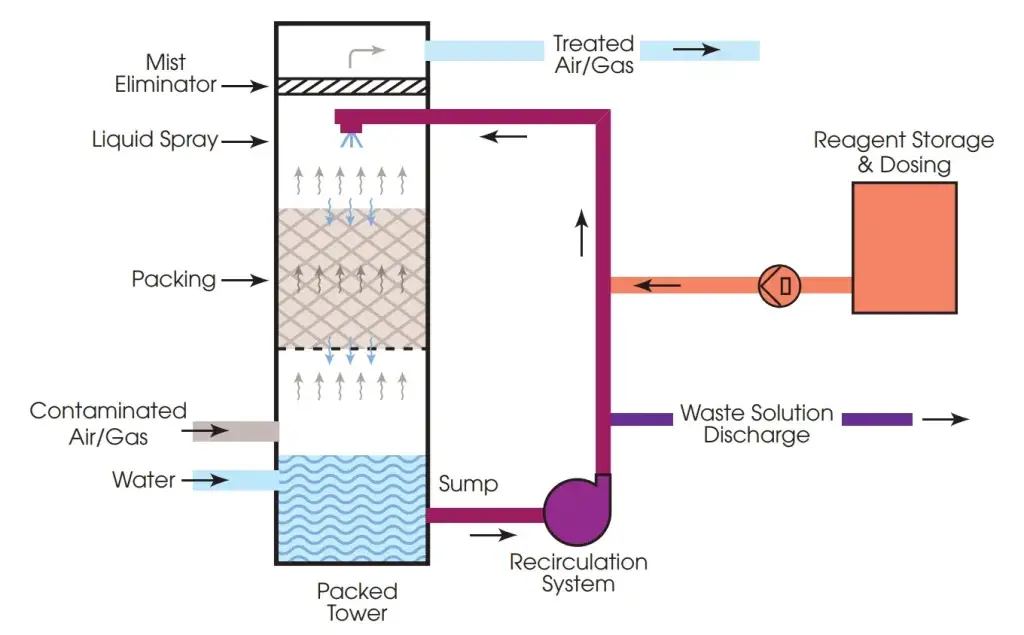
Packed tower scrubbers operate by bringing the contaminated gas into contact with a recirculated, chemically conditioned scrubbing liquor over a packed bed. Soluble contaminants such as H₂S, acid gases, ammonia and selected VOCs are absorbed into the liquid phase and reacted or neutralised within the scrubbing liquor, while the treated gas passes through a droplet eliminator before discharge.
ERG uses industry‑standard random packing and associated liquid distribution, recirculation and chemical dosing arrangements to optimise operating efficiency alongside system pressure drop and equipment size. Further information on the packed tower scrubber configuration is available on the packed tower scrubber technology.
Design parameters and typical duties
Typical design parameters for ERG wet chemical scrubbers include:
Flowrate ranges from 100 to 100,000 m³/hr per tower; multiple towers in parallel can be used for higher flowrates.
Odour loadings up to 1,000,000 ouE/m³ are common.
Soluble contaminants typically 50–200 ppm average and up to 1,000 ppm peak.
Typical removal efficiency of 99.5%, up to 99.95% as required.
Vessel diameters from 200 to 3,800 mm, with heights typically up to 10 m or higher if the process requires it.
These parameters allow chemical scrubbers to be applied to a wide range of odorous and process gas streams in wastewater treatment, municipal waste handling, chemical and industrial applications.
Diagram of typical chemical scrubber
System design and key features
ERG supplies complete chemical scrubber systems including:
Recirculation pump, pipework, fan, ductwork, access platform, instrumentation and control system – with the option to integrate a downstream carbon filter.
Common packing types including Snowflake / AstraPAC and 1″, 1.5″ and 2″ Pall rings.
Recirculated liquor flowrate selected to minimise pump flow and energy consumption while maintaining optimal scrubbing performance.
Liquor distribution across the packing using sprays or trough distributors depending on application.
Droplet elimination using chevron, impaction blade or woven mesh design to suit the application, with clean‑in‑place sprays available to assist with on‑line maintenance.
Scrubber sump tank integrated into the packed column vessel.
Chemical dosing, water make‑up and blowdown control configured to match specific performance requirements.
Instrumentation selection to give robust operation, high reliability and tight performance control.
Vessels designed as standard to BS EN 13121 or BS 4994.
Materials selection is matched to the contaminants and reaction chemistry; common materials include uPVC, PP, Derakane® GRP and Crystic® GRP.
Advantages of ERG wet chemical scrubbers
Key advantages of ERG’s chemical scrubbers include:
High removal efficiencies for H₂S, acid gases and other soluble contaminants, with typical performance ≥99.5% and higher when required.
Flexible design envelope covering a wide range of flowrates, odour loadings and contaminant concentrations.
Optimised liquor circulation and packing selection to balance mass transfer performance with energy consumption and pressure drop.
Integrated system supply including fans, ductwork, access and controls, simplifying interface management for the client.
Proven vessel and materials design to recognised standards for long service life and chemical resistance.
Frequently asked questions
When is a wet chemical scrubber preferred over a bio‑trickling filter?
A wet chemical scrubber is typically preferred where fast response is required, where contaminants are not readily biodegradable, or where operating conditions (for example high temperatures, variable loads or aggressive chemistries) make biological treatment less suitable. Bio‑trickling filters are more commonly selected for biodegradable odorous compounds at low to medium loadings where a lower‑chemical, biological solution is preferred.
How do you determine the required removal efficiency and tower size?
The required removal efficiency and tower size are determined from the inlet flowrate, odour or contaminant loading, target outlet concentration, gas properties and acceptable pressure drop. From these, ERG defines packing depth, tower diameter, recirculation rate and reagent dosing scheme, ensuring that the specified performance (for example 99.5–99.95% removal) is achieved with appropriate safety margins.Lorem ipsum dolor sit amet, consectetur adipiscing elit. Ut elit tellus, luctus nec ullamcorper mattis, pulvinar dapibus leo.
Maeve
Hi, I'm Maeve, ERG's virtual assistant.
Would you like to chat with an expert, or are you just browsing?
No problem. Feel free to look around — I'm here if you need me.
What is your enquiry about?
Great. Can you leave your details so the right person can get back to you?
Please give us a short description of your enquiry.
We'll only use your details to respond to your enquiry.
Sending your enquiry…
Thank you. One of our experts will contact you shortly.
Sorry, something went wrong sending your enquiry. Please try again in a moment.