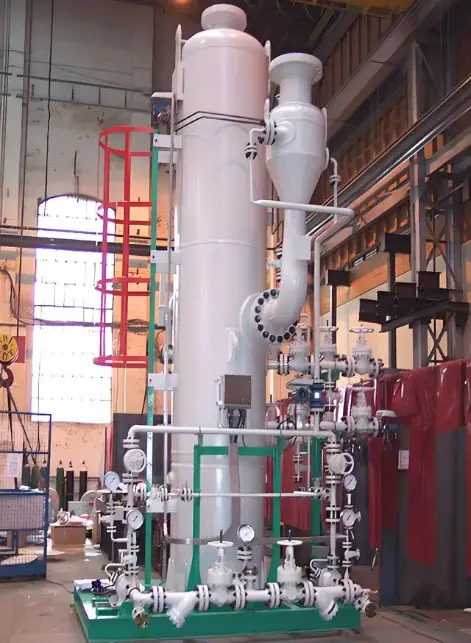
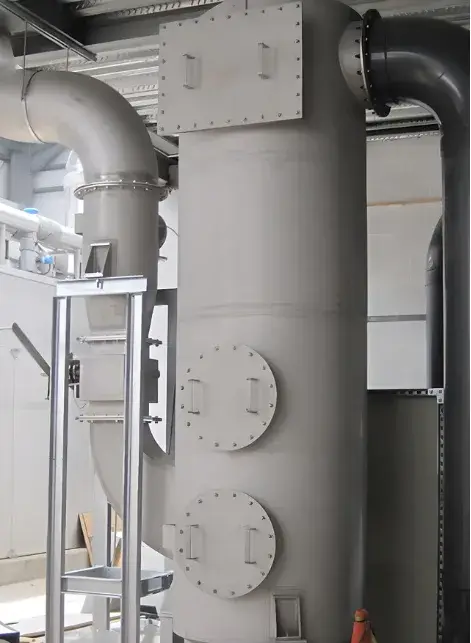
ERG venturi scrubbers are used for solids removal from flue gases and process vents, providing efficient capture of particulates down to around 0.2 µm from industrial gas streams. They are suitable for both mechanically generated (larger) and chemically generated (fine) particulates, typically in the 0.5–10 µm range, with material loading, density and solubility all factored into ERG’s design for each duty.
Venturi scrubber operating principle
The flue or process vent gas stream enters the top of the venturi where the scrubbing liquid, usually recirculated, is sprayed into the gas stream. In the venturi throat, the gas accelerates and mixes intimately with the scrubbing liquid due to intense eddies present in the turbulent flow. The change in momentum allows particulates to be entrained in the liquid droplets, effectively removing solids from the gas stream.
As the gas slows and expands at the venturi outlet, the droplets recombine and then enter a cyclone separator where they agglomerate and drain into the sump tank ready for recirculation through the venturi throat. A final mist elimination stage removes any residual droplets. Venturis may be orientated vertically, horizontally or at an angle, depending on layout constraints and process requirements.
Venturi selection and performance
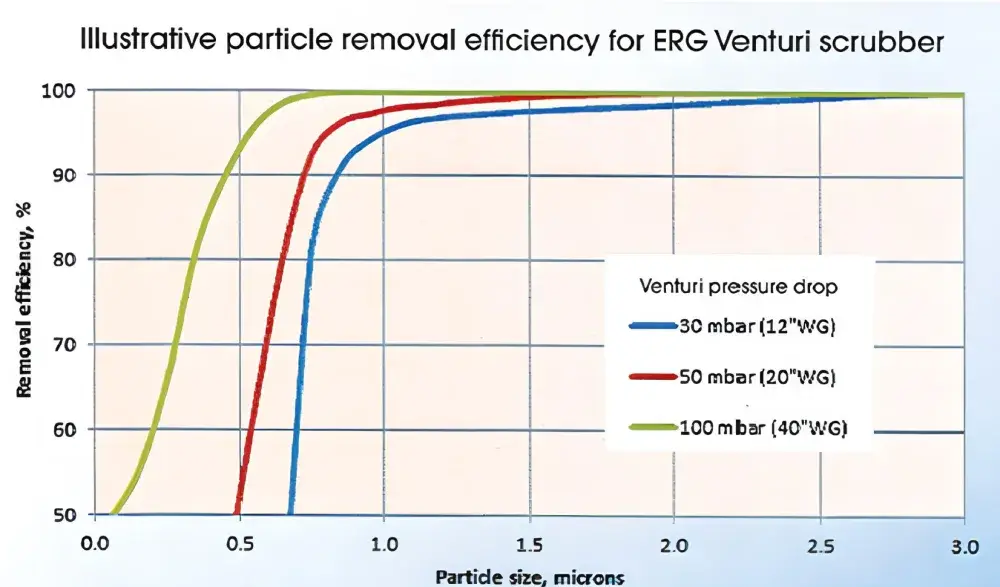
The gas‑side pressure drop is the primary parameter determining particulate removal efficiency; the smaller the particulate, the higher the pressure drop required. Indicative performance is typically presented in a pressure‑drop versus particle‑size graph
Fixed throat venturis have no internal moving parts and so are simple to operate and maintain. If the gas flow rate is variable, the pressure drop across the throat varies and so does the particulate removal efficiency. Higher flow rates result in greater particulate removal efficiency.
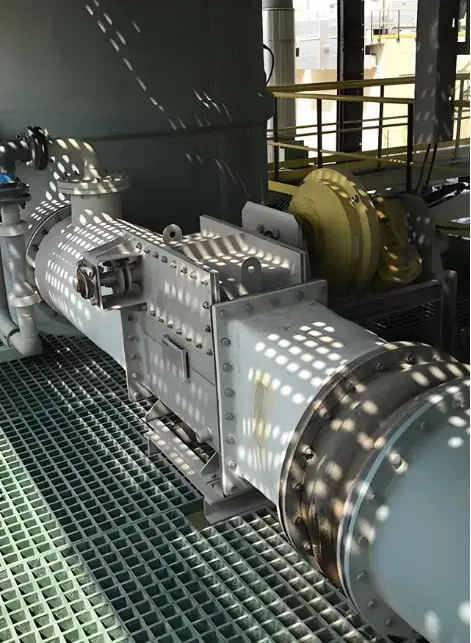
Variable throat venturis include adjustable blades in the throat. For variable gas flows these can be automatically modulated to achieve a constant pressure drop ensuring high and consistent particulate removal efficiency is maintained, independent of flowrate. The mechanism that adjusts the position of the blades is located outside the gas flow and is highly reliable. Variable throat venturis may also be manually adjustable to optimise performance and power consumption without the complexity of an automatic actuator and control loop.
System configuration options
ERG venturi scrubbers are typically supplied as part of a gas cleaning package. The package is designed for each application and can include:
Side‑stream settler and/or press – used with insoluble particulate to remove captured solids from the liquor circuit as a slurry or a dry cake.
Separate sump tank – used to allow on‑line inspection of the scrubbing liquor, especially when particulate is prone to float on the liquid surface.
Integrated quench and venturi vessel – used when hot flue gas is being treated; the gas is quenched to the adiabatic saturation temperature in the upper part of the venturi and then accelerated in the throat below.
High‑pressure fans – to provide the motive force through extraction ducts, venturi vessel and any additional scrubbing stages; treated gas is discharged to the client’s process or to atmosphere, with typical fan duties ranging from 25 to 100 mbar depending on application.
Recirculation pumps – pumps with suitable seal plans provide the required flowrate and pressure at the venturi throat, with duty/standby arrangements used to enhance system reliability and availability.
Downstream scrubbing – frequently required to remove soluble acidic contaminants (for example HCl, Cl₂, HF, HBr, SO₂) or alkaline contaminants (for example NH₃); this is provided by other ERG mass‑transfer technologies such as packed towers, V‑tex® scrubbers or tray towers.
Construction materials
Depending on operating temperature, gas composition and contaminant type, ERG can provide the venturi and cyclone in a range of materials, including:
Carbon steel
Stainless steels (304, 316)
Duplex stainless steels
Hastelloy (C‑22 or C‑276)
Inconel
Thermoplastic‑lined or composite options such as PVC/GRP, PP/GRP or chemically resistant GRP (Crystic® or Derakane® resins)
Materials are selected to provide appropriate corrosion resistance, mechanical strength and service life for the specific application.
Maeve
Hi, I'm Maeve, ERG's virtual assistant.
Would you like to chat with an expert, or are you just browsing?
No problem. Feel free to look around — I'm here if you need me.
What is your enquiry about?
Great. Can you leave your details so the right person can get back to you?
Please give us a short description of your enquiry.
We'll only use your details to respond to your enquiry.
Sending your enquiry…
Thank you. One of our experts will contact you shortly.
Sorry, something went wrong sending your enquiry. Please try again in a moment.