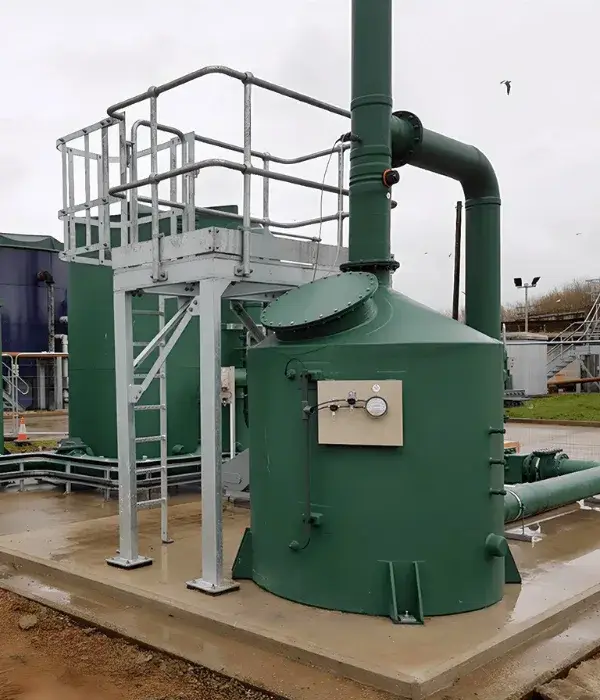
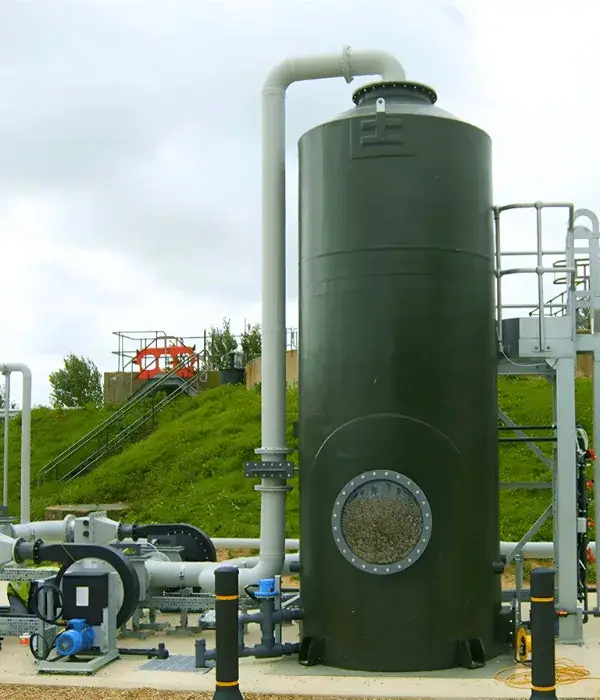
ERG designs and supplies wastewater odour control systems for sewage treatment works, configured to control odorous emissions, meet permit requirements and maintain reliable long-term operation.
Typical wastewater odour sources and duties
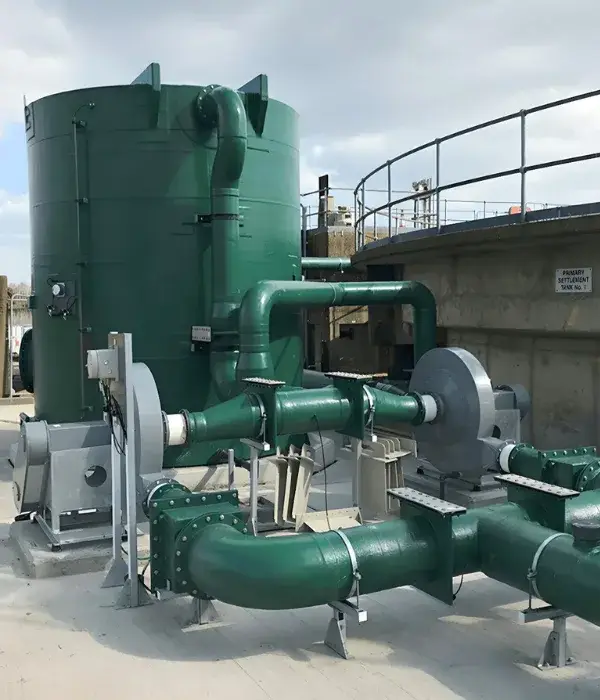
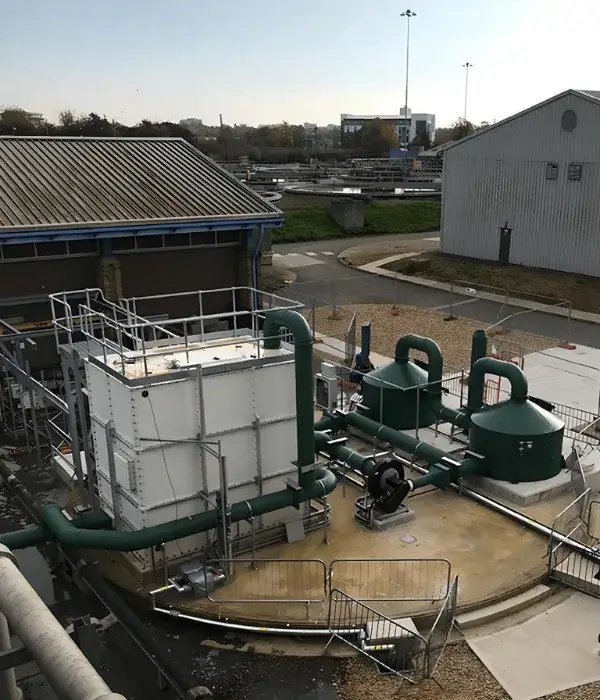
Our systems are applied across inlet works, settlement tanks, sludge treatment and associated wastewater infrastructure, with bio‑trickling filters, carbon filters and scrubbers sized for each duty. Each odour control package is designed to achieve defined odour and hydrogen sulphide (H₂S) emission limits while controlling fan power, chemical consumption and long‑term maintenance costs across the asset life.
ERG as a framework odour control contractor
ERG is proud to be a framework odour control contractor for Thames Water, Southern Water and Scottish Water, and to count the majority of the UK’s water companies among our customers. We are also supplying the odour control for London’s Tideway Tunnel, providing large-scale wastewater odour control units on this strategic sewage infrastructure project.
Cost-effective wastewater odour control systems
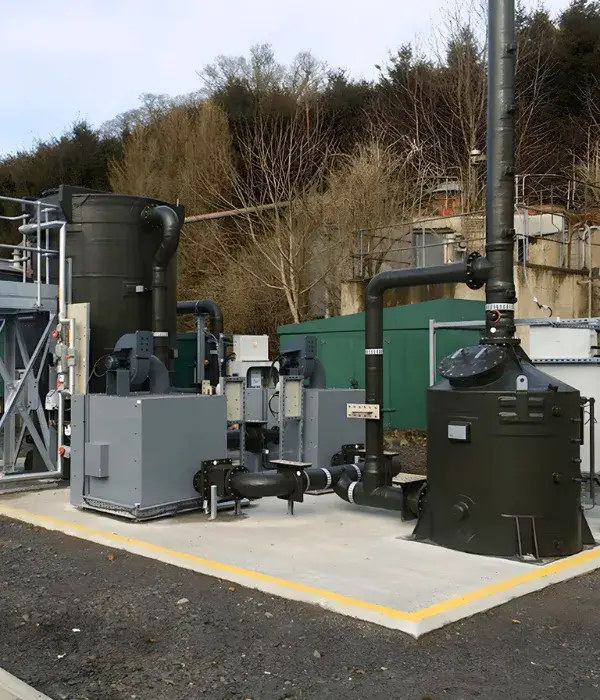
Based around our standard range of bio‑trickling filters and carbon filters, we offer cost-effective solutions for controlling odour at sewage treatment plants. A typical configuration of a bio‑trickling filter followed by a polishing carbon filter is effective for achieving a stack concentration of 1,000 ou~E~/m³ or less from:
Pumping stations
Inlet works, screens, detritors and associated skips
Primary settlement and associated distribution chambers
Imported and exported sewage/sludge tanks and tanker loading/discharge
Primary, RAS, SAS, digested sludge tanks and dewatering equipment
These technologies are selected and combined to provide reliable hydrogen sulphide (H₂S) removal and consistent odour performance across variable wastewater operating conditions.
Complete odour control packages for sewage treatment works
ERG provides the following comprehensive services:
Design of the complete odour control system including:
Interface with covers and equipment OEMs
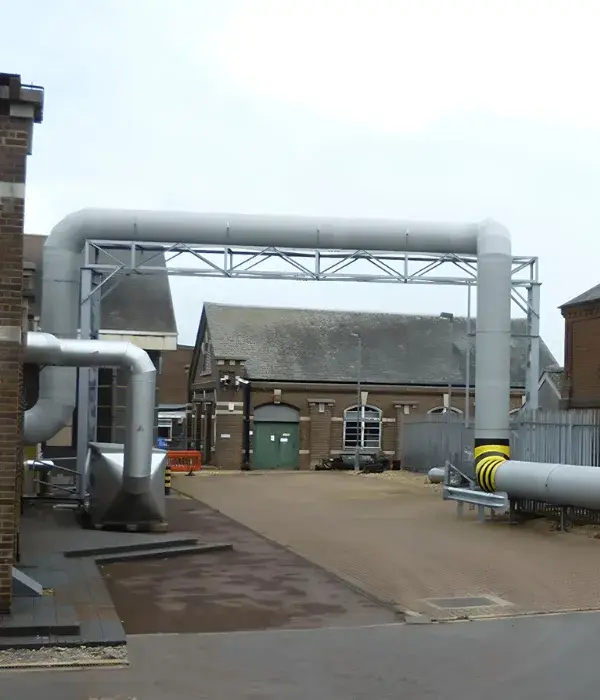
Extraction ductwork and associated supports
Odour control system – bio‑trickling filter and/or carbon filter and fans
Control package – MCC/C&I panel, instrumentation, power and control cabling
Discharge stack and monitoring
Access structure
Procurement and manufacture of system equipment items
Delivery and off‑loading
Mechanical and electrical installation of the system equipment items including site management
Commissioning and management of performance testing
ERG odour control systems are widely applied to pumping stations, inlet works and sludge treatment processes, where variable loads and intermittent operation require robust and flexible system design.
Further details of our capabilities are in our Water Industry User Guide, and specific details are available for individual frameworks.
Design services for wastewater odour control
We have extensive design capabilities for wastewater and sewage odour control systems. In addition to straightforward design and build odour projects, our clients also benefit from:
3D modelling of all packages – we model using Plant 3D and export as .dwg and Navisworks
BIM integration
Optioneering and FEED contracts
All design and build contracts include a complete set of design deliverables as standard, covering process design, equipment sizing, GA and detail drawings, and integration with wider wastewater treatment plant layouts.
Optioneering and FEED (Front End Engineering Design) contracts
There is often pressure to improve the odour impact of existing sewage treatment sites – new housing or commercial developments close to the site boundary, new processes requiring additional odour treatment, or older OCUs reaching the end of their service life.
ERG can help with defining the available options for upgrading existing assets and the preliminary engineering to allow formal project budgets to be set or released for implementation. We provide competitively priced design work carried out by our team of graduate and chartered engineers; in each case, the design output is tailored to meet the needs of the project – typical deliverables include:
Summary report identifying the available options for reusing/upgrading odour control assets versus providing new OCU(s)
Details of the technical and construction pros and cons of each option
Indicative CapEx and OpEx costings for major options
Preliminary engineering design for the selected option – input to the formal project specification
Read how this approach benefited Southern Water at Eastney and other ERG clients who implemented large odour control projects to improve their site’s existing odour control.
Project management and site services
Our project management and site staff are dedicated to ensuring each project is completed safely and to the full project requirements. All staff site managers and/or supervisors hold SMSTS or SSSTS certification, and all our staff have an applicable CSCS (or equivalent) card.
Case studies and technical resources
Read or download our case studies, product brochures and user guides for water industry odour control systems. These resources provide further technical information on bio‑trickling filter design, carbon filter performance, chemical scrubber applications and integrated wastewater odour control system configurations.
Our customers
ERG’s clients include leading UK and Ireland utility companies. Our reference list for wastewater and sewage odour control systems covers a wide range of treatment works sizes, from small rural sites to major conurbation treatment plants.
Frequently asked questions
Which odour control technologies are typically used on sewage treatment works?
On sewage treatment works, odorous air from inlet works, settlement tanks and sludge handling is commonly treated using bio‑trickling filters followed by polishing carbon filters for residual odour and VOC removal. Venturi scrubbers and chemical scrubbers are used where sludge drying, lime pasteurisation or other processes generate higher particulate or soluble contaminant loads in the exhaust gas.
How are design airflows and odour loads defined for wastewater odour control systems?
Design airflows and odour loads are defined from process data, site surveys and accepted design guidance for each wastewater asset type, combined with hydrogen sulphide (H₂S) and odour measurements where available. This information is used to size bio‑trickling filters, carbon filters and scrubbers, and to confirm that emission limits and stack concentrations (e.g. 1,000 ou~E~/m³ or less) can be achieved with appropriate safety margins.
Can existing wastewater odour control units be upgraded or reconfigured?
Existing odour control units can often be upgraded through media replacement, additional stages (e.g. adding a polishing carbon filter), fan upgrades or ductwork modifications to rationalise extraction points. Optioneering and FEED studies are used to compare re‑use and upgrade options against new build OCUs, taking into account CapEx, OpEx and constructability on live wastewater treatment sites.
Maeve
Hi, I'm Maeve, ERG's virtual assistant.
Would you like to chat with an expert, or are you just browsing?
No problem. Feel free to look around — I'm here if you need me.
What is your enquiry about?
Great. Can you leave your details so the right person can get back to you?
Please give us a short description of your enquiry.
We'll only use your details to respond to your enquiry.
Sending your enquiry…
Thank you. One of our experts will contact you shortly.
Sorry, something went wrong sending your enquiry. Please try again in a moment.