ERG designs and supplies odour control systems for food, flavourings and pet food manufacturing, with packages tailored to site-specific odour, VOC and environmental permit requirements.
Odour control for flavourings, food and pet food manufacturing
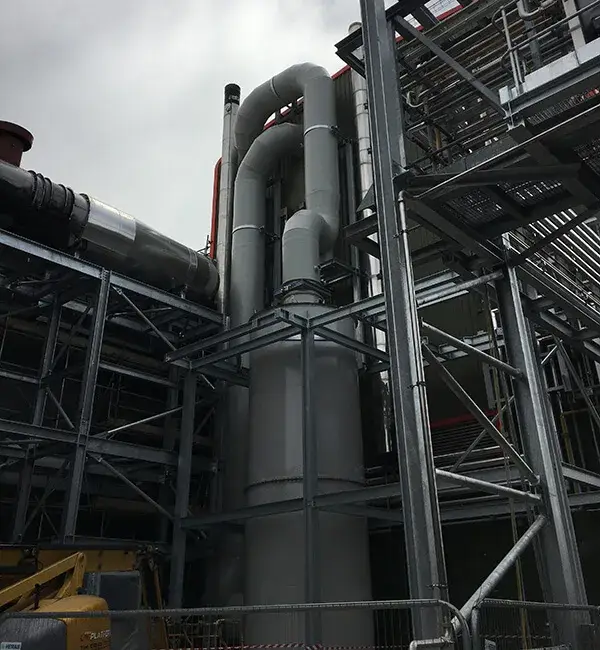
We have supplied odour control systems to the food, flavourings and pet food sector for more than 20 years. Our experience includes semi-moist pet food granulators, processed food frying operations, flavourings spray dryers and vegetable oil processing, with treatment systems selected to suit the air volume, compound mix, discharge point and permit limit.
Our bespoke packages are designed for each site’s specific requirements to provide efficient, safe and straightforward odour control, minimising nuisance odours for staff and neighbours. Whether for a new facility or for an upgrade or retrofit to an existing process line, each system is supplied with a performance guarantee aligned to the site odour permit.
Typical odour control configurations
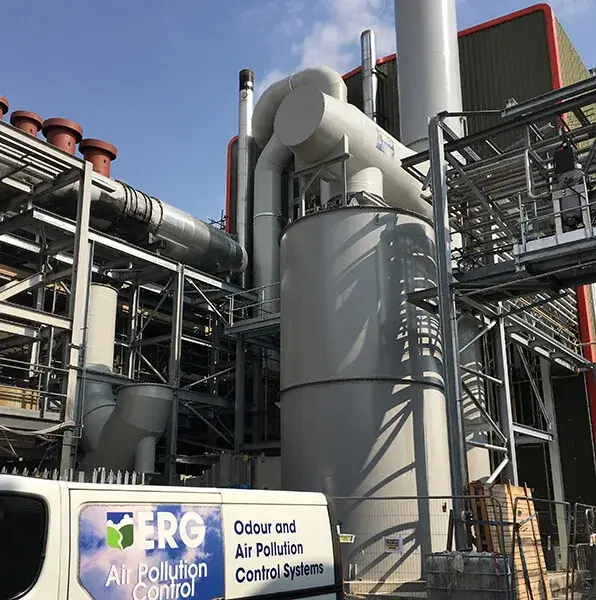
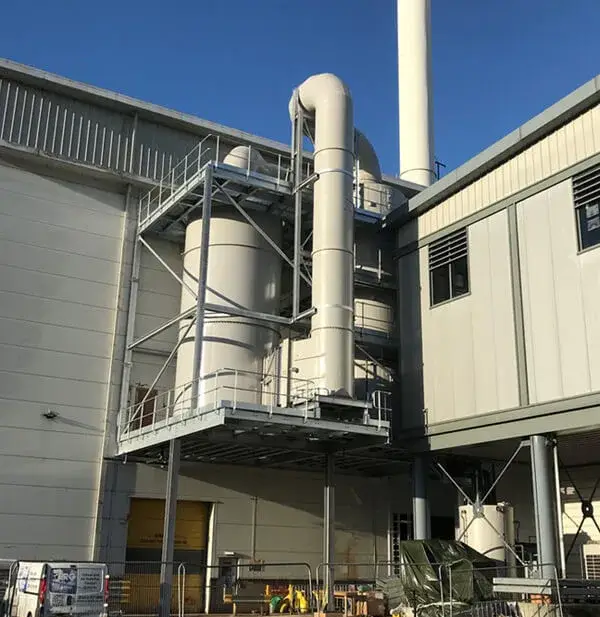
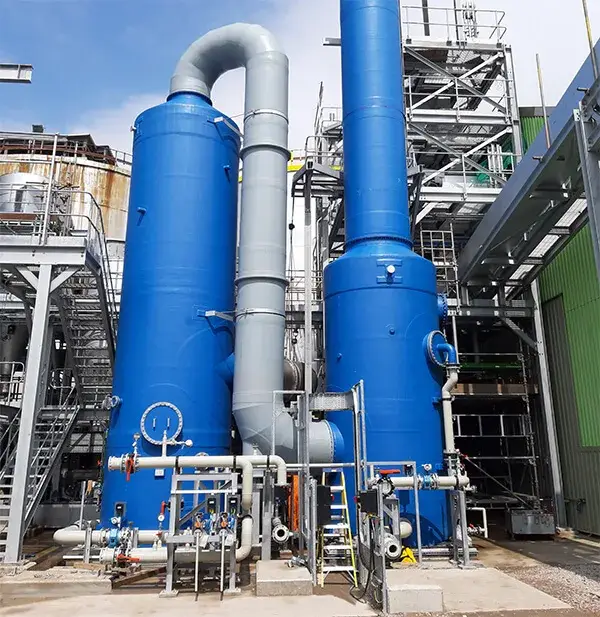
Most odorous air streams from these processes can be treated using a combination of a chemical scrubber and carbon filter. A minority of projects are better suited to thermal oxidation, particularly where higher concentration organic vapours or more stringent VOC abatement requirements apply.
Typical systems include some or all of the following:
Building and LEV (Local Exhaust Ventilation) ductwork
Single or multi-stage chemical scrubbing for bulk treatment of odorous, complex organic compounds using
Typical odour concentrations at the stack are 1,000 ouE/m³, rising to 3,000 ouE/m³ for highly odorous operations with tall discharge stacks to aid dispersion.
Complete odour control packages
ERG provides a comprehensive service:
Design of the complete odour control system including:
Interface with processing equipment – direct connections and extract hoods
Extraction ductwork and associated supports
Odour control system – chemical scrubber and/or carbon filter, or thermal oxidation, and fans
Chemical storage and dosing, and simple effluent treatment
Extracted air cooling and reheating
Control package – MCC/C&I panel, instrumentation, power and control cabling
Discharge stack and monitoring
Access structure
New or upgraded odour control units (OCUs)
Procurement and manufacture of system equipment items
Delivery and off‑loading
Mechanical and electrical installation of the system equipment items including site supervision
Commissioning and management of performance testing
These complete odour control packages are engineered as part of wider air pollution control systems for food and pet food plants, focusing on stable performance and compliance with odour and emissions permits.
Challenging odour streams in food processing
Food and flavourings processes often generate complex odorous air streams containing grease, condensable vapours and variable organic compounds. ERG systems are designed to manage these conditions through appropriate pre-treatment, scrubber selection and system configuration, ensuring stable long-term performance.
Design services for food and pet food odour control
We have extensive design capabilities. In addition to straightforward design and build odour projects, our clients also benefit from:
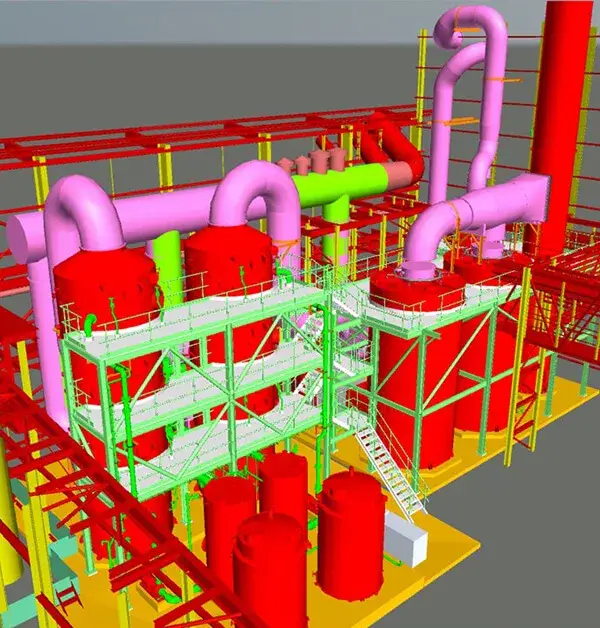
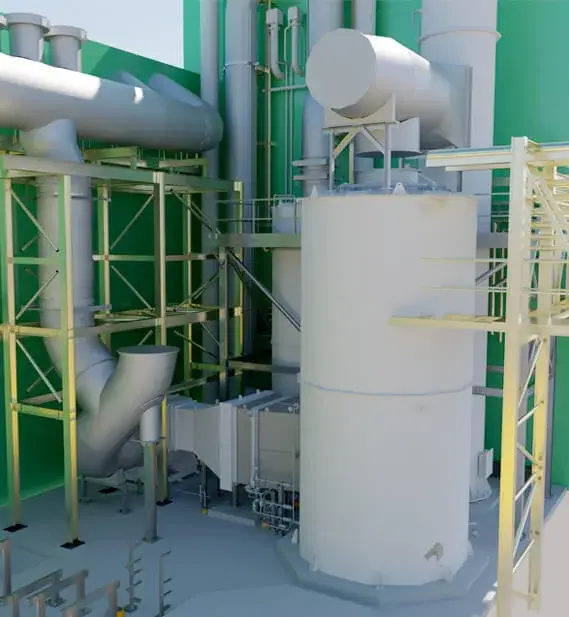
3D modelling of all packages – we model using Plant 3D and export as .dwg and Navisworks
BIM integration where required
Optioneering and FEED contracts
All design and build contracts include a complete set of design deliverables as standard. In all cases, our designs use best practice as described in the Environment Agency Guidance H4 Odour Management, applied to food and flavourings process conditions and VOC abatement requirements.
Optioneering and FEED (Front End Engineering Design) contracts
Existing food and pet food manufacturing sites are often under pressure to expand capacity and reduce their odour impact on new or established neighbours. ERG can help with defining the available options for upgrading existing assets and the preliminary engineering to allow formal project budgets to be set or released for implementation. We provide competitively priced design work carried out by our team of graduate and chartered engineers; in each case, the design output and consultancy fee is tailored to meet the needs of the project.
Typical deliverables include:
Engineering review and testing of the current system
Summary report identifying the available options for reusing/upgrading odour control assets versus providing new OCU(s), including a BAT assessment consistent with current BREF, drawing on any available third-party odour monitoring or ERG’s pilot trials
Details of the technical and construction pros and cons of each option
Indicative CapEx and OpEx costings for major options
Preliminary engineering design for the selected option – input to the formal project specification
Read how this approach has benefitted ERG clients who have implemented large odour control projects to improve their site’s existing odour control.
Project management and site services
Our project management and site staff are dedicated to ensuring each project is completed safely and to the full project requirements. All staff site managers and/or supervisors hold SMSTS or SSSTS certification, and all our staff have an applicable CSCS (or equivalent) card. Where required, we can act as the CDM Principal Contractor.
Most retrofit projects require detailed planning of interfaces and temporary works to limit disruption to production, and manual handling of large equipment in areas with limited access. ERG has significant experience in successfully managing these requirements on live food and pet food manufacturing sites.
Case studies and resources
Download and read our case studies and brochures of the range and products. These provide more detail on odour control system configurations, VOC abatement solutions and retrofit projects for flavourings, food and pet food applications.
Our customers
ERG’s clients include major international brands and smaller local manufacturers. Our reference list for pet food, flavourings and food odour control covers a wide range of batch and continuous processes, product types and plant capacities.
Frequently asked questions
Which odour control technologies are typically used on food and pet food manufacturing sites?
Most food and pet food odour control systems use a combination of chemical scrubbers and polishing carbon filters to treat odorous organic compounds and VOCs from cooking, drying and granulation processes. Thermal oxidation is applied where higher concentration organic vapours or tighter VOC limits justify the higher energy input and where recovered heat can be used within the process.
How do you handle grease, condensables and complex organic compounds in exhaust streams?
Grease, condensables and complex organic compounds are managed using sub‑coolers to condense water vapour and higher boiling compounds, followed by appropriately selected scrubbers and carbon filters. Correct pre‑treatment improves downstream equipment performance, reduces fouling and helps maintain stable odour and VOC abatement efficiencies over the design life of the system.
Can odour control systems be retrofitted to existing production lines without major downtime?
Odour control systems can be retrofitted to existing food and pet food production lines through careful planning of extraction points, duct routing and tie‑ins, combined with staged installation and temporary works. Detailed project management and close coordination with plant operations are used to limit shutdown periods while achieving the required odour and VOC emission performance.
Maeve
Hi, I'm Maeve, ERG's virtual assistant.
Would you like to chat with an expert, or are you just browsing?
No problem. Feel free to look around — I'm here if you need me.
What is your enquiry about?
Great. Can you leave your details so the right person can get back to you?
Please give us a short description of your enquiry.
We'll only use your details to respond to your enquiry.
Sending your enquiry…
Thank you. One of our experts will contact you shortly.
Sorry, something went wrong sending your enquiry. Please try again in a moment.