Industrial Carbon Filtration for Biffa Waste’s Cannock Site
Project Overview
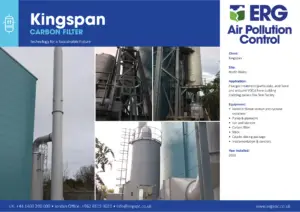
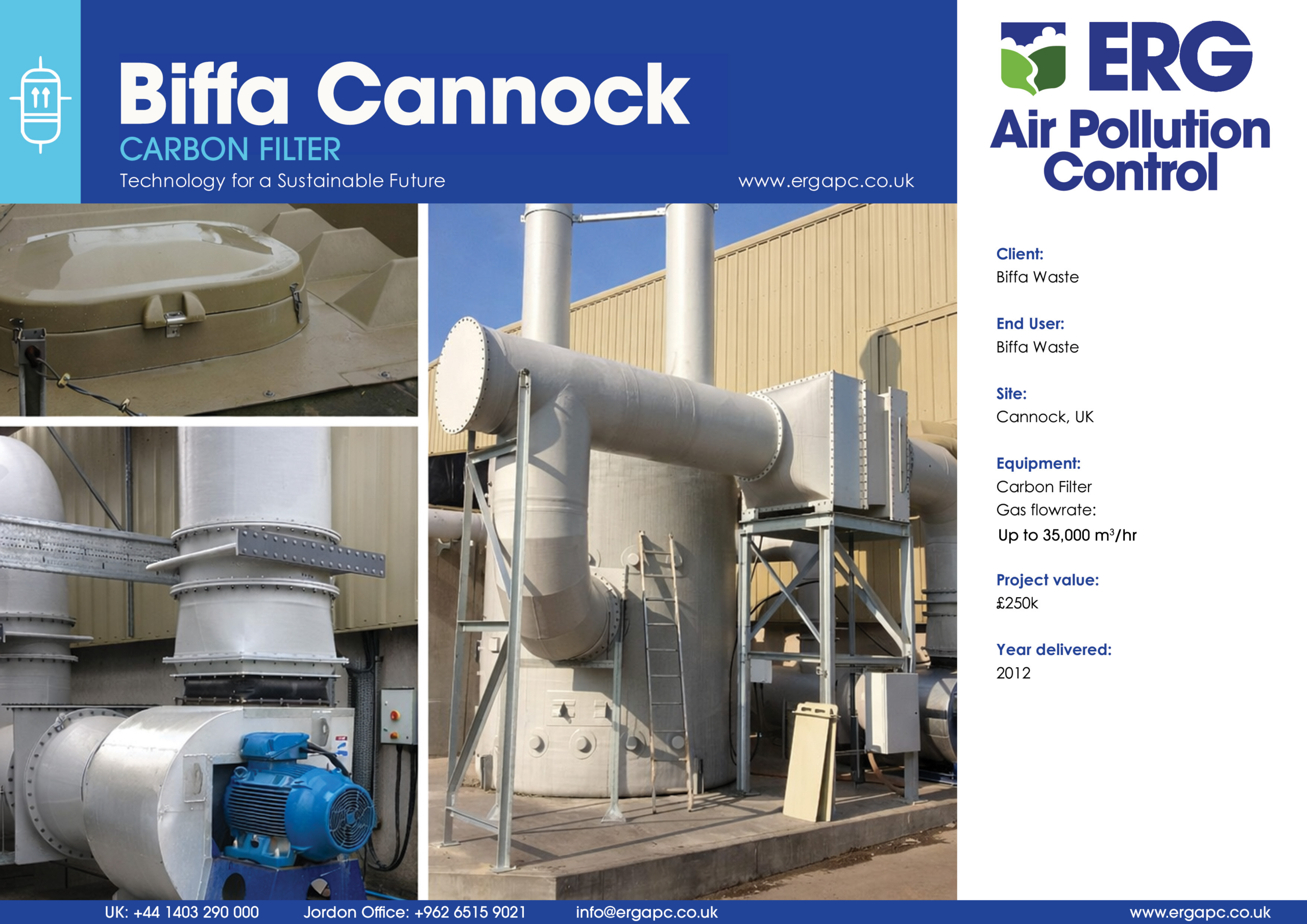
ERG Air Pollution Control supplied a carbon filter for Biffa Waste at its Cannock site in the UK. Delivered in 2012, the £250,000 project had a stated gas flow rate of up to 35,000 m³/h.
The project photographs show the filter vessel alongside large-diameter ductwork, structural supports and a fan. The installation illustrates an important consideration for carbon filtration at this scale. The filter, ductwork and fan need to work together so that the required volume of air passes through the media under suitable treatment conditions.
The Challenge – Treating a Large Volume of Extracted Air
At a stated flow of up to 35,000 m³/h, the filter must accommodate a substantial volume of gas. Airflow helps determine the size of the equipment, while the gas composition and contaminant loading determine the media needed for treatment.
The distribution of air across the carbon bed matters as much as the total flow. If air is concentrated in one part of the bed, some media can become exhausted while other areas remain underused. Vessel geometry and inlet connections can help distribute the flow, while the bed depth and air velocity affect how long the air remains in contact with the carbon.
Those factors also affect pressure loss. The gas handling equipment needs to move air through the ductwork and filter at the required rate, taking account of the resistance across the complete air path.
ERG’s Solution – Carbon Filtration
ERG supplied a carbon filter for the Cannock installation. Carbon filtration is used to treat suitable gaseous compounds in industrial exhaust air, including compounds that contribute to odour.
The treatment relies on adsorption. As air passes through the bed, suitable molecules adhere to the carbon’s extensive internal surface. The choice of carbon depends on the compounds present and the operating conditions. Temperature, moisture and the presence of other compounds can influence how much of a target contaminant the media retains.
Carbon has a finite treatment capacity. For comparable installations, media management therefore starts with understanding what enters the filter and how that loading varies during operation. This helps operators plan monitoring and media replacement around the actual duty.
Engineering and System Integration
The Cannock photographs show large flanged duct connections around the filter vessel, together with duct supports and a motor-driven fan. These illustrate how a carbon filter fits into the wider air handling arrangement.
Large duct sections need suitable support, and their routing affects both the space required and the resistance the fan must overcome. The position of the vessel and its connections also affects how easily operators can inspect the equipment. The case sheet includes a close-up of an access cover, a practical feature on equipment that requires periodic inspection.
For similar installations, media handling should be considered when planning the layout. Operators need space to reach the vessel openings, remove spent carbon and load fresh media. Allowing for those tasks early helps make the equipment serviceable once the ductwork and supporting structures are in place.
Project Technical Specifications
Parameter | Project details |
Client | Biffa Waste |
End user | Biffa Waste |
Site | Cannock, UK |
Equipment supplied | Carbon filter |
Stated gas flow rate | Up to 35,000 m³/h |
Project value | £250,000 |
Year delivered | 2012 |
Engineering Benefits
The Cannock project provides an example of carbon filtration for a waste sector client at an airflow of up to 35,000 m³/h. Carbon offers a treatment mechanism for suitable gaseous compounds, while the documented installation illustrates the practical requirements of connecting a filter vessel to substantial ductwork and providing access for servicing.
ERG’s Expertise in Industrial Carbon Filtration
ERG supplies carbon filtration equipment for industrial air treatment applications. Selecting a system starts with understanding the airflow, the compounds to be treated and the site’s operating conditions. Those inputs inform the choice of media, the size of the vessel and how the equipment can be connected and maintained.
Contact ERG Air Pollution Control to discuss carbon filtration for a waste facility or an upgrade to an existing extracted-air treatment system.