Kingspan
Activated Carbon Filtration and Multi-Stage Flue Gas Treatment for Fire Testing
Project Overview
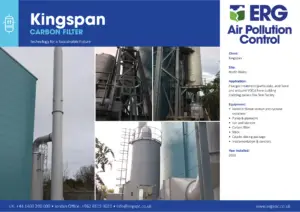
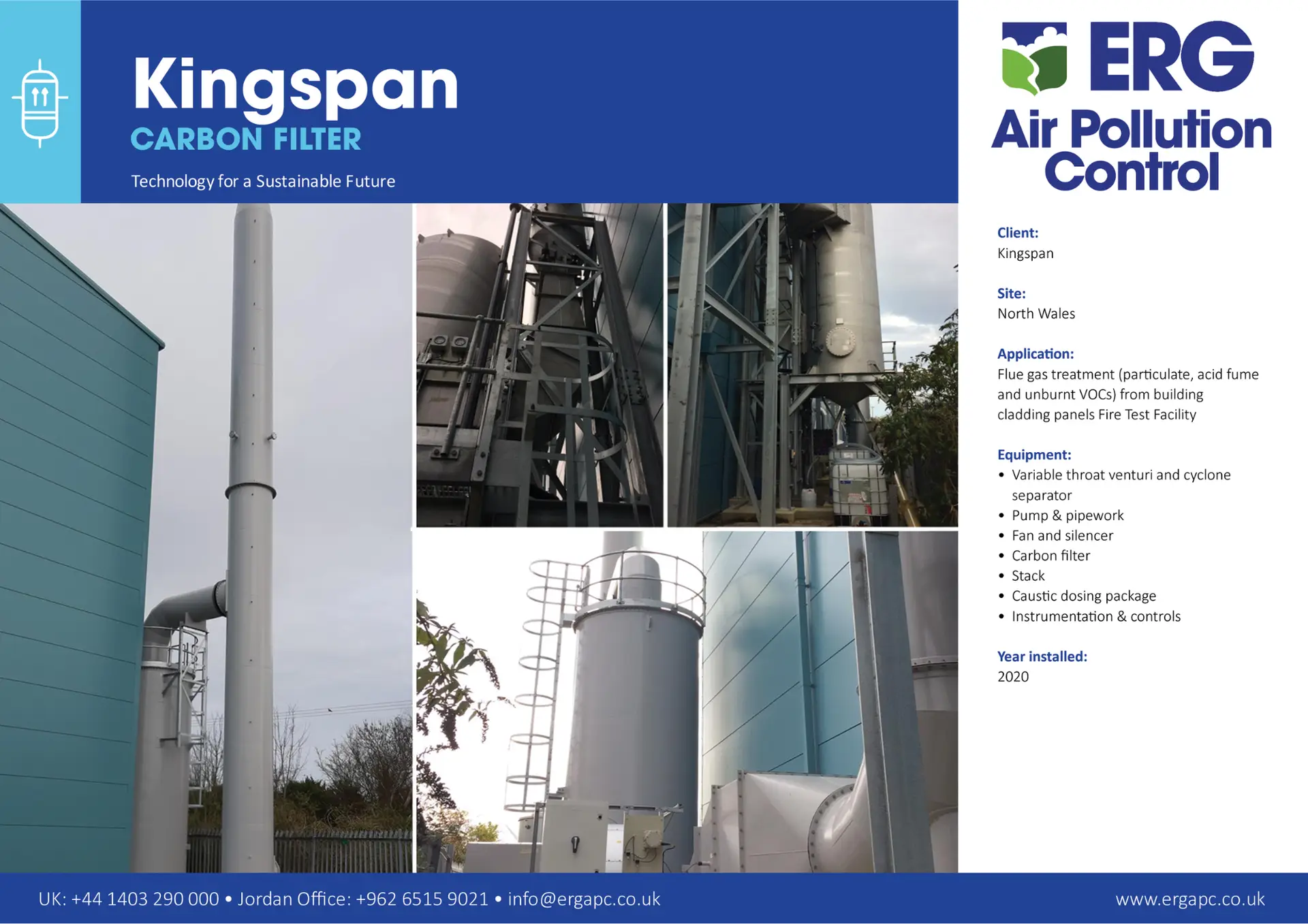
ERG Air Pollution Control supplied an integrated flue gas treatment system for Kingspan at its building cladding panel fire test facility in North Wales. Installed in 2020, the system was designed to treat a combination of particulate matter, acidic fumes and unburnt volatile organic compounds (VOCs) generated during fire testing.
The installation combined a variable throat Venturi scrubber, cyclone separator and activated carbon filtration, supported by a caustic dosing package, pumps, pipework, extraction fan, silencer, discharge stack and instrumentation and controls.
This multi-technology approach provided a treatment arrangement for the different types of contaminants associated with the facility’s fire testing operations.
The Challenge – Complex Emissions from Building Cladding Fire Tests
Fire testing of building cladding panels can generate complex flue gas streams containing particles, acidic gases and unburnt organic compounds. The composition and concentration of these emissions can vary according to the materials being tested and the combustion conditions.
At Kingspan’s North Wales facility, the specified application involved treating particulate matter, acid fumes and unburnt VOCs.
These pollutants require different removal mechanisms. Particulates must be captured and separated from the gas stream, while acidic gases can be treated through wet scrubbing with suitable chemical dosing. Certain residual organic compounds can be removed through adsorption onto activated carbon.
The challenge was therefore to combine complementary gas cleaning technologies within a single treatment arrangement, supported by suitable extraction, liquid circulation and process control equipment.
ERG’s Solution – Venturi Scrubbing, Cyclone Separation and Carbon Filtration
ERG supplied a multi-stage treatment system incorporating wet scrubbing, gas-liquid separation and carbon filtration.
The variable throat Venturi scrubber uses high-velocity gas-liquid contact to promote particulate capture. As contaminated gas passes through the Venturi throat, it comes into contact with scrubbing liquid droplets, allowing particles to be collected within the liquid phase.
The adjustable throat provides a means of varying the gas velocity and pressure drop to suit the treatment requirements.
A cyclone separator provides separation of entrained liquid droplets from the gas stream through centrifugal action, helping to remove liquid collected during the wet scrubbing process.
The system also incorporates a caustic dosing package to support treatment of acidic components within the wet scrubbing arrangement.
Activated carbon filtration provides a further treatment mechanism for suitable residual gaseous contaminants, including certain VOCs. Activated carbon contains a highly porous structure that enables organic compounds to be retained on the media surface through adsorption.
The effectiveness of carbon filtration depends on factors including gas composition, temperature, moisture content, contaminant concentration and carbon selection.
Together, the technologies provide complementary treatment functions for the mixed flue gas emissions generated by the fire test facility.
Equipment Supplied
ERG’s scope of supply included:
Variable throat Venturi scrubber: Intensive gas-liquid contact for particulate capture.
Cyclone separator: Separation of entrained liquid droplets from the gas stream.
Pumps and pipework: Supporting the wet scrubbing and liquid circulation arrangements.
Extraction fan and silencer: Providing gas movement and noise attenuation.
Carbon filter: Adsorption treatment for suitable residual organic contaminants.
Discharge stack: For release of treated flue gases.
Caustic dosing package: Supporting chemical treatment of acidic components.
Instrumentation and controls: Monitoring and control of the treatment system.
Applications and Benefits of Activated Carbon Flue Gas Treatment
Activated carbon filtration is used in industrial air pollution control where suitable gaseous contaminants require adsorption treatment.
For mixed exhaust streams, carbon filtration can be combined with upstream wet scrubbing and separation technologies to address different pollutant types.
The Kingspan installation illustrates how Venturi scrubbing, cyclone separation and activated carbon filtration can be incorporated into an integrated treatment system for industrial fire testing.
Similar treatment principles may be relevant to other specialist industrial applications producing combinations of particulate matter, acidic fumes and organic vapours, subject to the characteristics of the exhaust stream.
ERG’s Industrial Gas Treatment Expertise
ERG Air Pollution Control designs and supplies engineered emissions treatment systems incorporating wet scrubbing, particulate separation and activated carbon adsorption technologies.
The Kingspan installation in North Wales demonstrates ERG’s experience in integrating complementary air pollution control equipment for complex industrial flue gas applications.
For further information about activated carbon filters, Venturi scrubbers or multi-stage industrial flue gas treatment, contact ERG Air Pollution Control.