Syngenta – HCl and Chlorine Gas Scrubbing System
Hastelloy Quench and V-tex®
Scrubber for Industrial Acid Gas Treatment – Grangemouth
Project Overview
ERG Air Pollution Control supplied a specialist acid gas treatment system for Syngenta at its Grangemouth manufacturing facility in Scotland.
Delivered in 2011, the project incorporated a Hastelloy quench and a 1,300 mm diameter V-tex
®
scrubber for the treatment of gas streams containing hydrogen chloride (HCl) and chlorine (Cl₂).
The system was designed to handle a gas flow rate of 1,500 m³/h, combining gas quenching and wet scrubbing technology within an integrated treatment package.
The project demonstrates ERG’s experience in supplying engineered air pollution control equipment for chemically demanding industrial applications, where contaminant characteristics and materials of construction are important considerations.
The equipment was supplied as part of a project valued at approximately £185,000.
The Challenge
Industrial chemical manufacturing processes can generate gas streams containing acidic and corrosive compounds, including hydrogen chloride and chlorine.
Both substances require careful consideration when designing emissions treatment systems. Hydrogen chloride is a highly soluble acid gas, while chlorine presents additional challenges relating to chemical absorption, scrubbing liquid selection and materials compatibility.
For the Syngenta installation, the requirement was to provide an integrated gas treatment arrangement capable of handling 1,500 m³/h of process gas.
The combination of a quench and wet scrubber allowed the treatment system to address gas conditioning and contaminant removal within a coordinated equipment package.
Material selection was an important engineering consideration because of the potentially corrosive nature of the process environment.
ERG’s Solution
ERG supplied a Hastelloy quench and a 1,300 mm diameter V-tex
®
scrubber to provide a combined gas conditioning and acid gas treatment system.
The quench stage forms the initial part of the treatment arrangement. Quenching is used in industrial gas cleaning to reduce gas temperature through contact with a cooling medium, preparing the gas stream for subsequent treatment.
Hastelloy is a family of nickel-based corrosion-resistant alloys used in demanding chemical processing environments. Its selection for the quench provides a material solution suited to applications requiring resistance to aggressive process conditions.
Following the quench, the gas passes to the V-tex
®
wet scrubbing stage.
ERG’s V-tex
®
technology uses intensive gas-liquid contact to promote the transfer of contaminants from the gas stream into the scrubbing liquid.
For acid gas applications, wet scrubbing provides an established method of treating soluble or chemically reactive contaminants, with performance dependent on the scrubbing liquid chemistry, operating conditions and gas composition.
The Syngenta system was configured around a 1,300 mm diameter V-tex
®
scrubber, designed for a gas flow rate of 1,500 m³/h.
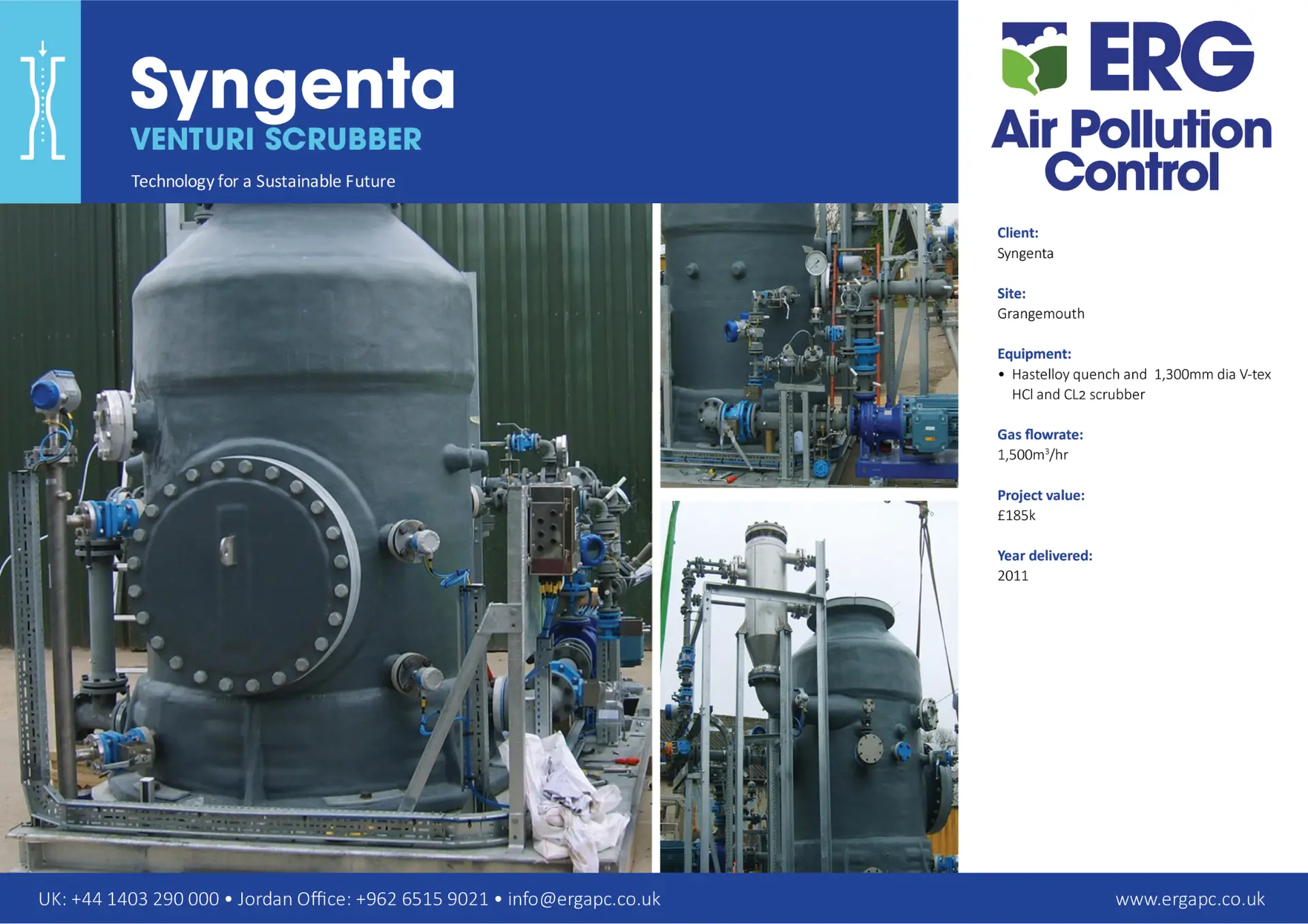
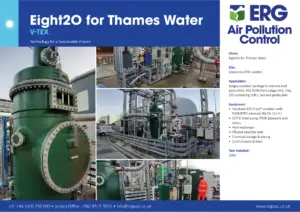
The project photographs illustrate the substantial scrubber vessel, associated quench equipment, pumps, pipework and supporting steelwork, demonstrating the integrated nature of the treatment arrangement.
The completed package provided Syngenta with a dedicated system for HCl and chlorine gas treatment within its Grangemouth facility.
Technical Highlights
| Parameter |
Project specification |
| Client |
Syngenta |
| Site |
Grangemouth, Scotland, UK |
| Industry |
Chemical manufacturing |
| Application |
HCl and chlorine gas treatment |
| Target contaminants |
Hydrogen chloride (HCl) and chlorine (Cl₂) |
| Treatment technology |
Gas quench and V-tex®
wet scrubbing |
| Quench construction |
Hastelloy |
| Scrubber type |
V-tex®
scrubber |
| Scrubber diameter |
1,300 mm |
| Gas flow rate |
1,500 m³/h |
| Project value |
£185,000 |
| Year delivered |
2011 |
Engineering Benefits
Combined treatment stages: The system incorporates a quench and V-tex® scrubber to provide gas conditioning and acid gas treatment within one integrated arrangement.
HCl and chlorine treatment: The equipment was specified for a process gas stream containing hydrogen chloride and chlorine.
Corrosion-resistant quench: Hastelloy construction provides a material solution for demanding chemical processing environments.
Specialist wet scrubbing technology: ERG’s V-tex
®
system promotes intensive gas-liquid contact for contaminant absorption.
Defined treatment capacity: The installation was designed to handle a process gas flow rate of 1,500 m³/h.
Engineered equipment package: The combination of quench, scrubber and associated process equipment demonstrates ERG’s ability to supply integrated gas treatment systems.
Supporting Emissions Control in Chemical Manufacturing
Chemical manufacturing facilities can generate complex process emissions containing acidic, corrosive or otherwise hazardous substances.
The effective treatment of these emissions requires an understanding of gas composition, temperature, flow rate, chemical behaviour and materials compatibility.
Hydrogen chloride and chlorine are both important contaminants in industrial emissions control, but their treatment characteristics differ.
Hydrogen chloride is readily absorbed into water, while chlorine removal typically requires consideration of the scrubbing liquid chemistry to support effective absorption and reaction.
For applications involving elevated gas temperatures, a quench stage can provide useful gas conditioning ahead of the main scrubbing process.
Combining these treatment stages allows an emissions control system to be engineered around the requirements of the particular process.
The Syngenta installation demonstrates the application of this approach, using a Hastelloy quench and V-tex
®
scrubber to treat a 1,500 m³/h process gas stream at an established chemical manufacturing facility.
ERG’s Expertise in Acid Gas Scrubbing
ERG Air Pollution Control has extensive experience in the design and supply of wet scrubbing systems for industrial and chemical manufacturing applications.
Its capabilities include packed tower scrubbers, V-tex
®
scrubbers, quench systems, Venturi scrubbers and integrated gas cleaning packages.
The Syngenta project demonstrates ERG’s ability to combine specialist scrubbing technology with corrosion-resistant materials for the treatment of chemically demanding process emissions.
From equipment selection and process engineering through to manufacture and integration, ERG provides solutions tailored to individual gas treatment requirements.
For chemical manufacturers seeking to control hydrogen chloride, chlorine or other acid gas emissions, ERG can assess the process conditions and recommend suitable abatement technologies.
For further information about HCl scrubbing, chlorine gas treatment, V-tex®
technology or industrial acid gas abatement, contact ERG Air Pollution Control.