Biwater
Biological Odour Control and Carbon Filtration at Craigtown More, Northern Ireland
Project Overview
ERG Air Pollution Control delivered a biological odour control installation for Biwater at Craigtown More, Northern Ireland, in 2006.
The project was undertaken for Biwater, with Northern Ireland Water identified as the end-user, and involved an integrated air treatment system combining biological filtration with activated carbon filtration.
Designed to handle a gas flow rate of 40,000 m³/hr, the installation incorporated a biofilter followed by a carbon filter, providing two successive treatment stages for wastewater-related odorous air.
With a recorded project value of £550,000, the installation demonstrates ERG’s established experience in supplying large-capacity odour control systems for the UK water industry.
The Challenge – Managing Odorous Air at Wastewater Facilities
Wastewater treatment processes can generate odorous gases as organic matter breaks down during collection, storage and treatment.
These emissions can include hydrogen sulphide (H₂S), reduced sulphur compounds and other substances associated with wastewater odours.
Effective odour control requires contaminated air to be collected from relevant process areas and conveyed to an appropriate treatment system.
For the Craigtown More project, the documented gas flow rate was 40,000 m³/hr, requiring a treatment arrangement capable of handling a substantial volume of extracted air.
The project incorporated biological filtration and carbon filtration to provide two treatment mechanisms within the same installation.
The original case study does not identify the individual contaminants, inlet concentrations or required removal efficiencies.
ERG’s Solution – Biofilter Followed by Activated Carbon
ERG’s equipment scope comprised a biofilter followed by a carbon filter.
This arrangement combines biological treatment with adsorption-based filtration.
Biological Filtration
Biofilters use naturally occurring microorganisms to break down suitable biodegradable contaminants within an air stream.
Contaminated air passes through a biologically active filter medium, where odorous compounds can transfer into the moisture surrounding the media and undergo microbial degradation.
Biological filtration is widely used in wastewater odour control because it can treat suitable compounds through a natural biological process.
Successful operation depends on factors such as contaminant loading, moisture, temperature and the characteristics of the filter media.
The Craigtown More installation incorporated biological filtration as the first treatment stage.
Activated Carbon Filtration
Following the biofilter, the air passed through an activated carbon filter.
Activated carbon uses a highly porous structure to adsorb suitable gaseous contaminants from an air stream.
In wastewater odour control applications, carbon filtration can provide additional treatment for residual odorous compounds remaining after an upstream biological process.
The combination of a biofilter and carbon filter provides complementary treatment mechanisms within an integrated odour control system.
The original project documentation does not specify the carbon media type, filter configuration or individual stage efficiencies.
Large-Capacity Air Treatment
The Craigtown More installation was designed for a gas flow rate of 40,000 m³/hr.
At this capacity, effective air distribution and integration of the treatment equipment are important considerations in the design of the overall system.
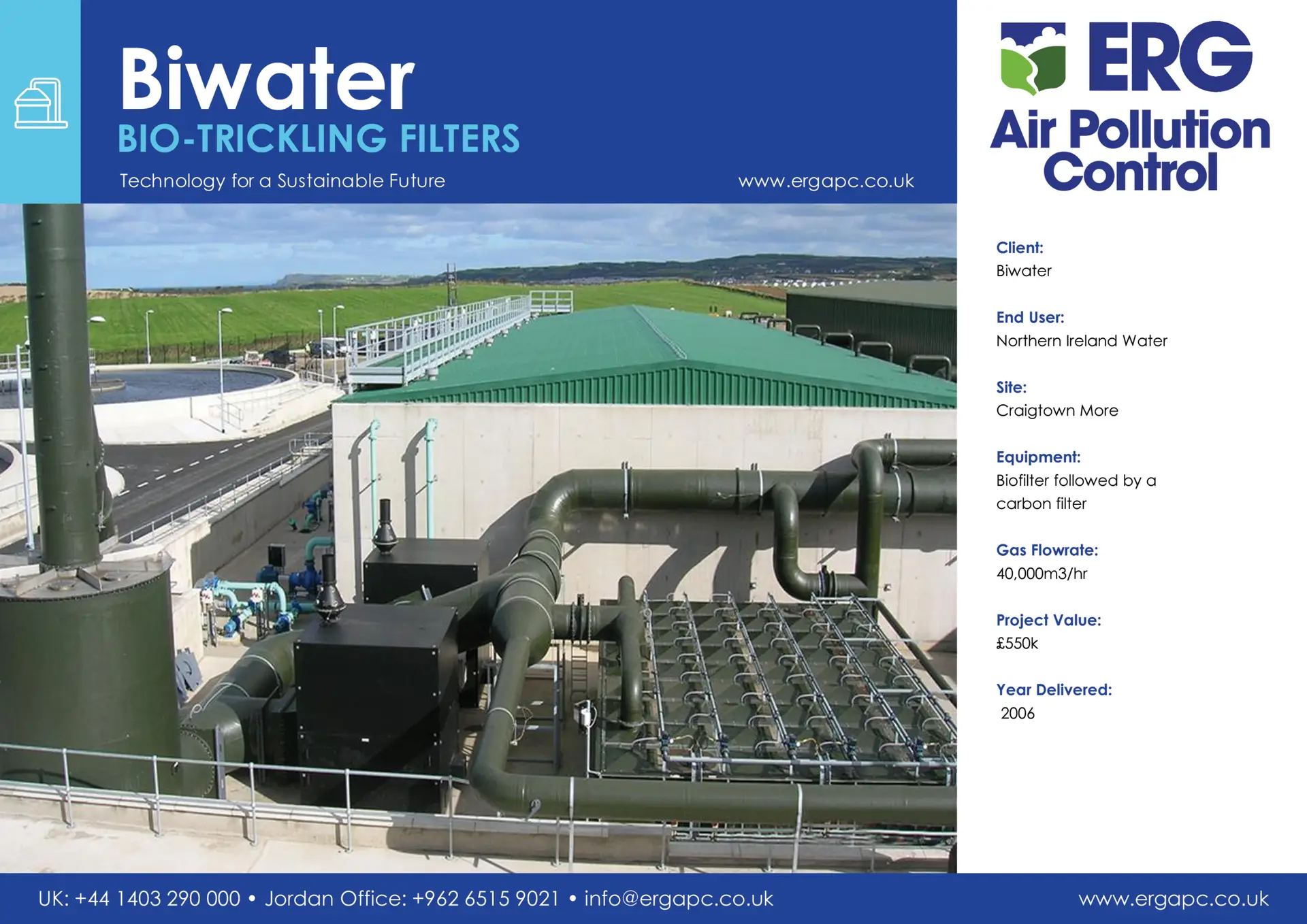
The original project photograph shows substantial external ductwork, treatment equipment and associated structures forming part of the installation.
The arrangement illustrates the physical scale of a biological and carbon odour control system serving a major wastewater application.
Although the photograph shows associated mechanical equipment, the original case sheet identifies the biofilter and carbon filter as the confirmed equipment scope.
Project Specifications
| Parameter | Project detail |
|---|---|
| Client | Biwater |
| End-user | Northern Ireland Water |
| Site | Craigtown More, Northern Ireland |
| Industry | Water and wastewater |
| Application | Odour control |
| Primary technology | Biofilter |
| Secondary technology | Activated carbon filter |
| Treatment sequence | Biofilter followed by carbon filter |
| Gas flow rate | 40,000 m³/hr |
| Project value | £550,000 |
| Year delivered | 2006 |
Combining Biological and Carbon Odour Treatment
Biological filtration and activated carbon are established technologies used in wastewater odour control.
Biological treatment is suitable for many biodegradable odorous compounds, while activated carbon can provide additional removal of selected contaminants through adsorption.
Combining the two technologies allows an odour control system to incorporate different treatment mechanisms.
The appropriate design depends on the characteristics of the extracted air, contaminant concentrations, treatment objectives and operating conditions.
The Craigtown More project demonstrates the application of this combined approach to a high-volume wastewater air treatment requirement.
ERG’s Experience in Wastewater Odour Control
ERG Air Pollution Control designs and supplies engineered odour control systems for wastewater treatment works, pumping stations, sludge handling facilities and industrial applications.
Its technology portfolio includes biological filters, bio-trickling filters, chemical scrubbers and activated carbon filtration systems.
The Biwater Craigtown More project provides an early reference for ERG’s experience in supplying biological and carbon odour control equipment for the UK water industry.
Delivered in 2006, the £550,000 installation demonstrates ERG’s capability to provide integrated odour treatment systems handling gas flows of 40,000 m³/hr.
For further information about biological odour control, biofilters, activated carbon filtration or wastewater air treatment systems, contact ERG Air Pollution Control.