Doha South STW
High-Capacity Biological Odour Control for Doha South Sewage Treatment Works, Qatar
Project Overview
ERG Air Pollution Control supplied three integrated odour control units (OCUs) for the Doha South Sewage Treatment Works project in Qatar, working for client WABAG on behalf of end-user Ashghal Public Works Authority (PWA).
Delivered in 2022, the project involved the design, material supply and manufacturing of biological odour control systems for the treatment of hydrogen sulphide (H₂S) emissions associated with municipal wastewater treatment.
The three OCUs were designed for individual gas flow rates of 47,500 m³/hr, 40,200 m³/hr and 182,000 m³/hr, providing a combined nominal treatment capacity of 269,700 m³/hr.
The project specification identified average H₂S concentrations of up to 100 ppm and maximum concentrations of 175 ppm, with a required removal efficiency greater than 99.8%.
The installation demonstrates ERG’s capability to engineer large-capacity biological odour control systems for major wastewater infrastructure projects.
The Challenge – Hydrogen Sulphide Treatment at a Major Sewage Treatment Works
Municipal wastewater treatment facilities can generate hydrogen sulphide as organic material breaks down under anaerobic conditions.
H₂S is a highly odorous and corrosive gas that requires appropriate management within wastewater treatment infrastructure.
At Doha South STW, the project required three separate odour control units to treat contaminated air streams with different design flow rates.
The largest unit, OCU-3, was designed to handle 182,000 m³/hr, making it a substantial air treatment installation.
The specified inlet concentrations and removal efficiency required treatment systems designed to address significant hydrogen sulphide loads.
ERG’s solution incorporated biological filtration and activated carbon treatment, with the configuration selected according to the requirements of each odour control unit.
OCU-1 – Two-Stage Bio-Trickling Filtration and Carbon Treatment
OCU-1 was designed for a gas flow rate of 47,500 m³/hr.
The treatment arrangement incorporated two stages of bio-trickling filtration followed by a carbon filter.
Bio-trickling filters use microorganisms growing on wetted packing media to treat suitable gaseous contaminants.
Hydrogen sulphide can be biologically oxidised under appropriate operating conditions as contaminated air passes through the filter media.
The two-stage arrangement provides successive biological treatment stages before the air reaches the carbon filtration equipment.
Activated carbon filtration provides an additional adsorption-based treatment mechanism for suitable residual contaminants.
This configuration combines biological and physical treatment processes within an integrated odour control unit.
OCU-2 and OCU-3 – Single-Stage Carbon Filtration
OCU-2 and OCU-3 were designed for gas flow rates of 40,200 m³/hr and 182,000 m³/hr respectively.
Both units incorporated single-stage carbon filtration.
Activated carbon filters use porous media to adsorb suitable gaseous contaminants from an air stream.
For hydrogen sulphide treatment, carbon media selection and operating conditions are important considerations in achieving the required removal performance.
The use of different treatment configurations across the three OCUs demonstrates how odour control technology can be selected to suit individual process requirements.
The original case study does not specify the carbon media formulation, bed depth or replacement intervals.
High-Efficiency H₂S Removal
The original project documentation specifies an H₂S removal requirement exceeding 99.8%.
This requirement applied to a project involving average inlet concentrations of up to 100 ppm and maximum concentrations of 175 ppm.
Achieving high hydrogen sulphide removal efficiency requires suitable process design, treatment media selection and operating conditions.
The Doha South project illustrates the use of biological filtration and carbon treatment within a large municipal wastewater application.
The original case study does not provide commissioning results or independently measured outlet concentrations, so the stated efficiency is treated as a project specification rather than verified operating performance.
Integrated Design and Manufacturing
ERG’s scope included the design, material supply and manufacturing of the fully integrated odour control units.
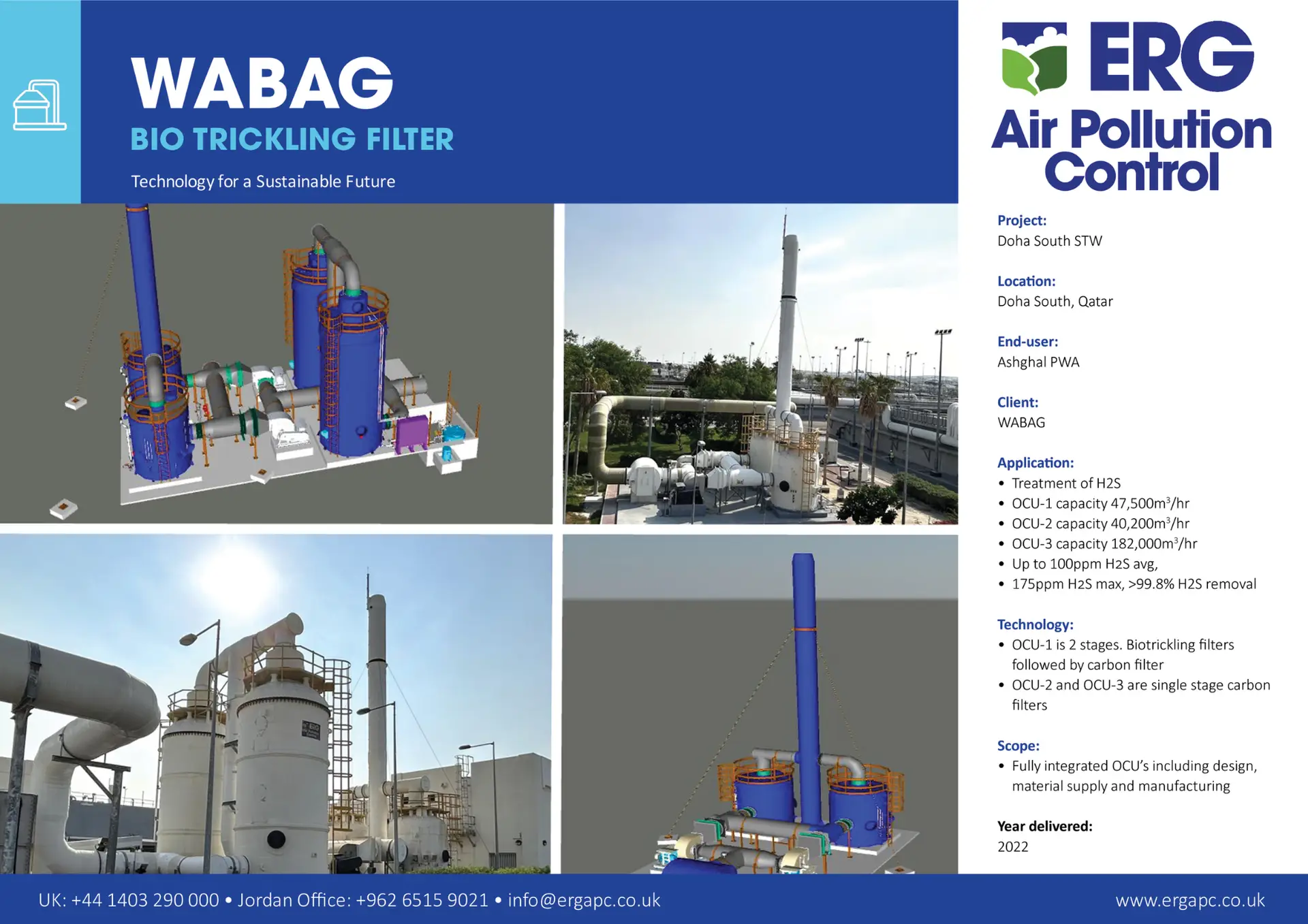
The original project photographs and engineering illustrations show substantial treatment vessels, connecting ductwork, access arrangements and associated equipment.
These elements demonstrate the scale of the installation and the engineering involved in delivering high-capacity odour control equipment.
The project required three separate treatment systems with differing capacities and treatment configurations, forming part of the wider Doha South sewage treatment infrastructure.
Project Specifications
| Parameter | Project detail |
|---|---|
| Project | Doha South STW |
| Location | Doha South, Qatar |
| Client | WABAG |
| End-user | Ashghal PWA |
| Industry | Municipal wastewater treatment |
| Application | Hydrogen sulphide odour control |
| OCU-1 design capacity | 47,500 m³/hr |
| OCU-2 design capacity | 40,200 m³/hr |
| OCU-3 design capacity | 182,000 m³/hr |
| Combined nominal capacity | 269,700 m³/hr |
| Average inlet H₂S | Up to 100 ppm |
| Maximum inlet H₂S | 175 ppm |
| Specified H₂S removal | >99.8% |
| OCU-1 technology | Two-stage bio-trickling filters followed by carbon filtration |
| OCU-2 technology | Single-stage carbon filtration |
| OCU-3 technology | Single-stage carbon filtration |
| ERG scope | Design, material supply and manufacturing |
| Year delivered | 2022 |
Biological and Carbon Odour Control for Wastewater Treatment
Large sewage treatment works require odour control systems capable of handling substantial air volumes and varying contaminant loads.
Bio-trickling filtration provides a biological treatment mechanism for suitable biodegradable contaminants, while activated carbon offers adsorption-based treatment.
These technologies can be applied individually or in combination depending on the characteristics of the extracted air and the required treatment performance.
The Doha South STW project demonstrates both approaches within one wastewater infrastructure programme.
ERG’s Experience in International Wastewater Odour Control
ERG Air Pollution Control designs and supplies odour control systems for municipal sewage treatment works, pumping stations and industrial applications.
Its technologies include bio-trickling filters, biological filters, activated carbon filtration and chemical scrubbing systems.
The Doha South STW project provides a significant reference for ERG’s international wastewater experience, with three integrated odour control units designed for a combined nominal capacity of 269,700 m³/hr.
Delivered in 2022, the project demonstrates ERG’s capability to design and manufacture large-scale odour control equipment for major infrastructure developments in Qatar.
For further information about high-capacity wastewater odour control, bio-trickling filters, activated carbon filtration or hydrogen sulphide treatment, contact ERG Air Pollution Control.