Doha West STW
High-Capacity Wastewater Odour Control Using Bio-Trickling Filters and Chemical Scrubbers
Project Overview
ERG Air Pollution Control supplied two integrated odour control units (OCUs) for SUEZ at the Doha West Sewage Treatment Works project, identified in the original case study as SUEZ, Marubeni.
Delivered in 2022, the project involved replacement odour control equipment designed to treat hydrogen sulphide (H₂S) emissions associated with wastewater treatment operations.
The installation incorporated two separate odour control systems, each designed around different treatment requirements and gas flow rates.
OCU-1 was designed for a gas flow of 67,400 m³/hr, while OCU-2 had a capacity of 21,400 m³/hr.
The original project specification identifies an H₂S inlet concentration of 500 ppm, with a maximum of 1,000 ppm, and a required removal efficiency exceeding 99.9%.
ERG’s scope included the design, material supply and manufacturing of fully integrated odour control units incorporating biological and chemical treatment technologies.
The project demonstrates ERG’s capability in engineering large-capacity wastewater odour control systems for major international infrastructure applications.
The Challenge – Hydrogen Sulphide Control at a Sewage Treatment Works
Wastewater treatment processes can generate hydrogen sulphide, a highly odorous and corrosive gas associated with anaerobic conditions in wastewater and sludge handling operations.
H₂S emissions can present challenges for wastewater operators because of their strong odour, potential health hazards and corrosive effects on infrastructure.
At Doha West STW, the project required new odour control units to replace existing equipment.
The original case study specifies an H₂S concentration of 500 ppm, with a maximum concentration of 1,000 ppm.
These concentrations required a treatment arrangement capable of handling a substantial contaminant load while meeting the specified H₂S removal requirement.
The project also involved two different air treatment capacities, requiring separate treatment configurations for the respective odour control units.
OCU-1 – Two-Stage Biological and Chemical Treatment
OCU-1 was designed for a gas flow of 67,400 m³/hr.
The treatment configuration incorporated two stages of bio-trickling filtration followed by caustic and bleach chemical scrubbing.
Bio-trickling filters use microorganisms growing on wetted packing media to treat suitable biodegradable gaseous contaminants.
Hydrogen sulphide can be biologically oxidised under appropriate conditions, with the treatment process influenced by factors such as gas loading, moisture, pH and contact time.
The two-stage biological arrangement provides successive treatment stages ahead of the downstream chemical scrubbing equipment.
The caustic and bleach scrubber provides a further treatment stage using chemical absorption and oxidation to reduce residual H₂S.
Combining biological and chemical treatment provides different removal mechanisms within a single integrated odour control system.
The original case study does not specify the individual removal efficiency of each stage.
OCU-2 – Duty/Standby Chemical Scrubbing
OCU-2 was designed for a gas flow of 21,400 m³/hr.
Unlike OCU-1, this system used duty/standby caustic and bleach scrubbers.
Chemical scrubbing provides a treatment method for hydrogen sulphide using a circulating liquid containing appropriate treatment reagents.
Caustic scrubbing supports absorption of acidic gases such as H₂S, while bleach can provide an oxidation mechanism.
The duty/standby configuration incorporates an operating treatment unit and an alternative unit available for standby service.
This arrangement provides operational flexibility for equipment management and maintenance.
The original case study identifies the duty/standby configuration but does not specify the operating changeover arrangements or control philosophy.
High-Efficiency Hydrogen Sulphide Removal
The project documentation specifies greater than 99.9% H₂S removal.
This is a significant treatment requirement for a wastewater odour control application involving the stated inlet concentrations.
Achieving high H₂S removal efficiency requires appropriate treatment technology selection, process design and operating conditions.
The Doha West project combines biological and chemical scrubbing technologies to address the specified treatment requirements.
The original case study does not provide commissioning test results or measured outlet concentrations.
The greater than 99.9% removal figure is therefore presented as the documented project requirement rather than independently verified operational performance.
Integrated Odour Control Unit Design
ERG’s documented scope included design, material supply and manufacturing of the fully integrated odour control units.
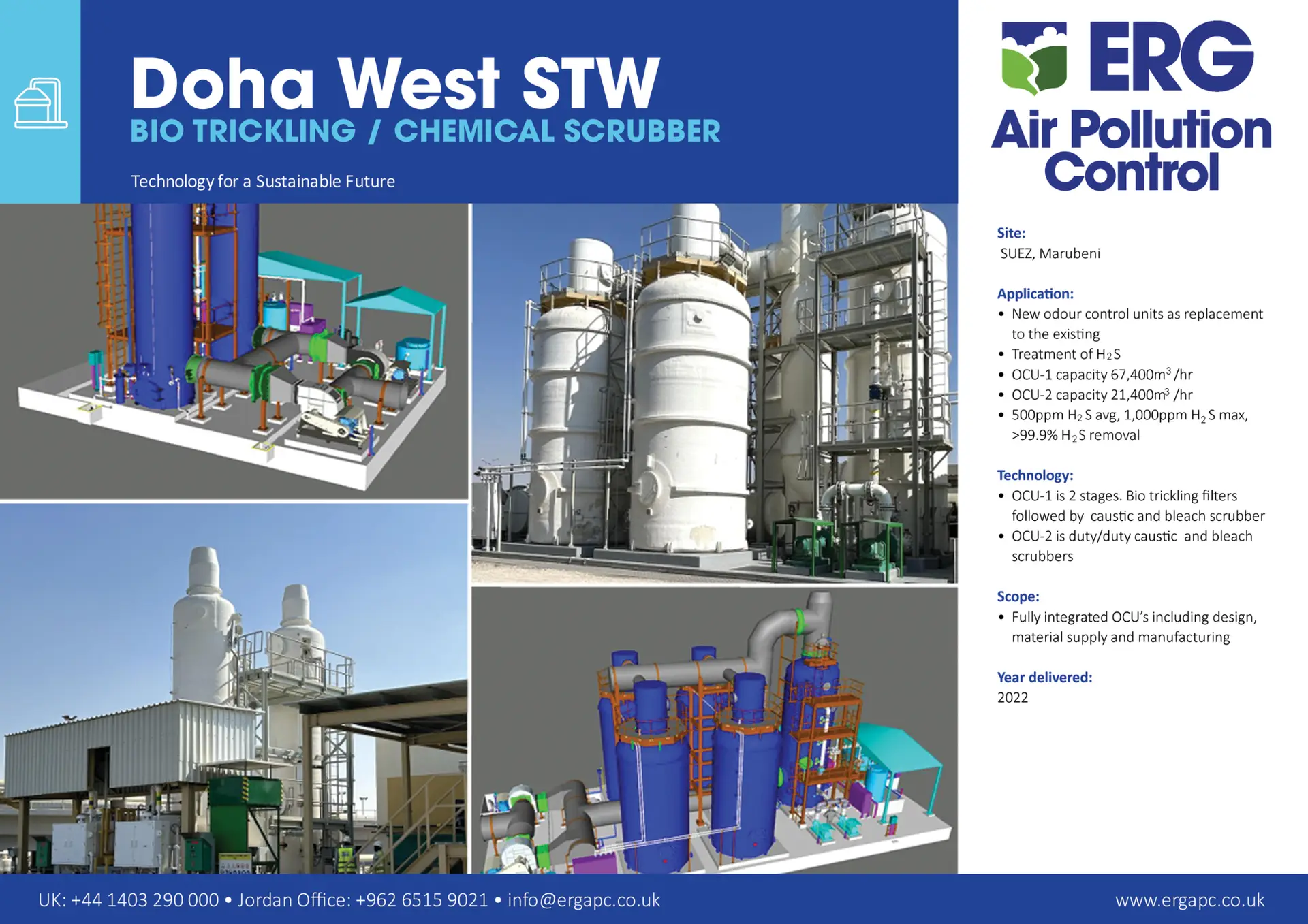
The project photographs and engineering illustrations show large vertical treatment vessels, connecting ductwork, access platforms and associated process equipment.
These components illustrate the scale and complexity of the installation.
Integrating biological and chemical treatment stages requires consideration of airflow distribution, equipment arrangement, process connections and access for operation and maintenance.
The Doha West project provides an example of engineering multiple odour control configurations for a major sewage treatment works.
Project Specifications
| Parameter | Project detail |
|---|---|
| Project | Doha West STW |
| Client / project parties | SUEZ, Marubeni |
| Industry | Municipal wastewater treatment |
| Application | Replacement odour control units |
| Target contaminant | Hydrogen sulphide (H₂S) |
| OCU-1 design flow | 67,400 m³/hr |
| OCU-2 design flow | 21,400 m³/hr |
| Total nominal design flow | 88,800 m³/hr |
| H₂S concentration | 500 ppm; maximum 1,000 ppm |
| Specified H₂S removal | >99.9% |
| OCU-1 technology | Two-stage bio-trickling filtration followed by caustic and bleach scrubbing |
| OCU-2 technology | Duty/standby caustic and bleach scrubbers |
| ERG scope | Design, material supply and manufacturing |
| Year delivered | 2022 |
Biological and Chemical Odour Control for Wastewater Infrastructure
Large wastewater treatment facilities require odour control systems capable of managing varying gas flow rates and contaminant loads.
Bio-trickling filtration can provide biological treatment of suitable compounds, while chemical scrubbing offers an additional mechanism for contaminant removal.
Combining these technologies can be appropriate where high contaminant loading or stringent treatment requirements justify multiple treatment stages.
The Doha West project illustrates two different configurations within one wastewater infrastructure programme: biological treatment followed by chemical scrubbing, and a duty/standby chemical scrubbing arrangement.
The selection of each configuration depends on the process requirements, operating philosophy and treatment duty.
ERG’s Experience in International Wastewater Odour Control
ERG Air Pollution Control designs and supplies engineered odour control systems for municipal wastewater treatment plants, pumping stations and industrial applications.
Its technology portfolio includes bio-trickling filters, biological treatment systems, chemical scrubbers and activated carbon filtration.
The Doha West STW project demonstrates ERG’s capability to design and manufacture large-capacity odour control equipment incorporating multiple treatment technologies.
Delivered in 2022, the project provides a reference for replacement wastewater odour control units designed to treat gas flows of 67,400 m³/hr and 21,400 m³/hr, with a specified hydrogen sulphide removal efficiency greater than 99.9%.
For further information about high-capacity wastewater odour control, hydrogen sulphide treatment, bio-trickling filters or chemical scrubbing systems, contact ERG Air Pollution Control.