Takeda
Pharmaceutical LEV Extraction and THF Vapour Treatment in Dublin
Project Overview
ERG Air Pollution Control delivered a specialist local exhaust ventilation (LEV) gas treatment package for Takeda at its pharmaceutical manufacturing facility in Dublin, Ireland.
Completed in 2018, the project involved the integration of mobile activated carbon filtration equipment for the removal of tetrahydrofuran (THF) from an extracted process gas stream.
The documented equipment package included mobile carbon filters, associated pipework and instrumentation, a pressure relief and vent/purge system, and integration with the existing plant.
The installation illustrates ERG’s experience in supporting pharmaceutical manufacturers with engineered solutions for the treatment of solvent-containing process emissions.
The Challenge – Managing Solvent Vapours in Pharmaceutical Manufacturing
Pharmaceutical manufacturing processes can involve organic solvents that generate vapours requiring controlled extraction and treatment.
Tetrahydrofuran (THF) is a volatile organic solvent used in chemical synthesis and other industrial applications. Where THF vapours are present in extracted process air, appropriate containment, ventilation and treatment arrangements are important.
For Takeda’s Dublin facility, the project application was identified as pharmaceutical plant LEV scrubbing, with the equipment specifically intended for THF removal.
Local exhaust ventilation systems capture airborne contaminants close to their source and direct them towards appropriate treatment or discharge arrangements.
Integrating solvent treatment equipment into an existing pharmaceutical plant requires consideration of the extraction system, process connections, instrumentation and operating requirements.
The original case study does not specify the inlet THF concentration, gas flow rate or required removal efficiency.
ERG’s Solution – Mobile Activated Carbon Filtration
The equipment supplied for the Takeda project included mobile activated carbon filters designed for THF removal.
Activated carbon adsorption is an established method of treating suitable volatile organic compounds in industrial gas streams.
As contaminated gas passes through an activated carbon bed, solvent molecules can be retained on the carbon’s internal surface through physical adsorption.
The suitability and performance of activated carbon treatment depend on factors including solvent concentration, temperature, humidity, airflow, contact time and the characteristics of the selected carbon media.
For solvent applications, appropriate assessment of adsorption behaviour, heat generation and operating conditions is particularly important.
The mobile filter arrangement provides a practical equipment configuration for applications where filter units may need to be exchanged or serviced.
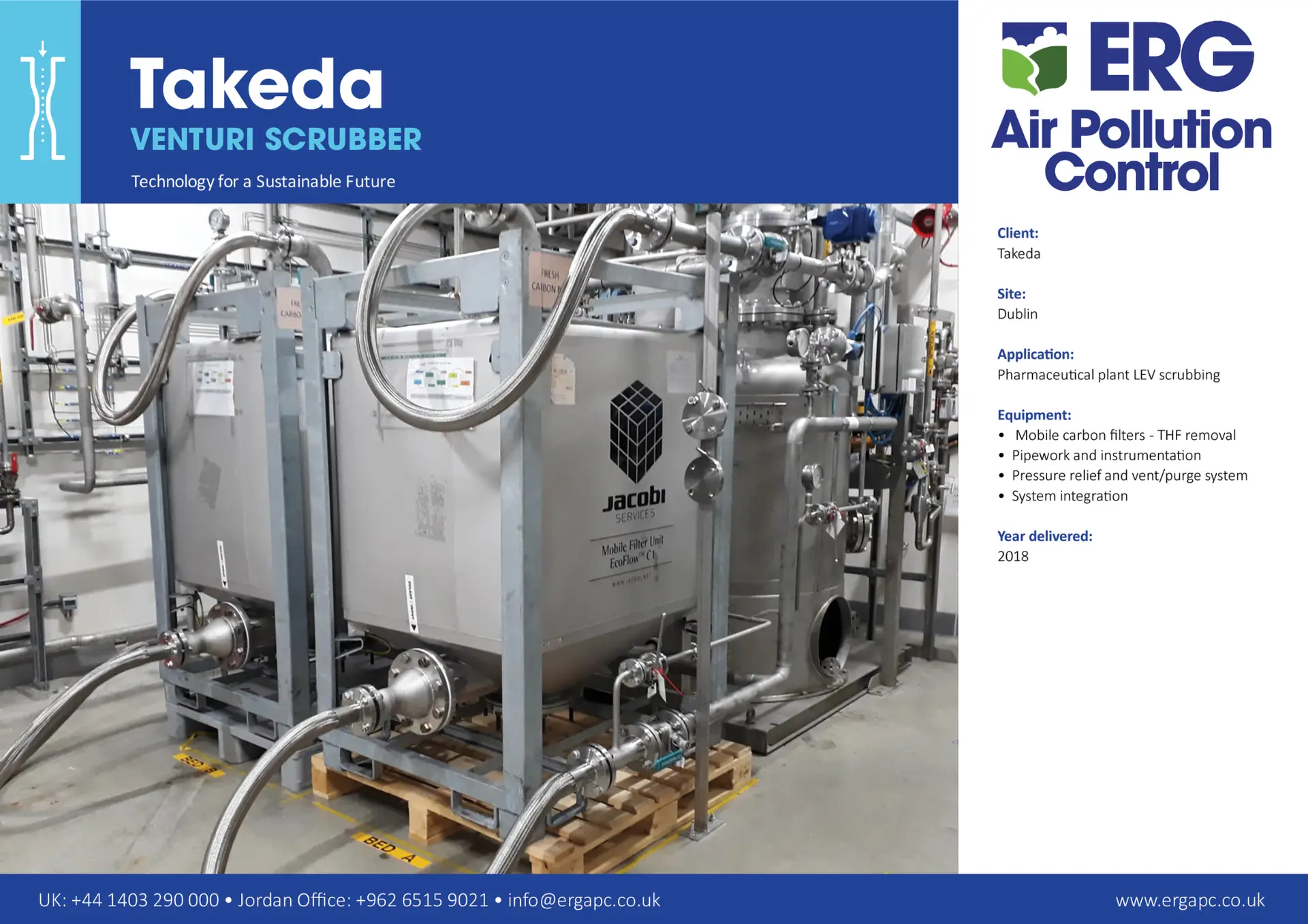
The original project photograph shows mobile carbon filter vessels connected to an arrangement of stainless steel pipework and associated process equipment.
Pipework, Instrumentation and System Integration
In addition to the carbon filters, ERG’s documented equipment package included pipework and instrumentation.
These components provide the connections and monitoring interfaces required to incorporate gas treatment equipment into a wider process installation.
The project also included a pressure relief and vent/purge system.
Pressure relief arrangements are important considerations in process equipment design, while vent and purge provisions can support controlled equipment operation and maintenance.
The specific operating sequence and safety design of the Takeda installation are not detailed in the original case study.
System integration formed part of the documented equipment scope, demonstrating the importance of connecting specialist gas treatment equipment with existing pharmaceutical manufacturing infrastructure.
Equipment Supplied
The original ERG case study identifies the following equipment:
Mobile activated carbon filters: Specified for THF vapour removal.
Pipework and instrumentation: Supporting the connection and operation of the filtration equipment.
Pressure relief and vent/purge system: Incorporated into the process gas treatment arrangement.
System integration: Connecting the equipment with the wider pharmaceutical plant installation.
Project Specifications
| Parameter | Project detail |
|---|---|
| Client | Takeda |
| Site | Dublin, Ireland |
| Industry | Pharmaceutical manufacturing |
| Application | Pharmaceutical plant LEV scrubbing |
| Target contaminant | Tetrahydrofuran (THF) |
| Documented treatment equipment | Mobile activated carbon filters |
| Supporting equipment | Pipework and instrumentation |
| Additional systems | Pressure relief and vent/purge |
| Scope | Equipment package and system integration |
| Year delivered | 2018 |
Activated Carbon Treatment for Pharmaceutical Solvent Emissions
Pharmaceutical manufacturing facilities may require specialist gas treatment systems to manage solvent vapours and other process emissions.
Activated carbon filtration can provide an appropriate treatment method for selected volatile organic compounds, subject to the characteristics of the gas stream and the requirements of the application.
The selection of treatment technology depends on factors such as contaminant composition, solvent loading, operating conditions, required outlet concentrations and maintenance arrangements.
Where mobile carbon filtration equipment is used, consideration must also be given to filter replacement, handling and integration with the extraction system.
The Takeda project provides an example of mobile carbon filtration equipment incorporated into a pharmaceutical LEV treatment application.
ERG’s Experience in Pharmaceutical Air Pollution Control
ERG Air Pollution Control designs and supplies engineered gas treatment systems for pharmaceutical and chemical manufacturing applications.
Its technology portfolio includes activated carbon filtration, wet scrubbing and other specialist air pollution control technologies.
The Takeda Dublin project demonstrates ERG’s experience in integrating solvent treatment equipment with pharmaceutical process ventilation systems.
Delivered in 2018, the installation provides a reference for mobile activated carbon filtration for THF removal, supported by associated pipework, instrumentation, pressure relief and vent/purge arrangements.
For further information about pharmaceutical solvent vapour treatment, activated carbon filtration or industrial LEV gas treatment systems, contact ERG Air Pollution Control.