Chlorine gas protection
Emergency Chlorine Gas Scrubbing for a Major Drinking Water Treatment Project in Sudan
Project Overview
ERG Air Pollution Control designed and manufactured an emergency chlorine gas scrubbing system for Biwater International as part of a major drinking water infrastructure project in Omdurman City, Greater Khartoum, Sudan.
The project formed part of a government-backed initiative to provide safe drinking water to approximately 1.5 million people.
Chlorine is widely used for drinking water disinfection, but its storage and handling require appropriate safety measures to protect personnel and surrounding communities from accidental releases.
Biwater International, appointed by the Government of Sudan to undertake the turnkey design and construction project, selected ERG to provide an emergency gas scrubbing package for the water treatment facility.
The system was engineered to respond to an accidental chlorine release from storage cylinders, extracting contaminated air and neutralising the gas before atmospheric discharge.
The Challenge – Protecting Against an Accidental Chlorine Release
Chlorine gas is highly toxic and presents a significant safety hazard if accidentally released from pressurised storage cylinders.
At the Omdurman water treatment facility, the emergency protection system needed to accommodate a worst-case release of one tonne of chlorine.
The engineering requirements included rapid extraction of contaminated air from the chlorine drum storage room, effective gas neutralisation and controlled discharge of treated air.
The system also needed to operate reliably in Sudan’s tropical environment while remaining compact, straightforward to transport and economical to operate.
ERG developed a dedicated emergency scrubbing package incorporating a chemical absorption system designed specifically for this application.
The Solution – Emergency Packed Tower Chlorine Scrubber
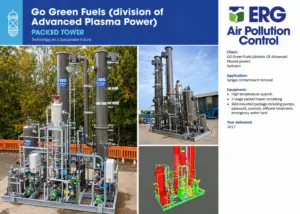
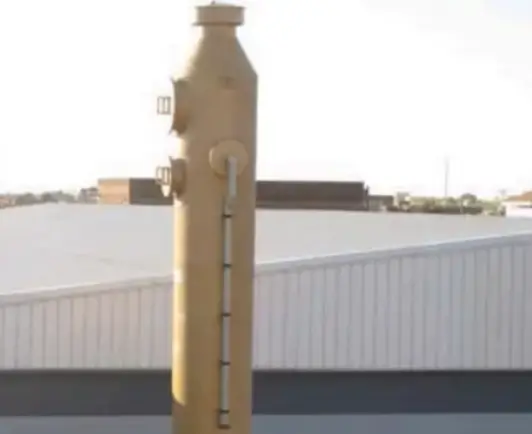
ERG supplied a packed tower scrubber with an integrated caustic solution storage sump and emergency extraction fan.
In the event of a serious accidental chlorine leak, the emergency system is designed to start and extract chlorine-contaminated air from the storage room.
The extraction fan provides four air changes per hour, drawing contaminated air through the scrubbing system.
Within the packed tower, the chlorine gas comes into contact with a recirculating sodium hydroxide (NaOH) solution.
The caustic solution chemically reacts with and neutralises the chlorine, reducing its concentration in the treated exhaust gas.
The system was designed to reduce the chlorine concentration at atmospheric discharge to less than 1.5 ppm.
Based on the specified design leakage rate and extraction capacity, the original project documentation states that the chlorine storage room would be cleared within approximately four to six hours.
This emergency treatment arrangement provides an engineered means of managing a major chlorine release while reducing the potential for uncontrolled atmospheric emissions.
Chemical Storage and Emergency Neutralisation Capacity
The scrubber sump tank was designed to contain sufficient caustic solution to accommodate the specified worst-case release of one tonne of chlorine.
The system requires approximately 10 m³ of 10% w/w sodium hydroxide solution for initial filling or replenishment.
This chemical storage capacity is an important part of the emergency protection design, ensuring that the scrubbing system has the reagent inventory required for the specified release scenario.
The packed tower provides gas-liquid contact for chlorine absorption, while the extraction fan maintains airflow from the storage area through the treatment system.
Materials of Construction and Environmental Conditions
The equipment was manufactured using chlorinated polyvinyl chloride (cPVC), reinforced with Atlac 490 glass reinforced plastic (GRP).
This construction was selected for the chemical service and environmental conditions associated with the installation.
The scrubber was designed to BS 4994 Category 1, with a design temperature of 80°C.
The complete package was also engineered to fit within a standard shipping container for international transportation.
This approach simplified delivery to the Sudanese project site while providing a compact installation suitable for the water treatment facility.
The total installed height was less than 9 metres.
Energy Efficiency and Operational Considerations
Because the system was intended for emergency operation rather than continuous treatment, electrical power requirements were an important design consideration.
The total installed electrical power was less than 10 kW, with absorbed power below 7 kW during emergency operation and weekly testing.
During normal standby conditions, the original specification recorded no absorbed operating power.
The equipment was also designed to operate at a noise level below 80 dB(A), measured at one metre.
These characteristics demonstrate how emergency gas scrubbing equipment can be engineered to provide substantial treatment capacity without the continuous energy demand associated with permanently operating abatement systems.
Project Technical Specifications
| Parameter | Project details |
|---|---|
| Client | Biwater International |
| End user | Government of Sudan drinking water project |
| Location | Omdurman City, Greater Khartoum, Sudan |
| Application | Emergency chlorine gas protection |
| Technology | Caustic packed tower scrubber |
| Design release scenario | 1 tonne of chlorine |
| Design outlet chlorine concentration | Less than 1.5 ppm |
| Storage room extraction rate | 4 air changes per hour |
| Estimated room clearance time | 4–6 hours under design conditions |
| Scrubbing reagent | Sodium hydroxide (NaOH) |
| Caustic solution inventory | Approximately 10 m³ of 10% w/w NaOH |
| Materials of construction | cPVC reinforced with Atlac 490 GRP |
| Design standard | BS 4994 Category 1 |
| Design temperature | 80°C |
| Total installed height | Less than 9 m |
| Installed electrical power | Less than 10 kW |
| Absorbed operating power | Less than 7 kW |
| Standby absorbed power | Nil, as specified |
| Noise level | Less than 80 dB(A) at 1 m |
| Transportation | Designed to fit within a standard shipping container |
Engineering Benefits
The emergency chlorine scrubbing system demonstrates ERG’s capability to develop chemical gas treatment solutions for safety-critical water infrastructure applications.
The project combined several important engineering requirements:
Emergency neutralisation capacity for a specified one-tonne chlorine release.
Packed tower chemical scrubbing to reduce chlorine emissions.
Corrosion-resistant construction suitable for chlorine and caustic service.
Compact, transportable equipment for an international infrastructure project.
Low electrical power consumption during standby conditions.
Equipment designed for operation in a challenging tropical environment.
The result was a purpose-designed emergency chlorine gas protection system tailored to the operational and safety requirements of the Omdurman water treatment facility.
ERG’s Expertise in Emergency Gas Scrubbing
ERG Air Pollution Control designs and supplies industrial gas scrubbing systems for the treatment of hazardous, corrosive and environmentally harmful gases.
Applications include emergency chlorine gas protection, acid gas removal, chemical processing emissions and industrial air pollution control.
Using technologies such as packed tower scrubbers, chemical absorption systems and corrosion-resistant equipment, ERG develops treatment packages to suit specific gas compositions, operating conditions and project requirements.
The Biwater International project demonstrates ERG’s experience in designing emergency gas treatment equipment for essential public infrastructure.
For further information about emergency chlorine scrubbers, chemical gas treatment or industrial air pollution control, contact ERG Air Pollution Control.