Frutarom
Two-Stage Chemical Scrubbing for Industrial Odour Control at Hartlepool
Project Overview
ERG Air Pollution Control supplied an industrial odour control system for Frutarom, a manufacturer of flavours and fragrances, at its Hartlepool facility in the UK.
Delivered in 2022, the installation was designed to treat 30,000 m³/hr of process air using two packed tower scrubbers operating with different chemical treatment solutions.
The first stage employed acid scrubbing to remove ammonia (NH₃), while the second stage used caustic bleach scrubbing to treat odorous and sulphur-containing compounds.
The original project case study records 99% ammonia removal, 90% overall odour removal, 99% hydrogen sulphide removal and 80% removal of methyl mercaptan, dimethyl sulphide and dimethyl disulphide.
The system incorporated PVC/GRP packed tower scrubbers, polypropylene recirculation pumps, chemical dosing equipment, a 30,000 m³/hr fan, ductwork connections, a discharge stack and a control panel.
The project demonstrates ERG’s experience in engineering multi-stage chemical scrubbing systems for complex industrial odour emissions.
The Challenge – Treating Mixed Odorous Compounds
Flavour and fragrance manufacturing can generate process emissions containing a mixture of odorous gases, depending on the raw materials and production processes involved.
These emissions may include ammonia and reduced sulphur compounds, which have different chemical properties and require appropriate treatment conditions.
For Frutarom’s Hartlepool facility, the odour control system needed to address ammonia, hydrogen sulphide (H₂S), methyl mercaptan (MeSH), dimethyl sulphide (DMS) and dimethyl disulphide (DMDS).
Hydrogen sulphide and several organic sulphur compounds can be detected by smell at very low concentrations, making their treatment important in industrial odour control applications.
A single chemical scrubbing solution is not necessarily suitable for treating all these contaminants effectively.
ERG therefore supplied a two-stage chemical scrubbing arrangement, allowing different chemical treatment conditions to be applied to the contaminated air stream.
ERG’s Solution – Two-Stage Packed Tower Scrubbing
The installation incorporated two packed tower scrubbers constructed from PVC/GRP.
Packed tower scrubbers use specially designed packing material to create a large contact surface between contaminated gas and circulating scrubbing liquid.
As the gas passes through the packing, suitable contaminants are absorbed into the liquid and, where appropriate, undergo chemical reactions.
The Frutarom system used separate acid and caustic bleach treatment stages to target different groups of contaminants.
Stage One – Acid Scrubbing for Ammonia Removal
The acid scrubbing stage was designed to remove ammonia from the process air.
Ammonia is an alkaline gas that can be absorbed into an acidic scrubbing solution, where it reacts to form dissolved ammonium salts.
The effectiveness of this process depends on factors including scrubbing liquid chemistry, gas-liquid contact and operating conditions.
For the Frutarom installation, the original case study records an ammonia removal efficiency of 99%.
This demonstrates the application of acid wet scrubbing to ammonia-containing emissions from industrial manufacturing operations.
Stage Two – Caustic Bleach Scrubbing for Odour Removal
Following acid scrubbing, the gas passes through a caustic bleach treatment stage.
Caustic bleach scrubbing combines alkaline absorption conditions with an oxidising chemical environment, providing treatment mechanisms suitable for certain reduced sulphur compounds and other odorous contaminants.
The original case study records the following removal efficiencies:
90% overall odour removal
99% hydrogen sulphide (H₂S) removal
80% removal of methyl mercaptan (MeSH), dimethyl sulphide (DMS) and dimethyl disulphide (DMDS)
These figures demonstrate the treatment objectives recorded for the installation, although the original document does not provide inlet and outlet concentrations or independent performance test results.
The combination of acid and caustic bleach scrubbing allows the system to address contaminants requiring different chemical treatment conditions.
Recirculation, Chemical Dosing and Gas Handling
The packed tower scrubbers were supported by polypropylene recirculation liquor pumps, providing circulation of the chemical scrubbing solutions through the treatment stages.
Chemical dosing equipment was incorporated to support the required scrubbing liquid chemistry.
The installation also included new ductwork connections to the existing system, integrating the scrubbers with the site’s process air extraction arrangements.
A fan rated at 30,000 m³/hr provided gas movement through the system, with treated air routed to the discharge stack.
A control panel was supplied to support operation of the treatment equipment.
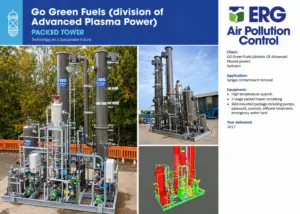
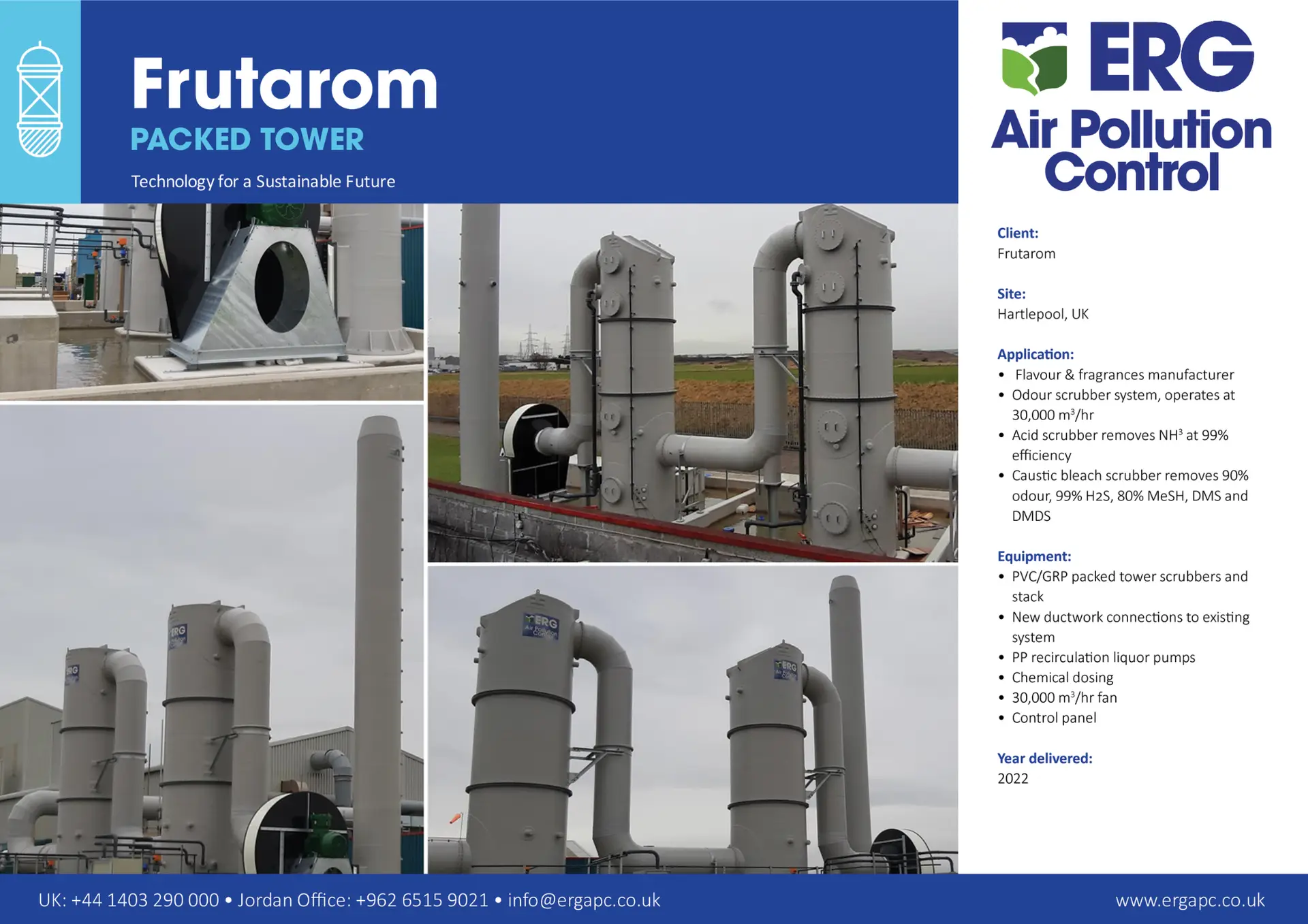
The project photographs show the two vertical packed tower scrubbers, associated ductwork, fan and discharge stack installed at the Hartlepool facility.
Equipment Supplied
ERG’s documented equipment scope included:
PVC/GRP packed tower scrubbers: Providing separate acid and caustic bleach treatment stages.
Polypropylene recirculation liquor pumps: Supporting scrubbing liquid circulation.
Chemical dosing equipment: Supporting the chemical treatment processes.
30,000 m³/hr fan: Providing process gas movement.
New ductwork connections: Integrating the equipment with the existing system.
Discharge stack: Providing a treated gas discharge route.
Control panel: Supporting system operation.
Project Specifications
| Parameter | Project detail |
|---|---|
| Client | Frutarom |
| Site | Hartlepool, UK |
| Industry | Flavours and fragrances manufacturing |
| Application | Industrial odour control |
| Design airflow | 30,000 m³/hr |
| Primary technology | Two-stage packed tower chemical scrubbing |
| First treatment stage | Acid scrubbing |
| Second treatment stage | Caustic bleach scrubbing |
| Ammonia removal | 99% |
| Overall odour removal | 90% |
| Hydrogen sulphide removal | 99% |
| MeSH, DMS and DMDS removal | 80% |
| Scrubber construction | PVC/GRP |
| Recirculation pumps | Polypropylene |
| Supporting equipment | Chemical dosing, fan, ductwork, stack and control panel |
| Year delivered | 2022 |
Chemical Scrubbing for Flavour and Fragrance Manufacturing
Industrial odour control systems must be designed around the chemical characteristics of the contaminants present.
Where emissions contain ammonia and reduced sulphur compounds, multi-stage chemical scrubbing can provide an appropriate treatment approach.
Acid scrubbing is commonly used for ammonia removal, while alkaline oxidising scrubbing solutions can be used to treat suitable sulphur-containing contaminants.
Packed tower scrubbers provide gas-liquid contact within a relatively compact vertical equipment arrangement, making them suitable for a range of industrial air pollution control applications.
The Frutarom project demonstrates the application of complementary chemical scrubbing stages to a mixed odorous gas stream at a substantial industrial airflow.
ERG’s Experience in Industrial Odour Control
ERG Air Pollution Control designs and supplies engineered wet scrubbing systems for industrial manufacturing processes.
Its technologies include packed tower scrubbers, chemical odour control systems, Venturi scrubbers and other specialist gas treatment equipment.
The Frutarom installation demonstrates ERG’s experience in combining different chemical treatment stages to address multiple contaminants within a single industrial odour control system.
Delivered in 2022, the project provides a reference for treating 30,000 m³/hr of process air with documented removal efficiencies for ammonia, hydrogen sulphide and organic sulphur compounds.
For further information about packed tower scrubbers, ammonia removal, sulphur compound treatment or industrial odour control systems, contact ERG Air Pollution Control.