Nestlé Purina Pet Care
New Chemical Scrubber and Activated Carbon Odour Control System for Kibble Manufacturing
Project Overview
ERG Air Pollution Control designed, supplied, installed and commissioned a new odour control unit (OCU) for Nestlé Purina Pet Care in 2021, supporting odour treatment associated with kibble manufacturing.
The project involved replacing redundant plasma treatment units with a new system incorporating two-stage chemical scrubbing, gas conditioning and activated carbon filtration.
Rather than replacing all the existing infrastructure, ERG integrated the new odour control equipment with retained fans and sections of the existing ductwork.
A raised steel installation platform was designed to accommodate the treatment equipment while maintaining an established access route beneath the installation.
The project demonstrates ERG’s ability to modernise industrial odour control systems while accommodating existing infrastructure and operational site constraints.
The Challenge – Replacing Redundant Odour Treatment Equipment
Pet food manufacturing can generate odorous process emissions associated with ingredient handling, processing and the production of dry kibble.
Effective treatment of extracted process air is an important consideration in managing odour emissions from these manufacturing operations.
At Nestlé Purina Pet Care, the project requirement was to replace redundant plasma treatment units with a new odour control system.
The installation also needed to incorporate existing fans and selected ductwork, reducing the need to replace infrastructure that could be retained within the revised treatment arrangement.
A further consideration was the available installation space.
The new equipment needed to be positioned above an existing access route, requiring a raised platform arrangement that would allow the route to remain usable.
The design therefore needed to address both the air treatment requirements and the physical integration of equipment within an established manufacturing facility.
ERG’s Solution – Two-Stage Chemical Scrubbing and Carbon Filtration
ERG supplied a new odour control system incorporating two-stage chemical scrubbing followed by a demister, reheater and activated carbon filter.
Two-Stage Chemical Scrubbing
The primary treatment process uses wet chemical scrubbing to treat suitable soluble and chemically reactive gaseous contaminants.
Chemical scrubbers promote contact between the contaminated air and circulating scrubbing liquid, allowing appropriate compounds to be absorbed and treated.
The two-stage arrangement provides successive scrubbing stages within the treatment process.
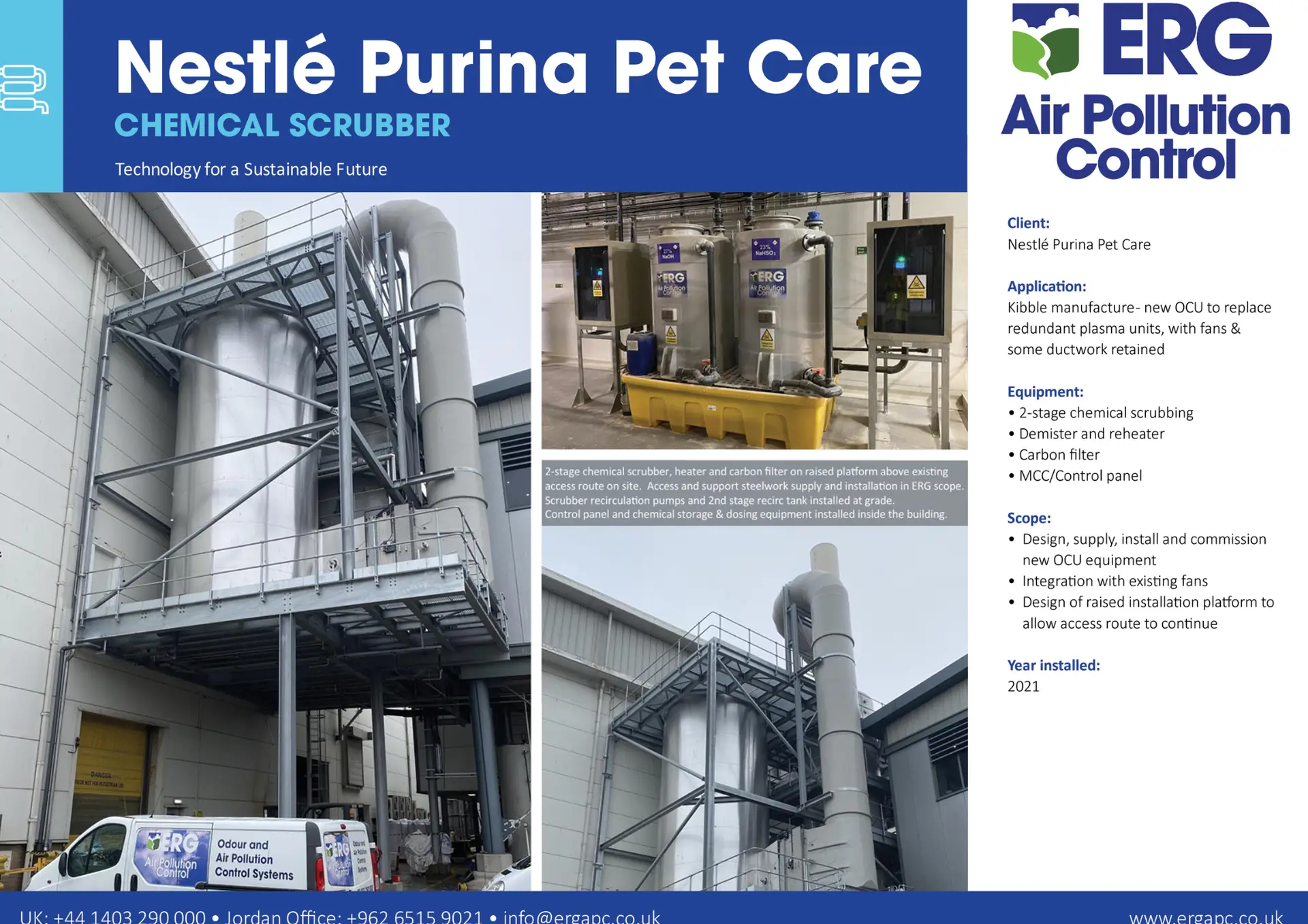
The project photographs identify scrubber recirculation pumps and a second-stage recirculation tank installed at ground level.
The original case sheet does not specify the individual odorous compounds, chemical reagents or required removal efficiencies.
Demister and Reheater
Following wet scrubbing, the system incorporates a demister and reheater to condition the gas before activated carbon treatment.
The demister removes entrained liquid droplets from the gas stream.
The reheater provides additional gas conditioning, helping to reduce relative humidity before the air enters the carbon filtration stage.
This is an important consideration because moisture can influence the adsorption performance of activated carbon.
Activated Carbon Filtration
The activated carbon filter provides a downstream treatment stage for suitable residual odorous compounds.
Activated carbon contains a highly porous structure that allows selected gaseous contaminants to be retained through adsorption.
Combining chemical scrubbing with carbon filtration provides complementary treatment mechanisms within a single odour control system.
Engineering Around Existing Site Infrastructure
An important feature of the project was the design of a raised installation platform.
The two-stage chemical scrubber, reheater and activated carbon filter were installed above an existing access route.
This allowed the new equipment to be accommodated while preserving access beneath the structure.
The original case sheet also records that the installation required access and support steelwork supplied and installed within ERG’s scope.
The scrubber recirculation pumps and second-stage recirculation tank were positioned at ground level, while the control panel and chemical storage and dosing equipment were installed inside the building.
ERG also integrated the new treatment equipment with existing fans and retained ductwork.
This combination of new and existing equipment demonstrates the importance of mechanical integration and installation planning when upgrading air pollution control systems within operational industrial facilities.
Equipment and Project Scope
ERG’s documented scope included:
Two-stage chemical scrubbing: Primary treatment of suitable odorous gaseous contaminants.
Demister: Removal of entrained liquid droplets.
Reheater: Gas conditioning before activated carbon filtration.
Activated carbon filter: Downstream adsorption treatment.
MCC/control panel: Electrical motor control and system operation.
Recirculation pumps and tank: Supporting the chemical scrubbing process.
Chemical storage and dosing equipment: Supporting scrubbing liquid treatment.
Raised installation platform: Accommodating the equipment while retaining the existing access route.
ERG undertook the design, supply, installation and commissioning of the new OCU and its integration with retained fans and ductwork.
Project Specifications
| Parameter | Project detail |
|---|---|
| Client | Nestlé Purina Pet Care |
| Industry | Pet food manufacturing |
| Application | Kibble manufacturing odour control |
| Project type | Replacement of redundant plasma treatment units |
| Primary treatment | Two-stage chemical scrubbing |
| Secondary treatment | Activated carbon filtration |
| Gas conditioning | Demister and reheater |
| Existing equipment retained | Fans and selected ductwork |
| Installation arrangement | Raised platform above existing access route |
| Supporting equipment | Recirculation pumps, tank, chemical dosing and controls |
| ERG scope | Design, supply, installation and commissioning |
| Year installed | 2021 |
Upgrading Odour Control Systems in Existing Manufacturing Facilities
Industrial odour control systems may need to be replaced or upgraded as equipment reaches the end of its useful life or treatment requirements change.
Where existing fans, ductwork and supporting infrastructure remain suitable, incorporating them into a new treatment arrangement can reduce the extent of replacement work.
However, successful integration requires careful consideration of equipment positioning, airflow arrangements, maintenance access and operational constraints.
The Nestlé Purina Pet Care project illustrates how a new multi-stage odour treatment system can be installed within an existing manufacturing environment while retaining selected infrastructure.
ERG’s Experience in Industrial Odour Control Upgrades
ERG Air Pollution Control designs, supplies and installs engineered odour control systems for industrial manufacturing applications.
Its technologies include chemical wet scrubbing, activated carbon filtration and integrated multi-stage treatment systems.
The Nestlé Purina Pet Care installation demonstrates ERG’s experience in replacing obsolete treatment equipment, integrating new systems with existing infrastructure and designing practical installation arrangements around site constraints.
Completed in 2021, the project forms part of ERG’s portfolio of industrial odour control installations and equipment upgrades.
For further information about chemical scrubbers, activated carbon filtration or industrial odour control system upgrades, contact ERG Air Pollution Control.