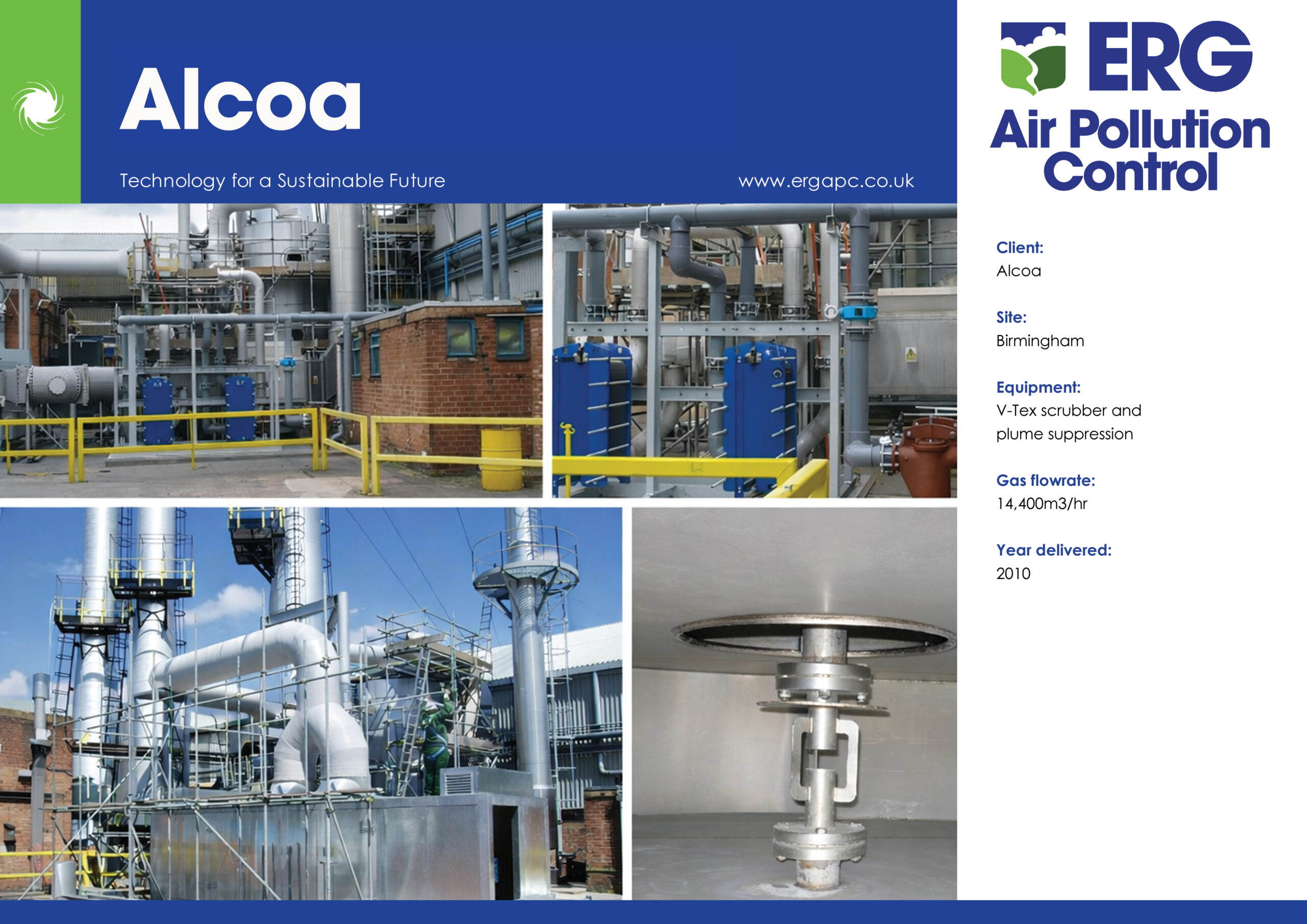
V-tex® Gas Scrubbing and Plume Suppression at Alcoa’s Birmingham Site
Project Overview
ERG Air Pollution Control supplied a V-tex® scrubber and plume suppression system for Alcoa’s Birmingham site. Delivered in 2010, the installation had a stated gas flow rate of 14,400 m³/h.
The project combined two related engineering duties: gas scrubbing and plume suppression. Scrubbing addresses contaminants carried within a gas stream, while plume suppression addresses the conditions that produce a visible discharge plume.
Considering these requirements together allows the treatment equipment and discharge arrangements to be assessed as one system. The Alcoa installation provides a reference for ERG’s experience supplying specialist gas cleaning equipment alongside provision for plume management.
The Challenge – Gas Treatment and Discharge Visibility
Industrial gas treatment must account for both the required contaminant removal and the condition of the gas leaving the equipment.
Wet scrubbing brings gas into contact with liquid. Depending on the process conditions, the treated gas can contain substantial water vapour and may approach saturation. When that gas is discharged into cooler surrounding air, water vapour can condense into fine droplets, producing a visible plume.
This creates a separate engineering consideration from pollutant removal. A visible water plume does not, by itself, establish the concentration of pollutants in the discharge. Equally, reducing plume visibility does not demonstrate that a particular emissions limit has been achieved.
At Alcoa’s Birmingham site, the documented equipment scope addressed both functions through a V-tex® scrubber and plume suppression provision. The stated gas flow of 14,400 m³/h established a key parameter for the gas handling duty.
ERG’s Solution – V-tex® Scrubbing with Plume Suppression
ERG supplied a V-tex® scrubber together with equipment for plume suppression.
The gas cleaning function and plume management function require complementary engineering decisions. The scrubber must be appropriate for the contaminants and operating conditions, while plume suppression must account for the moisture and thermal behaviour of the discharge.
In general, wet scrubbing relies on contact between the gas and a treatment liquid. Depending on the application, that contact can support the transfer of soluble contaminants into the liquid or the collection of entrained material. The selected technology, liquid conditions and equipment configuration determine the treatment mechanism.
The Alcoa case sheet identifies V-tex® as the supplied scrubber technology. Its particular contaminant duty is not specified, so the installation is presented as a documented gas scrubbing project without assigning an unsupported pollutant or manufacturing process.
Understanding Plume Suppression
Plume formation depends on the relationship between the discharged gas and the surrounding atmosphere. Gas temperature, moisture content, ambient temperature and humidity all influence whether visible condensation develops.
For comparable applications, plume suppression approaches may involve reducing the moisture content, changing the discharge temperature or combining conditioning measures. The appropriate method depends on the gas stream and the conditions under which plume visibility must be controlled.
These options have different implications for energy use, heat transfer and equipment layout. Selecting an approach therefore requires an understanding of the process rather than treating plume suppression as a standard accessory.
For Alcoa, plume suppression is a confirmed part of the recorded equipment scope. The specific method and operating conditions are not assigned beyond the information supplied.
Engineering and Design Considerations
A combined scrubbing and plume suppression installation requires attention to the interaction between gas cleaning, moisture management and gas movement.
Gas flow influences equipment sizing, velocities and pressure losses. The condition of the gas leaving the scrubber also affects the requirements of downstream equipment and the final discharge.
Materials must be selected for the actual gas composition, treatment liquid and operating temperature. Connections, seals and other wetted components need the same consideration as the principal vessels.
Access is another practical requirement. Equipment should allow inspection and servicing of components that may need cleaning, adjustment or replacement during operation.
The Alcoa photographs show vessels, extensive connected pipework, blue plate heat exchanger units, ductwork, access platforms and exhaust stacks. These illustrate the physical equipment arrangement without establishing the precise function or contractual scope of every visible component.
Project Technical Specifications
| Parameter | Project details |
|---|---|
| Client | Alcoa |
| Site | Birmingham |
| Scrubber technology | V-tex® |
| Additional treatment provision | Plume suppression |
| Stated gas flow rate | 14,400 m³/h |
| Year delivered | 2010 |
Engineering Benefits
The documented project illustrates several aspects of ERG’s gas treatment capability:
- Combined treatment requirements: The supply addressed gas scrubbing and plume suppression within the same project.
- Specialist scrubber technology: V-tex® equipment formed the gas cleaning provision.
- Defined gas handling duty: The installation records a gas flow rate of 14,400 m³/h.
- Consideration of discharge conditions: Plume suppression extended the scope beyond the scrubber’s contaminant treatment function.
These benefits describe the equipment provision and engineering relevance of the project. They do not imply unrecorded removal efficiencies, energy savings or measured plume reduction.
ERG’s Expertise in Gas Scrubbing and Plume Management
The Alcoa project demonstrates ERG’s experience supplying gas treatment equipment where scrubbing and discharge visibility must be considered together.
Our wider capabilities include industrial gas cleaning, process equipment engineering and support for existing treatment installations. For similar applications, the starting point is to establish the gas composition, flow, temperature, moisture content and required treatment outcome.
For further information about V-tex® scrubbing, industrial gas treatment or plume suppression requirements, contact ERG Air Pollution Control.