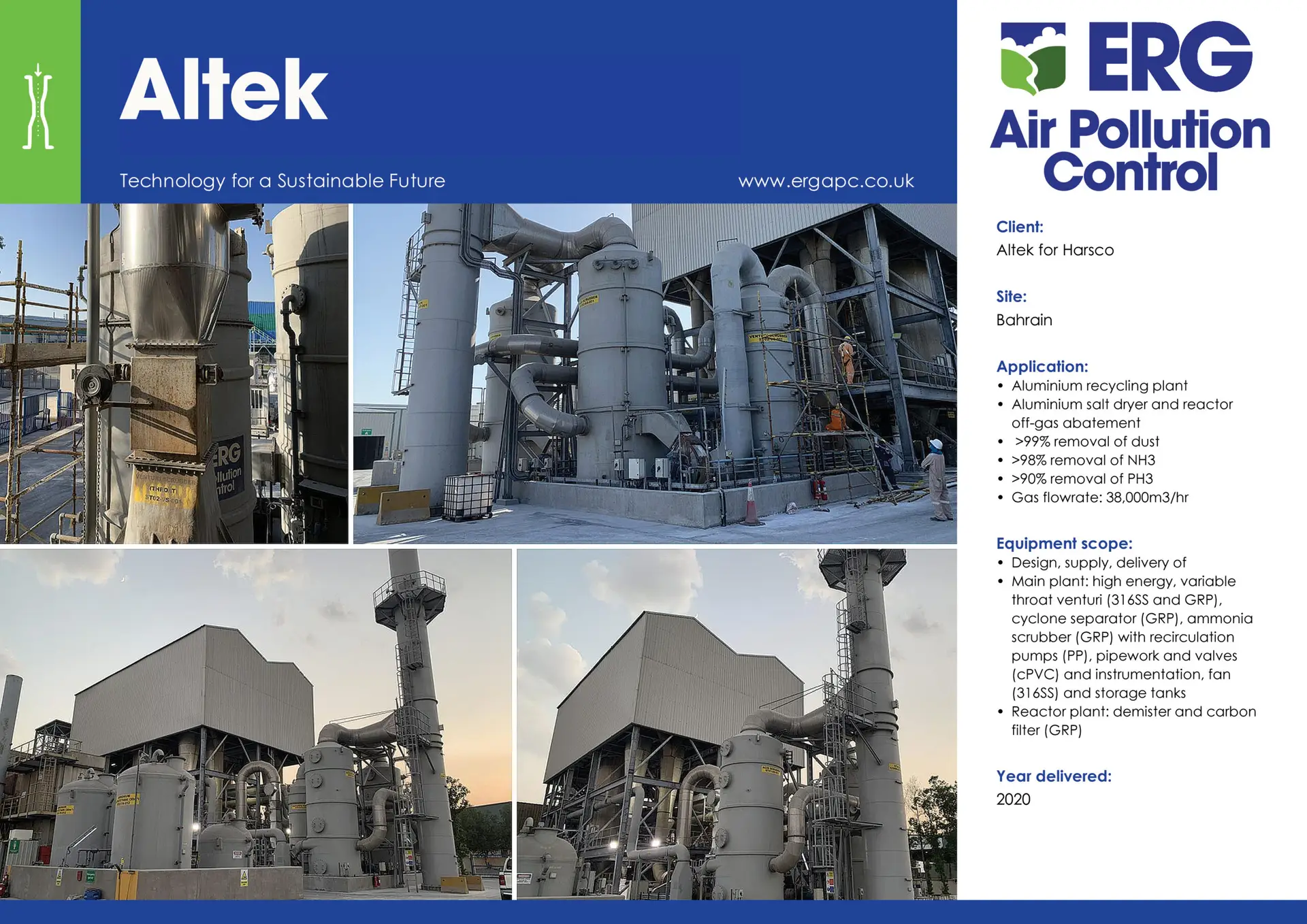
Aluminium Recycling Off-Gas Treatment for Dust, Ammonia and Phosphine in Bahrain
Project Overview
ERG Air Pollution Control designed, supplied and delivered off-gas abatement equipment for Altek for Harsco at an aluminium recycling plant in Bahrain.
Delivered in 2020, the project addressed emissions from an aluminium salt dryer and reactor plant. The equipment combined high-energy Venturi scrubbing, cyclone separation, ammonia scrubbing and a separate reactor treatment package incorporating a demister and carbon filter.
The project sheet records a gas flow rate of 38,000 m³/h and stated removal performance of greater than 99% for dust, greater than 98% for ammonia (NH₃) and greater than 90% for phosphine (PH₃).
The installation demonstrates ERG’s ability to combine particulate collection and gas treatment technologies within an industrial emissions package, with different equipment provided for the main plant and reactor duties.
The Challenge – Treating Particles and Gaseous Contaminants
The documented application involved both particulate and gaseous emissions. Dust, ammonia and phosphine present different treatment requirements, making technology selection central to the overall abatement approach.
Dust collection requires particles to be separated from the gas stream. Ammonia treatment involves transferring a gaseous contaminant into an appropriate treatment medium. Phosphine introduces another distinct gas treatment requirement that must be assessed against its chemical behaviour and the selected abatement process.
A single removal mechanism should not be assumed suitable for all three duties.
The project also covered off-gas from two process areas: the aluminium salt dryer and the reactor plant. ERG’s scope reflected this distinction, with a main treatment package and a separate demister and carbon filter arrangement for the reactor plant.
At a stated gas flow of 38,000 m³/h, the design needed to consider gas handling alongside the individual treatment functions.
ERG’s Solution – Main Plant Scrubbing and Separation
The main plant equipment comprised:
- A high-energy, variable-throat Venturi scrubber.
- A cyclone separator.
- An ammonia scrubber with recirculation pumps.
- Pipework, valves and instrumentation.
- A fan and storage tanks.
The Venturi scrubber was specified in 316 stainless steel and glass-reinforced plastic (GRP). The cyclone separator and ammonia scrubber were specified in GRP.
This package brought together intensive gas–liquid contact, separation and gas absorption equipment. Supporting liquid circulation and gas handling components formed part of the supplied system rather than being treated as separate equipment requirements.
High-Energy, Variable-Throat Venturi Scrubbing
A Venturi scrubber accelerates gas through a narrowed throat, bringing it into intensive contact with liquid droplets. Particles collide with droplets and become incorporated into the liquid, allowing them to be separated from the gas.
High-energy Venturi scrubbing uses the energy associated with this gas–liquid contact to support particulate collection. Its performance depends on factors including particle characteristics, liquid delivery, gas velocity and pressure loss.
The variable-throat feature allows the restriction at the throat to be adjusted. In general, this provides a means of managing contacting conditions and pressure loss as the operating duty changes.
For the Altek project, high-energy, variable-throat equipment is explicitly documented. The source does not specify the adjustment mechanism or control strategy, so no automatic operating sequence is attributed to the installation.
Cyclone Separation and Ammonia Scrubbing
The main plant package included a GRP cyclone separator.
Cyclonic separation uses rotational gas movement to separate entrained material from a gas stream. In wet scrubbing applications, this can provide a means of separating liquid carrying collected particles after gas–liquid contact.
The supplied ammonia scrubber provided a distinct gas treatment function. Ammonia is soluble in water, and suitable liquid chemistry can support its absorption and retention within a scrubbing system.
Effective ammonia treatment depends on the contact conditions and management of the circulating liquid. ERG’s documented scope included polypropylene recirculation pumps, supporting liquid movement through the scrubber arrangement.
The project sheet does not identify the scrubbing reagent. The treatment explanation therefore does not assign a particular acid, concentration or dosing regime to the installation.
Reactor Off-Gas Treatment – Demisting and Carbon Filtration
For the reactor plant, ERG supplied a demister and carbon filter in GRP.
Demisting removes entrained liquid droplets from a gas stream. This performs a different duty from removing gaseous contaminants and can be important where liquid carryover would affect downstream equipment.
Carbon treatment uses the media’s surface properties and, where applicable, reactive characteristics to capture suitable gas-phase contaminants. Media selection depends on the substances present and the operating conditions.
The reactor package demonstrates the use of complementary treatment functions. However, the source does not allocate the stated phosphine removal figure to a particular item of equipment or identify the carbon formulation. Those details require the project’s process documentation.
Engineering and Materials of Construction
The equipment scope records several materials selected across the treatment package:
- 316 stainless steel and GRP for the Venturi.
- GRP for the cyclone separator and ammonia scrubber.
- Polypropylene for the recirculation pumps.
- Chlorinated polyvinyl chloride (CPVC) for pipework and valves.
- 316 stainless steel for the fan.
- GRP for the reactor demister and carbon filter.
Using different materials across a plant allows components to be assessed against their particular chemical, mechanical and operating duties.
For comparable applications, material selection must consider corrosion, temperature, abrasion and the composition of both gas and liquid streams. Compatibility of seals, connections and other wetted parts is also important.
The inclusion of instrumentation and storage tanks further illustrates the need to consider process operation alongside the principal treatment vessels.
Project Technical Specifications
| Parameter | Project details |
|---|---|
| Client | Altek for Harsco |
| Site | Bahrain |
| Industry | Aluminium recycling |
| Application | Aluminium salt dryer and reactor off-gas abatement |
| Stated gas flow rate | 38,000 m³/h |
| Stated dust removal | Greater than 99% |
| Stated ammonia removal | Greater than 98% |
| Stated phosphine removal | Greater than 90% |
| Main particulate treatment | High-energy, variable-throat Venturi |
| Venturi construction | 316 stainless steel and GRP |
| Cyclone separator | GRP |
| Ammonia scrubber | GRP |
| Recirculation pumps | Polypropylene |
| Pipework and valves | CPVC |
| Fan | 316 stainless steel |
| Additional main plant scope | Instrumentation and storage tanks |
| Reactor treatment | Demister and carbon filter, GRP |
| ERG scope | Design, supply and delivery |
| Year delivered | 2020 |
Engineering Benefits
The Altek project illustrates several aspects of ERG’s industrial gas cleaning capability:
- Multiple treatment mechanisms: Particulate collection, gas absorption, demisting and carbon treatment were included.
- Process-specific equipment: Separate packages addressed the main plant and reactor requirements.
- Adjustable Venturi geometry: A variable throat formed part of the documented scrubber design.
- Specialist materials: Metallic and thermoplastic materials were specified across the equipment.
- Integrated supply: Pumps, a fan, storage tanks, pipework, valves and instrumentation accompanied the treatment vessels.
The removal figures describe source-stated performance rather than independently verified operating measurements.
ERG’s Expertise in Aluminium Recycling Emissions Treatment
The Bahrain installation demonstrates ERG’s experience engineering combined treatment packages for aluminium recycling off-gas.
Our capabilities include Venturi scrubbing, gas absorption, separation and carbon treatment, supported by equipment design and specialist material selection. The appropriate arrangement depends on the contaminants, process conditions and required treatment outcome.
For further information about aluminium recycling emissions, salt dryer off-gas or combined particulate and gas treatment systems, contact ERG Air Pollution Control.