Veolia Water Systems
Four Dual-Bed Activated Carbon Odour Control Units for Sabah Al-Ahmad Sea City, Kuwait
Project Overview
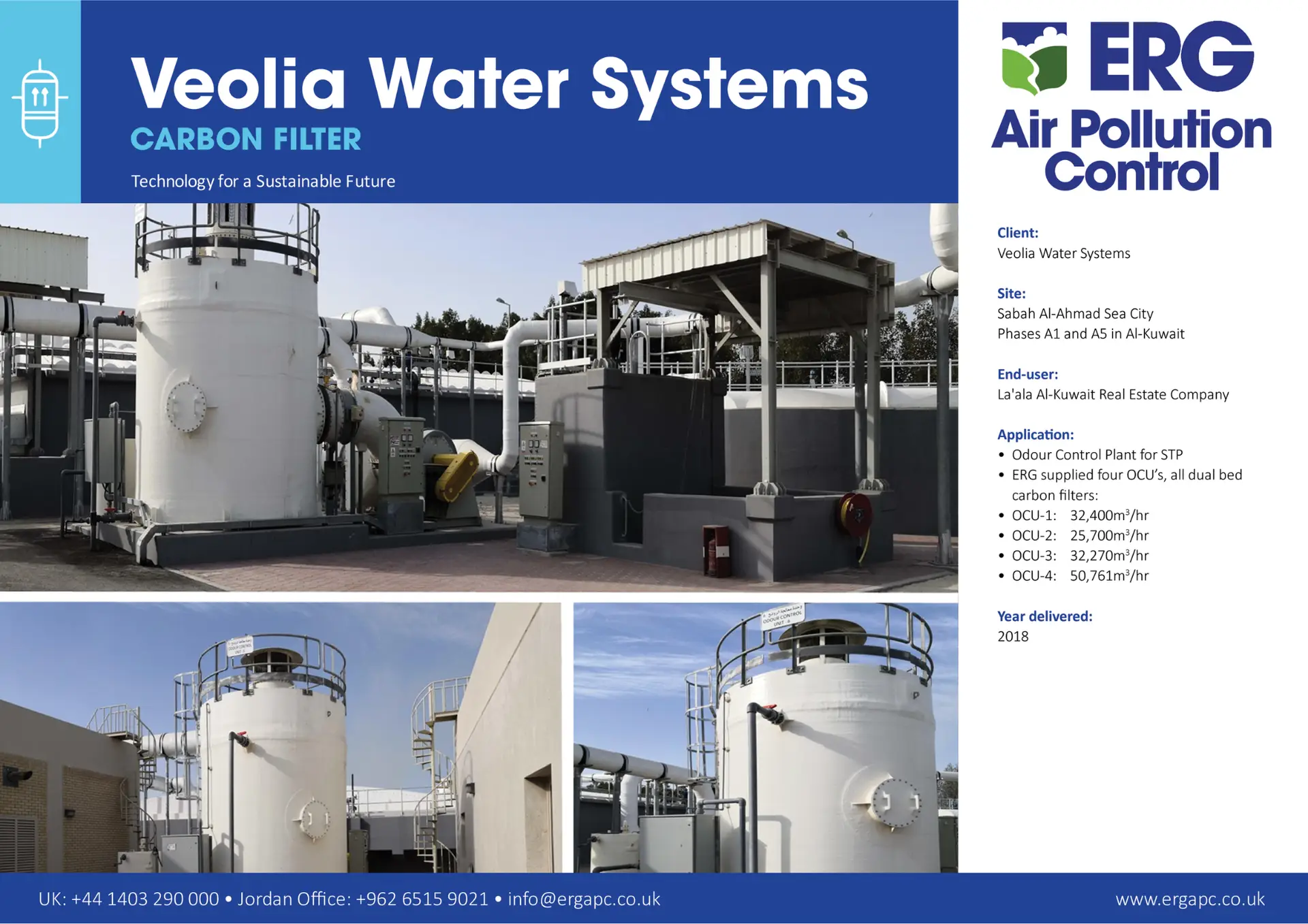
ERG Air Pollution Control supplied four activated carbon odour control units (OCUs) for Veolia Water Systems as part of the sewage treatment plant serving Sabah Al-Ahmad Sea City, Phases A1 and A5, in Kuwait.
Delivered in 2018 for end-user La’ala Al-Kuwait Real Estate Company, the project incorporated four dual-bed carbon filtration systems designed to treat odorous air extracted from wastewater treatment operations.
The individual units were specified for airflows ranging from 25,700 m³/hr to 50,761 m³/hr, providing a combined design treatment capacity of 141,771 m³/hr.
The installation demonstrates ERG’s experience in supplying large-scale activated carbon odour control equipment for municipal wastewater infrastructure in the Middle East.
The Challenge – Odour Control at a Sewage Treatment Plant
Sewage treatment plants can generate odorous air from several stages of wastewater collection, processing and treatment.
These emissions may contain hydrogen sulphide and other odorous compounds associated with the breakdown of organic material.
Where wastewater treatment infrastructure serves developing residential or commercial areas, effective odour management is an important consideration in protecting the surrounding environment and reducing nuisance emissions.
For the Sabah Al-Ahmad Sea City project, the specified requirement was for four odour control units serving the sewage treatment plant.
The individual design airflows indicate that the installation required treatment equipment capable of handling substantial volumes of extracted air.
The original project case sheet does not identify the individual extraction sources, contaminant concentrations or specified outlet emission limits.
ERG’s Solution – Dual-Bed Activated Carbon Filtration
ERG supplied four odour control units, each incorporating a dual-bed activated carbon filter arrangement.
Activated carbon is widely used in wastewater odour control because its porous structure provides a large internal surface area for the adsorption of suitable gaseous contaminants.
As contaminated air passes through the carbon media, selected compounds can be retained within the adsorbent structure, reducing their concentration in the treated air.
For wastewater applications, activated carbon systems can be configured with media selected to target contaminants such as hydrogen sulphide and other odorous compounds.
The specific carbon grades and media arrangements used at Sabah Al-Ahmad Sea City are not identified in the original case sheet.
A dual-bed configuration provides two carbon treatment beds within the filtration arrangement. Depending on the design, multiple beds can support staged adsorption treatment and additional treatment capacity.
The four units were designed to accommodate different airflow requirements, reflecting the varying capacities specified for the project.
Four High-Capacity Odour Control Units
The project comprised the following equipment:
OCU-1: Dual-bed activated carbon filter, 32,400 m³/hr.
OCU-2: Dual-bed activated carbon filter, 25,700 m³/hr.
OCU-3: Dual-bed activated carbon filter, 32,270 m³/hr.
OCU-4: Dual-bed activated carbon filter, 50,761 m³/hr.
Together, the four units provided a combined design airflow capacity of 141,771 m³/hr.
The installation illustrates ERG’s ability to supply multiple carbon filtration systems for wastewater applications requiring substantial air handling capacity.
Project Specifications
| Parameter | Project detail |
|---|---|
| Client | Veolia Water Systems |
| End-user | La’ala Al-Kuwait Real Estate Company |
| Site | Sabah Al-Ahmad Sea City, Phases A1 and A5, Kuwait |
| Application | Sewage treatment plant odour control |
| Treatment technology | Dual-bed activated carbon filtration |
| Number of OCUs | 4 |
| OCU-1 design airflow | 32,400 m³/hr |
| OCU-2 design airflow | 25,700 m³/hr |
| OCU-3 design airflow | 32,270 m³/hr |
| OCU-4 design airflow | 50,761 m³/hr |
| Combined design airflow | 141,771 m³/hr |
| Year delivered | 2018 |
Activated Carbon Filtration for Wastewater Odour Control
Activated carbon filtration is an established technology for treating odorous air from municipal and industrial wastewater facilities.
Typical applications include sewage treatment works, pumping stations, sludge handling areas and other enclosed wastewater processes.
The suitability of activated carbon depends on several factors, including contaminant composition, concentration, temperature, humidity, airflow and the required outlet conditions.
Carbon media selection is particularly important where hydrogen sulphide or other challenging odorous compounds are present.
For large-scale wastewater facilities, multiple odour control units may be used to accommodate different extraction requirements across the treatment site.
The Sabah Al-Ahmad Sea City project provides an example of this approach, with four independently specified carbon filtration units serving the wider sewage treatment plant application.
ERG’s Experience in Large-Scale Wastewater Odour Control
ERG Air Pollution Control designs and supplies engineered odour control systems for municipal and industrial wastewater applications.
Its technologies include activated carbon filtration, biotrickling filters, biofilters and chemical wet scrubbing systems.
The Veolia Water Systems project in Kuwait demonstrates ERG’s experience in supplying high-capacity activated carbon filtration equipment for wastewater infrastructure in the Middle East.
Delivered in 2018, the four-unit installation represents a combined design treatment capacity of more than 140,000 m³/hr.
For further information about activated carbon filters, dual-bed carbon odour control units or sewage treatment plant odour control systems, contact ERG Air Pollution Control.