Variable-Throat Venturi Scrubber for Yeast Dryer Exhaust at Felixstowe
Project Overview
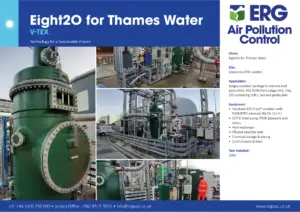
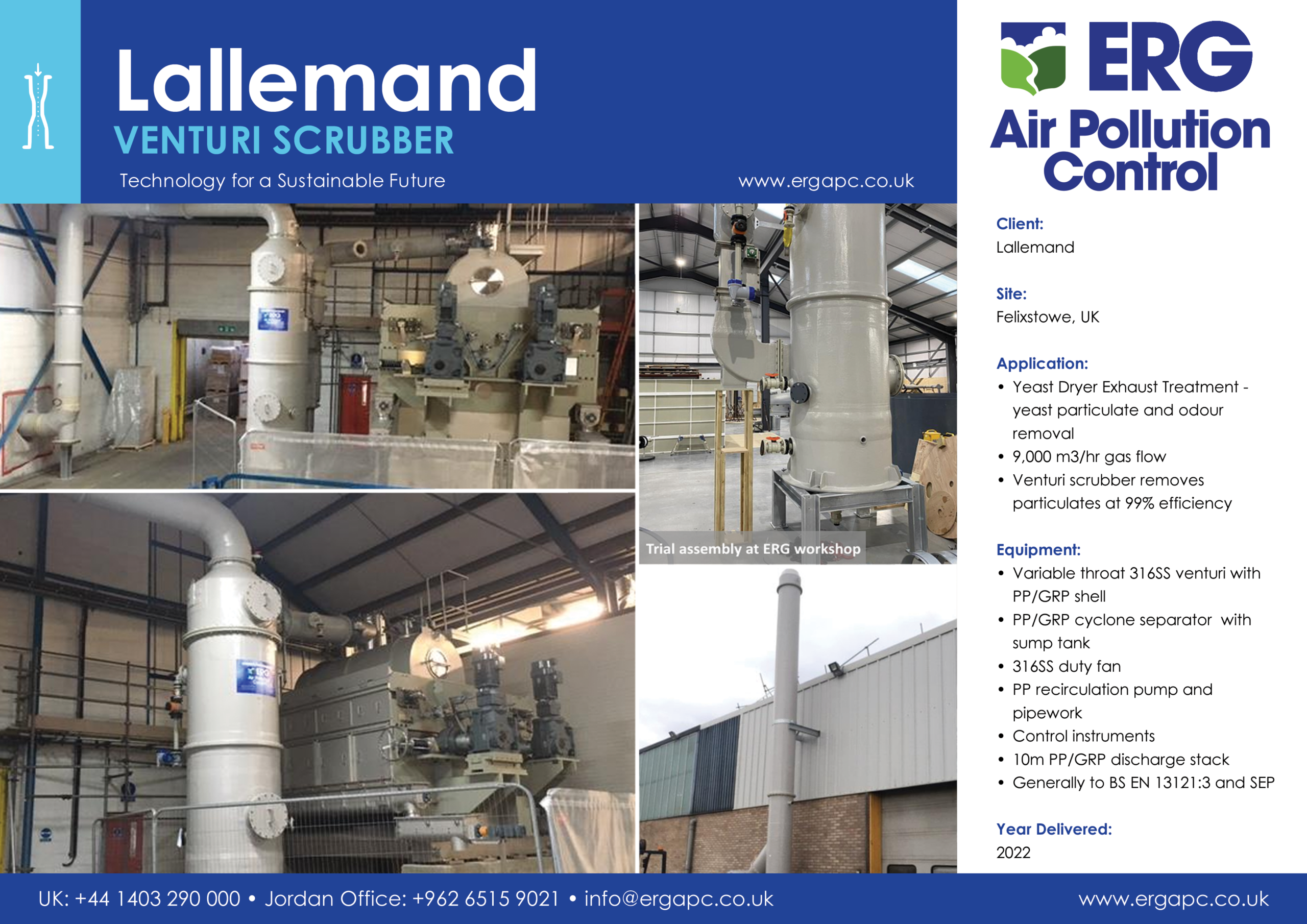
ERG Air Pollution Control supplied a variable-throat Venturi scrubber package for Lallemand’s yeast dryer exhaust at Felixstowe, UK. Delivered in 2022, the system was supplied for yeast particulate and odour removal at a stated gas flow of 9,000 m³/h. The project sheet gives a particulate removal efficiency of 99% for the Venturi scrubber.
The equipment package included a cyclone separator with a sump tank, a recirculation pump and pipework, a duty fan, control instruments and a 10 m discharge stack. ERG also carried out a trial assembly at its workshop before delivery.
The Challenge – Capturing Yeast Particulates from Dryer Exhaust
Yeast dryer exhaust carries suspended material that needs to be separated from the air before discharge. In a wet scrubbing system, particle collection involves two steps. First, the particles must come into contact with liquid droplets. Then the droplets carrying the captured material must be separated from the gas.
At Felixstowe, particulate and odour removal were both part of the documented treatment duty. The case sheet gives a figure for particulate collection. Odour treatment is a separate consideration because its effectiveness depends on the compounds present and how readily they transfer into the scrubbing liquid.
ERG’s Solution – Variable-Throat Venturi and Cyclone Separation
ERG supplied a variable-throat Venturi in 316 stainless steel with a polypropylene and glass-reinforced plastic (PP/GRP) shell. In a Venturi scrubber, gas accelerates through a narrowed section called the throat. The fast-moving gas disperses introduced liquid into droplets, which collide with suspended particles and carry captured material into the liquid phase.
The variable throat allows the opening to be adjusted. At a given gas flow, changing the opening changes the gas velocity through the throat and the pressure loss across it. This gives the operator a means of adjusting the conditions for particle capture. The fan duty needs to account for that resistance as well as losses through the rest of the system.
The package also included a PP/GRP cyclone separator with a sump tank. In a wet scrubbing system, the cyclone puts the gas into a rotating flow that separates entrained droplets from the air. Those droplets carry the material collected in the Venturi. The sump collects liquid for the recirculation circuit.
Engineering and Design – Materials and Liquid Recirculation
The project used different materials for different parts of the equipment. The Venturi and duty fan were specified in 316 stainless steel. The Venturi shell, cyclone separator and discharge stack used PP/GRP, while the recirculation pump and pipework were specified in polypropylene.
In comparable wet scrubbers, the liquid circuit needs to be considered alongside the gas path. The pump returns scrubbing liquid to the contacting stage, while the pipework needs to accommodate the required flow and the material carried in the liquor. As particulates accumulate in the liquid, its condition can affect how well the scrubber operates and how often components need attention.
System Integration and Workshop Trial Assembly
The duty fan, control instruments and discharge stack formed part of the equipment supply. The fan moved exhaust air through the treatment system, while the 10 m stack provided a defined discharge route. The project photographs show the treatment vessel beside the dryer equipment indoors and the stack outside the building.
The case sheet also shows a trial assembly at ERG’s workshop. Trial assembly gives the team an opportunity to check how fabricated equipment and connections fit together before delivery. For a package that links indoor treatment equipment to an external discharge, the position and orientation of those connections are important to the site layout.
Project Technical Specifications
Parameter | Project details |
Client | Lallemand |
Site | Felixstowe, UK |
Application | Yeast dryer exhaust treatment |
Treatment duty | Yeast particulate and odour removal |
Stated gas flow | 9,000 m³/h |
Stated particulate removal efficiency | 99% |
Venturi | Variable throat, 316 stainless steel with PP/GRP shell |
Separator | PP/GRP cyclone separator with sump tank |
Duty fan | 316 stainless steel |
Liquid circuit | Polypropylene recirculation pump and pipework |
Monitoring and controls | Control instruments |
Discharge stack | 10 m, PP/GRP |
Source design reference | Generally to BS EN 13121:3 and SEP, as cited on the case sheet |
Workshop preparation | Trial assembly at ERG’s workshop |
Year delivered | 2022 |
Engineering Benefits
- Particle capture and liquid separation. The Venturi and cyclone addressed successive steps in removing yeast particulates from the exhaust.
- Adjustable gas–liquid contact. The variable throat provided a means of adjusting gas velocity and pressure loss through the Venturi.
- Integrated air and liquid handling. The fan, recirculation equipment, instruments and stack were supplied alongside the scrubber and separator.
- Equipment fit considered before delivery. Workshop trial assembly gave ERG an opportunity to check how the equipment and connections fitted together.
ERG’s Expertise in Dryer Exhaust Treatment
The Felixstowe project demonstrates ERG’s experience combining wet particulate collection, cyclone separation and liquid recirculation in a dryer exhaust treatment package. For similar applications, ERG can assess airflow, particle characteristics and odour requirements to select equipment suited to the process and site layout.
Contact ERG Air Pollution Control to discuss Venturi scrubbing, yeast dryer exhaust treatment or wet particulate collection for a manufacturing process.