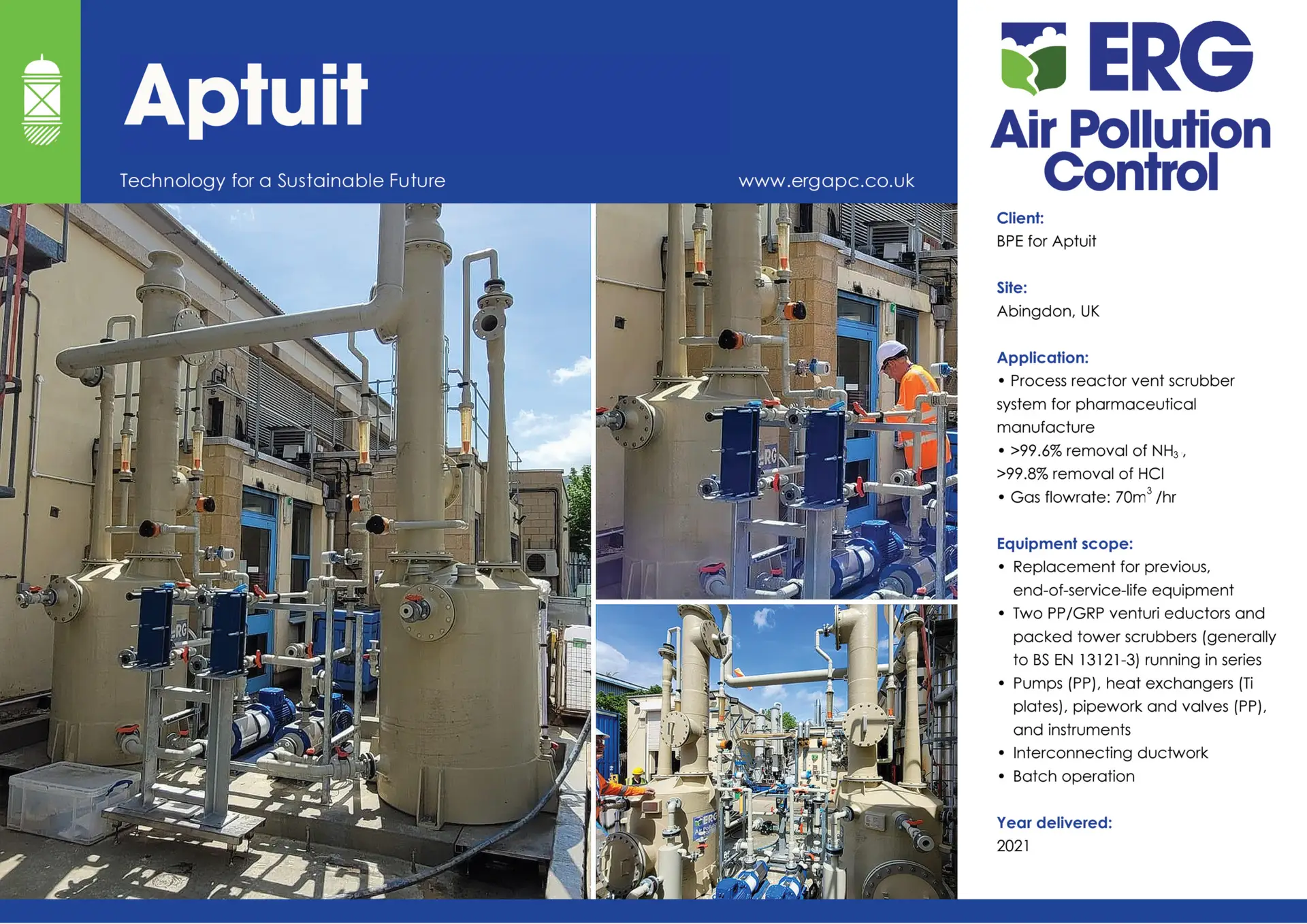
Pharmaceutical Reactor Vent Scrubbing for Ammonia and Hydrogen Chloride Removal
Project Overview
ERG Air Pollution Control supplied a replacement process reactor vent scrubbing system for BPE, working on behalf of Aptuit at its pharmaceutical manufacturing facility in Abingdon, UK.
Delivered in 2021, the project replaced gas treatment equipment that had reached the end of its service life. The replacement package combined Venturi eductors and packed tower scrubbers operating in series, with associated pumps, heat exchangers, pipework, valves, instrumentation and interconnecting ductwork.
The system served a batch manufacturing application with a stated gas flow rate of 70 m³/h. The project sheet lists removal performance figures of greater than 99.6% for ammonia (NH₃) and greater than 99.8% for hydrogen chloride (HCl).
The installation provides an example of ERG’s pharmaceutical gas scrubbing capability, combining treatment of acidic and alkaline gases with specialist materials and replacement equipment engineering.
The Challenge – Replacing Pharmaceutical Reactor Vent Treatment Equipment
Pharmaceutical reactor vents can carry gases released during processing, with the composition and release pattern depending on the manufacturing operation. Treatment equipment must therefore be selected around the substances present and the conditions under which they enter the system.
At Aptuit, the documented treatment duty involved ammonia and hydrogen chloride. These contaminants have different chemical characteristics: ammonia is alkaline, while hydrogen chloride forms hydrochloric acid when dissolved in water. Scrubbing arrangements must account for those characteristics when selecting treatment liquids, materials and operating conditions.
The existing equipment had reached the end of its service life, creating a requirement for a replacement reactor vent scrubber system. The new equipment also needed to serve batch operation.
In general, batch processes require consideration of changes in gas loading over a production cycle. This makes the relationship between gas contact, liquid circulation and process monitoring particularly relevant when engineering reactor vent treatment.
ERG’s Solution – Venturi Eductors and Packed Tower Scrubbers
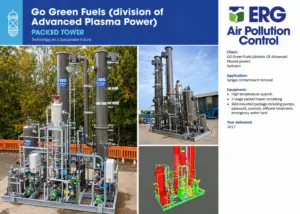
ERG supplied two PP/GRP Venturi eductors and packed tower scrubbers operating in series.
Venturi eductors use a flowing liquid to entrain gas and bring it into contact with the treatment liquid. Packed tower scrubbers provide a further gas–liquid contacting environment, using packing to create a wetted surface for contaminant absorption.
Combining these technologies provides complementary forms of gas–liquid contact. The series arrangement allows the gas to pass through successive treatment equipment rather than dividing the flow between parallel units.
For ammonia and hydrogen chloride scrubbing, treatment depends on transferring the contaminants into the liquid and maintaining suitable chemical conditions. The appropriate reagents and operating settings must be selected for the individual application.
The Aptuit project sheet records the series configuration and target contaminants without identifying the reagent used in either stage. The treatment approach can therefore be explained without assigning an unsupported chemical dosing arrangement.
Chemical-Resistant Construction and Material Selection
The principal gas-contacting equipment was specified in polypropylene and glass-reinforced plastic, abbreviated to PP/GRP.
These materials are widely used in chemical treatment equipment. Polypropylene can provide chemical resistance, while GRP can provide structural reinforcement, depending on the construction arrangement. Their suitability must be assessed against the actual chemicals, concentrations and temperatures involved.
The package also incorporated polypropylene pumps, pipework and valves, together with heat exchangers using titanium plates.
Material compatibility extends beyond the scrubber vessels. Pumps, valves, connections and heat-transfer surfaces may all contact process liquids, so their selection forms part of the overall equipment design.
The project sheet describes the Venturi eductors and packed tower scrubbers as generally to BS EN 13121-3. This qualified description is retained without presenting it as an independently verified certification claim.
Integrated Equipment and Batch Operation
ERG’s scope extended beyond the main scrubber equipment to include pumps, heat exchangers, pipework, valves, instruments and interconnecting ductwork.
In a chemical scrubbing package, pumps support liquid movement through the treatment equipment. Heat exchangers provide a means of transferring heat between fluids, while instrumentation supports observation and control of relevant process conditions. Their precise duties depend on the system design.
Interconnecting ductwork links the gas treatment equipment, making the connections between components part of the supplied package.
The documented batch operating mode is an important feature of the application. Equipment for reactor vent treatment must be considered in relation to the production cycle, rather than assuming a constant gas composition or loading throughout operation.
Project Technical Specifications
| Parameter | Project details |
|---|---|
| Client | BPE for Aptuit |
| End user | Aptuit |
| Site | Abingdon, UK |
| Industry | Pharmaceutical manufacturing |
| Application | Process reactor vent scrubbing |
| Project type | Replacement of end-of-service-life equipment |
| Technology | Venturi eductors and packed tower scrubbers |
| Configuration | Operating in series |
| Gas flow rate | 70 m³/h |
| Stated ammonia removal | Greater than 99.6% |
| Stated hydrogen chloride removal | Greater than 99.8% |
| Main equipment construction | PP/GRP |
| Pumps | Polypropylene |
| Heat exchangers | Titanium plates |
| Pipework and valves | Polypropylene |
| Additional scope | Instruments and interconnecting ductwork |
| Standard reference | Generally to BS EN 13121-3 |
| Operating mode | Batch |
| Year delivered | 2021 |
Engineering Benefits
The Aptuit installation brings together several aspects of ERG’s reactor vent treatment capability:
- Treatment of acidic and alkaline contaminants: The documented duty covered both hydrogen chloride and ammonia.
- Successive gas treatment: Venturi eductors and packed tower scrubbers operated in series.
- Specialist material selection: PP/GRP equipment was combined with polypropylene liquid-handling components and titanium heat exchanger plates.
- Integrated equipment supply: The scope included the main treatment equipment and associated mechanical components, instrumentation and ductwork.
- Replacement system provision: The package addressed equipment that had reached the end of its service life.
The listed removal figures describe the source-stated performance; they are not presented as independently verified operating measurements.
ERG’s Expertise in Pharmaceutical Gas Scrubbing
The Aptuit project demonstrates ERG’s experience supplying replacement chemical gas treatment equipment for pharmaceutical reactor vents.
Our capabilities include Venturi eductors, packed tower scrubbers and specialist equipment packages engineered around the contaminants, gas flow and operating conditions of each application. Replacement projects also benefit from considering the main treatment equipment alongside its associated liquid-handling components and gas connections.
For further information about pharmaceutical gas scrubbing, ammonia removal, hydrogen chloride treatment or replacement reactor vent scrubbers, contact ERG Air Pollution Control.