Jacobs for GSK
Mobile Venturi Scrubbing for HCl and Pharmaceutical Particulate Removal in Cork
Project Overview
ERG Air Pollution Control supplied a specialist mobile Venturi scrubbing system for Jacobs, for a GSK pharmaceutical application in Cork, Ireland.
Delivered in 2017, the project involved a skid-mounted scrubbing package designed for local exhaust ventilation (LEV) and reactor vent gas treatment.
The system was specified for the removal of hydrogen chloride (HCl) and active pharmaceutical ingredient (API) particulates from process emissions.
ERG’s equipment package incorporated a Venturi eductor, V-tex
®
scrubber and subcooler, together with associated pumps, pipework and a heat exchanger.
The original project case study identifies Hastelloy C22 construction, reflecting the demanding materials requirements of the application.
The equipment was also specified to ASME VIII Division 1, with PED Category IV requirements and ATEX hazardous area classifications.
The project demonstrates ERG’s experience in supplying compact, engineered wet scrubbing systems for pharmaceutical manufacturing environments where corrosive gases and process particulates require treatment.
The Challenge – Treating HCl and API Particulates
Pharmaceutical manufacturing processes can generate complex gas streams containing both gaseous contaminants and suspended particulate matter.
Reactor vent systems may require treatment of acidic gases, while local exhaust ventilation arrangements can be used to capture airborne contaminants generated during manufacturing operations.
For the GSK application in Cork, the documented treatment requirement involved hydrogen chloride and API particulate removal.
Hydrogen chloride is a corrosive, highly water-soluble gas that can be treated using suitable wet scrubbing technology.
API particulates present a different treatment challenge because they are solid particles rather than gaseous contaminants.
The combination of these pollutants requires consideration of gas-liquid contact, particle capture, chemical compatibility and the operating characteristics of the extraction system.
The original case study does not provide the gas flow rate, inlet concentrations or specified removal efficiencies.
ERG’s Solution – Skid-Mounted Venturi and V-tex®
Scrubbing
ERG supplied a skid-mounted package incorporating a Venturi eductor, V-tex
®
scrubber and subcooler.
Venturi scrubbing uses gas acceleration and contact with scrubbing liquid to promote contaminant capture.
This technology is particularly relevant to applications involving particulate matter, where gas-liquid interaction can assist in transferring particles from the gas stream into the scrubbing liquid.
The V-tex
®
scrubber provides an additional wet treatment stage within the documented equipment arrangement.
The combined system was specified for the HCl and API particulate removal duty identified in the original project literature.
The skid-mounted configuration brings the principal treatment equipment together on a common support structure, providing a compact package for integration with process ventilation or reactor vent systems.
The case study identifies the scrubber as mobile, although the precise arrangements for relocation and connection are not detailed.
Hastelloy C22 Construction
A significant feature of the project was the use of Hastelloy C22.
Hastelloy C22 is a nickel-based alloy used in demanding chemical processing applications where resistance to corrosion is an important consideration.
The presence of hydrogen chloride in the process gas stream makes material selection particularly relevant.
Equipment exposed to aggressive chemical conditions must be designed with consideration of process temperature, concentration, moisture and other operating factors.
The original case study identifies Hastelloy C22 construction but does not provide a detailed material schedule for each component.
The use of this specialist alloy demonstrates the importance of corrosion-resistant construction in pharmaceutical gas treatment applications.
Subcooling and Supporting Equipment
The documented equipment package included a subcooler, pump, pipework and heat exchanger.
Gas cooling and temperature control can be important in wet scrubbing systems because operating temperature influences gas properties, absorption behaviour and equipment performance.
The heat exchanger and associated circulation equipment provide supporting functions within the wider scrubbing arrangement.
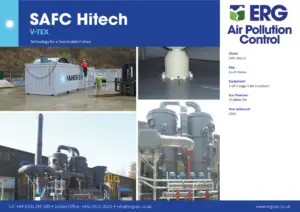
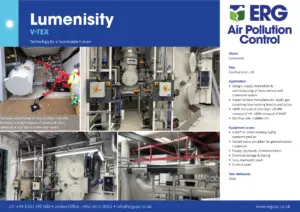
The original project photographs show the stainless-steel-alloy vessel assembly, flanged connections, pumps, pipework and heat exchanger equipment mounted within the skid structure.
These images illustrate the mechanical integration required to produce a compact industrial gas treatment package.
The original case sheet does not specify the cooling duty, heat exchanger capacity or circulation flow rates.
Pressure Vessel and Hazardous Area Requirements
The original project documentation identifies several engineering classifications.
The equipment was specified to ASME VIII Division 1, a recognised pressure vessel design code.
The case sheet also records PED Category IV requirements, with an equipment classification of fluid group 1.
An ATEX classification of Zone 0 inside and Zone 1 outside is identified.
These requirements are relevant to equipment intended for demanding process environments where pressure containment and potentially explosive atmospheres must be considered.
The original case study does not include the detailed conformity assessment documentation or certification records.
Project Specifications
| Parameter |
Project detail |
| Client |
Jacobs for GSK |
| Site |
Cork, Ireland |
| Industry |
Pharmaceutical manufacturing |
| Application |
LEV and reactor vent gas treatment |
| Target contaminants |
HCl and API particulates |
| Primary technology |
Venturi eductor and V-tex®
scrubber |
| Configuration |
Mobile, skid-mounted package |
| Additional treatment equipment |
Subcooler |
| Supporting equipment |
Pump, pipework and heat exchanger |
| Construction material |
Hastelloy C22 |
| Pressure vessel code |
ASME VIII Division 1 |
| PED classification |
Category IV, fluid group 1 |
| ATEX classification |
Zone 0 inside, Zone 1 outside |
| Year delivered |
2017 |
Mobile Wet Scrubbing for Pharmaceutical Manufacturing
Pharmaceutical manufacturing facilities may require specialist gas treatment systems to manage acidic emissions and airborne process particulates.
Where both gases and particles are present, the treatment arrangement must be selected according to the characteristics of the process stream.
Venturi scrubbers can provide effective particle capture under suitable operating conditions, while wet scrubbing technology can also be applied to the treatment of soluble acid gases.
Material selection, temperature control and pressure equipment requirements are important considerations in the overall design.
The Jacobs for GSK installation provides an example of a compact mobile scrubbing package incorporating multiple treatment and supporting components.
ERG’s Experience in Pharmaceutical Air Pollution Control
ERG Air Pollution Control designs and supplies engineered gas treatment systems for pharmaceutical, chemical and other industrial manufacturing applications.
Its technology portfolio includes Venturi scrubbers, V-tex
®
systems, packed tower scrubbers and specialist corrosion-resistant equipment.
The Jacobs for GSK project demonstrates ERG’s experience in supplying integrated scrubbing equipment for applications involving both corrosive gases and pharmaceutical particulates.
Delivered in 2017, the installation provides a reference for a mobile, skid-mounted Venturi and V-tex
®
scrubbing system incorporating Hastelloy C22 construction and specialist pressure equipment requirements.
For further information about pharmaceutical gas scrubbing, HCl treatment, Venturi scrubbers or mobile industrial air pollution control systems, contact ERG Air Pollution Control.