Janssen Pharmaceuticals
High-Efficiency HCl Scrubbing for Pharmaceutical Manufacturing in Cork
Project Overview
ERG Air Pollution Control supplied a specialist packed tower gas scrubbing system for Janssen Pharmaceuticals at its Little Island facility in Cork, Ireland.
Delivered in 2019, the system was designed to treat hydrogen chloride (HCl) emissions arising from a batch pharmaceutical manufacturing process.
The application required 99.99% HCl removal efficiency, with the scrubbing system designed to handle a batch discharge of 115 kg of hydrogen chloride over a six-minute period.
ERG’s solution incorporated a spray quench/subcooler and packed tower scrubber, manufactured using corrosion-resistant materials suitable for the process conditions.
The equipment package also included ECTFE-lined magnetic drive pumps, PTFE-lined pipework and PFA-lined valves, with the scrubber vessel constructed from ECTFE-lined glass reinforced plastic (GRP).
The installation demonstrates ERG’s experience in supplying engineered acid gas scrubbing systems for demanding pharmaceutical manufacturing applications.
The Challenge – High-Concentration HCl Emissions from Batch Processing
Pharmaceutical manufacturing can involve chemical reactions and batch processes that generate concentrated acid gas emissions over relatively short periods.
Unlike continuous processes, batch discharges may create rapidly changing gas compositions and contaminant loads, requiring treatment systems designed around peak operating conditions.
At Janssen’s Little Island facility, the documented duty involved a discharge of 115 kg of HCl over six minutes.
This represents an average HCl discharge rate of approximately 1,150 kg/hr during the six-minute release period, illustrating the intensity of the treatment requirement.
The system was specified for 99.99% HCl removal efficiency.
Hydrogen chloride is highly soluble in water, making wet scrubbing an established treatment method. However, equipment must be appropriately designed to manage the gas loading, operating conditions and corrosive nature of the process.
The original case study does not specify the gas volumetric flow rate, inlet concentration or outlet emission concentration.
ERG’s Solution – Spray Quench and Packed Tower Scrubber
ERG supplied an integrated spray quench/subcooler and packed tower scrubbing arrangement.
The spray quench/subcooler provides an initial gas conditioning stage before the main packed tower treatment section.
Packed tower scrubbers use specially selected packing media to provide a large contact surface between contaminated gas and circulating scrubbing liquid.
As the gas passes through the packed section, hydrogen chloride can be absorbed into the liquid phase.
The performance of the system depends on factors including liquid circulation, gas-liquid contact, packing selection, temperature and operating conditions.
For the Janssen installation, the scrubbing system was specified to achieve 99.99% HCl removal efficiency.
This figure represents the documented design requirement rather than an independently verified operational result.
Corrosion-Resistant Equipment Construction
Material selection was an important feature of the Janssen project.
The scrubber vessel was manufactured from ECTFE-lined glass reinforced plastic (GRP), combining the structural properties of GRP with a chemically resistant internal lining.
ECTFE, or ethylene chlorotrifluoroethylene, is a fluoropolymer used in industrial applications requiring resistance to aggressive chemicals.
The associated equipment package incorporated ECTFE-lined magnetic drive pumps, PTFE-lined pipework and PFA-lined valves.
These materials are used in chemical processing applications where compatibility with corrosive fluids is a significant design consideration.
Magnetic drive pumps also provide a sealless pumping arrangement, avoiding the conventional rotating shaft seal found in many centrifugal pump designs.
Together, these equipment selections illustrate the emphasis placed on chemical compatibility and process containment.
Pressure Equipment and Hazardous Area Requirements
The original case study identifies the scrubber vessel as designed to BS EN 13121-3 and classified under the Pressure Equipment Directive (PED) as Category IV, Module G.
BS EN 13121-3 addresses the design and workmanship of above-ground GRP tanks and vessels.
The case study also records an ATEX hazardous area classification of Zone 1, IIB, T4, Category 2G.
These specifications demonstrate the engineering and regulatory considerations associated with the installation.
The original project documentation does not provide the detailed design calculations, conformity assessment records or certification documentation.
Equipment Supplied
ERG’s documented equipment package included:
Spray quench/subcooler and packed tower scrubber
ECTFE-lined GRP scrubber vessel
ECTFE-lined magnetic drive pumps
PTFE-lined pipework
PFA-lined valves
Vessel design to BS EN 13121-3
PED Category IV, Module G specification
ATEX Zone 1, IIB, T4, Category 2G specification
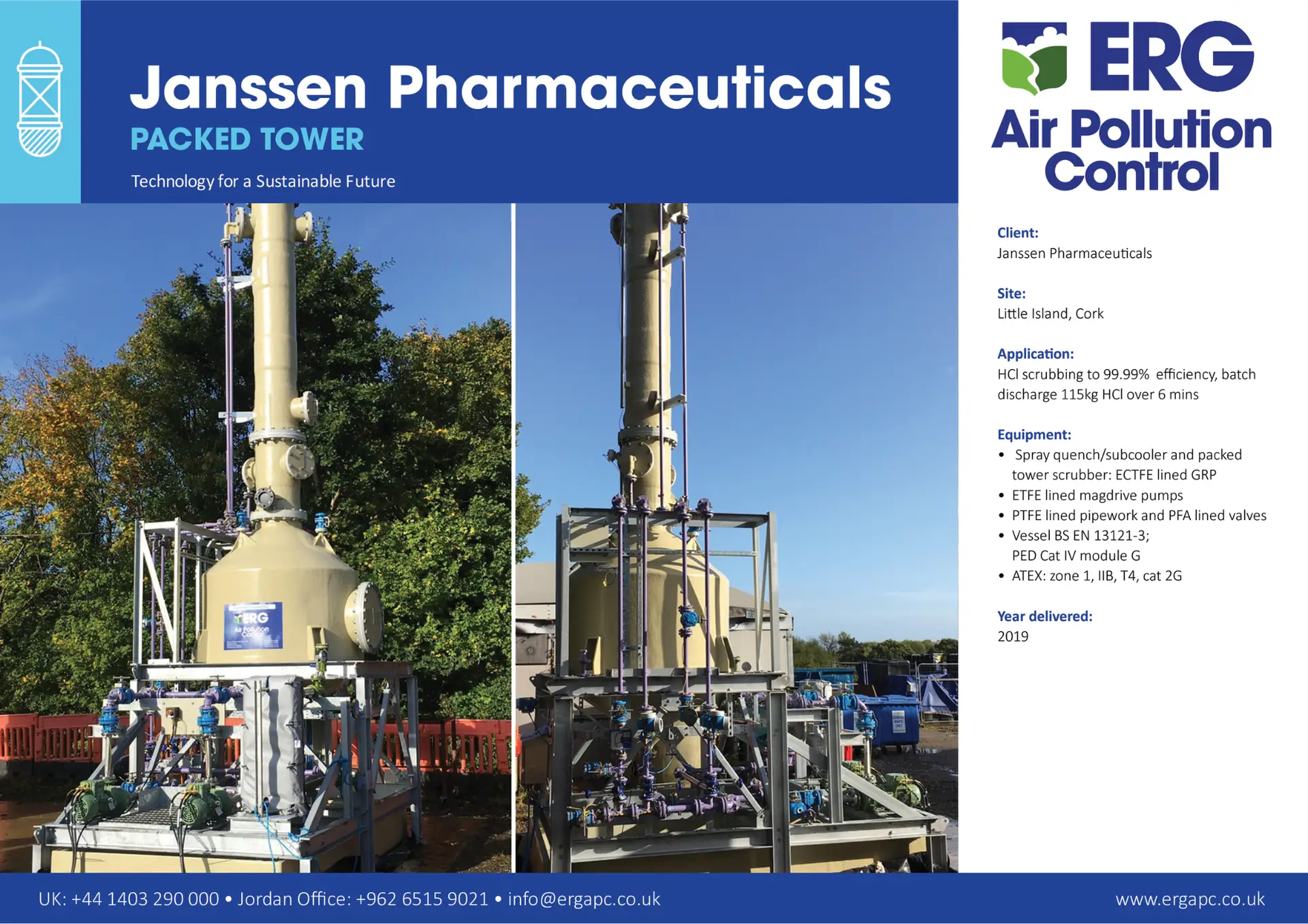
The project photographs show the vertical scrubber assembly, support steelwork, pumps, pipework and associated equipment arranged within a compact installation.
Project Specifications
| Parameter | Project detail |
|---|---|
| Client | Janssen Pharmaceuticals |
| Site | Little Island, Cork, Ireland |
| Industry | Pharmaceutical manufacturing |
| Application | Batch hydrogen chloride gas scrubbing |
| HCl batch discharge | 115 kg over six minutes |
| Specified HCl removal efficiency | 99.99% |
| Primary technology | Packed tower wet scrubber |
| Gas conditioning | Spray quench/subcooler |
| Scrubber construction | ECTFE-lined GRP |
| Pumps | ECTFE-lined magnetic drive |
| Pipework | PTFE-lined |
| Valves | PFA-lined |
| Vessel standard | BS EN 13121-3 |
| PED classification | Category IV, Module G |
| ATEX specification | Zone 1, IIB, T4, Category 2G |
| Year delivered | 2019 |
High-Efficiency Acid Gas Scrubbing for Pharmaceutical Applications
Pharmaceutical manufacturers may require specialist gas treatment systems to manage hydrogen chloride and other acidic emissions generated during chemical processing.
Batch processes can present particular challenges because contaminant loading may vary significantly over a short operating period.
Wet scrubbing systems must therefore be designed with consideration of the expected gas loading, scrubbing chemistry, temperature and required removal performance.
Corrosion-resistant materials are also important where equipment is exposed to aggressive process conditions.
The Janssen installation provides an example of a packed tower scrubber specified for high-efficiency HCl removal in a batch pharmaceutical manufacturing application.
ERG’s Experience in Pharmaceutical Gas Scrubbing
ERG Air Pollution Control designs and supplies engineered wet scrubbing systems for pharmaceutical, chemical and other industrial manufacturing applications.
Its technology portfolio includes packed tower scrubbers, Venturi scrubbers, quench systems and specialist corrosion-resistant gas treatment equipment.
The Janssen Pharmaceuticals project demonstrates ERG’s experience in designing scrubbing packages for demanding batch process applications, combining high removal efficiency requirements with specialist materials and hazardous area considerations.
Delivered in 2019, the installation provides a reference for a pharmaceutical HCl scrubbing system designed for a 115 kg batch discharge over six minutes, with a specified 99.99% removal efficiency.
For further information about pharmaceutical acid gas treatment, HCl scrubbers or corrosion-resistant packed tower scrubbing systems, contact ERG Air Pollution Control.