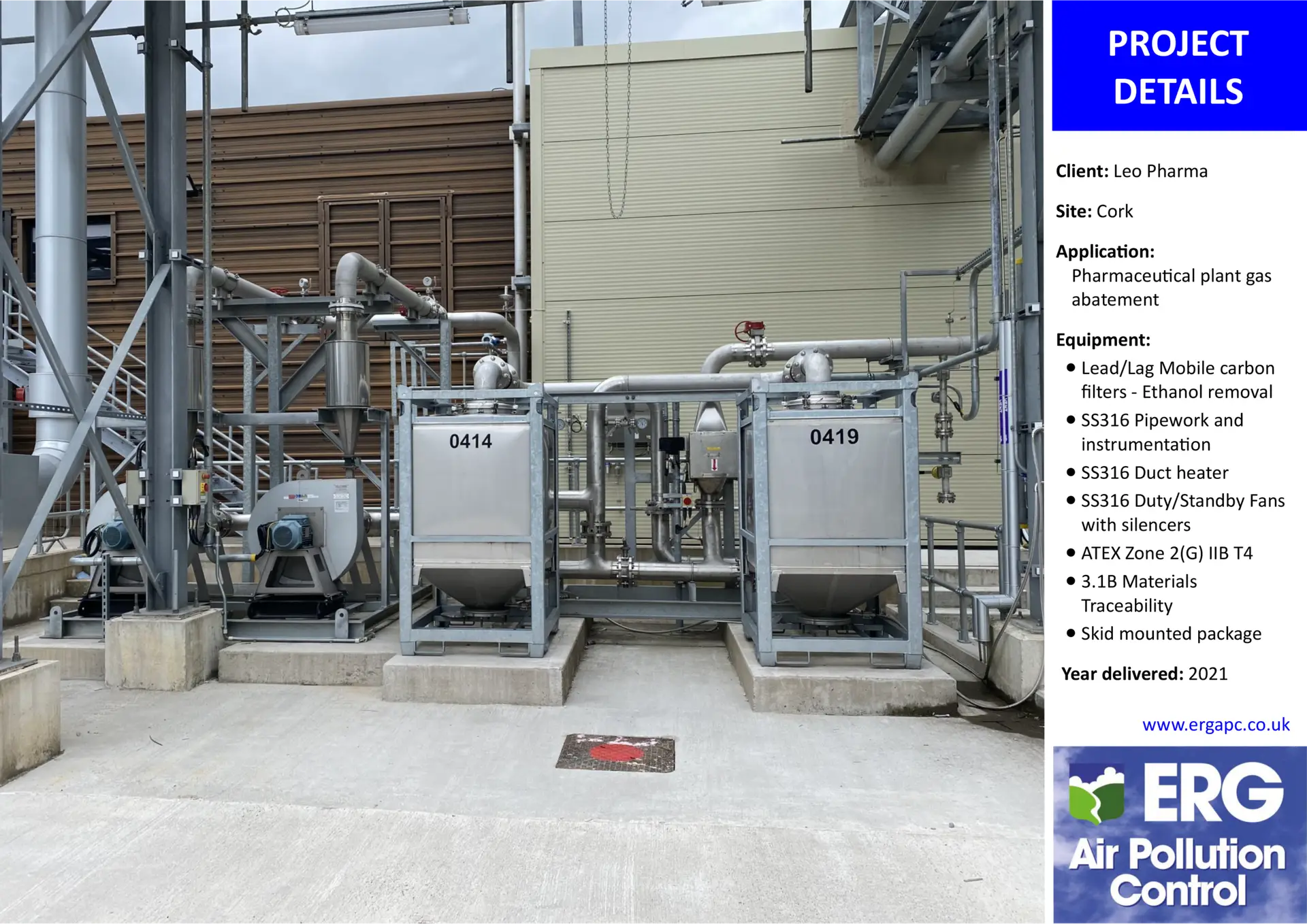
Leo Pharma – Ethanol Vapour Abatement System
Lead/Lag Activated Carbon Filtration for Pharmaceutical Manufacturing – Cork, Ireland
Project Overview
ERG Air Pollution Control supplied an integrated ethanol vapour abatement system for Leo Pharma at its pharmaceutical manufacturing facility in Cork, Ireland.
Delivered in 2021, the project involved a skid-mounted activated carbon filtration package designed to treat ethanol-containing process gases generated during pharmaceutical manufacturing operations.
The system incorporated two mobile carbon filtration units arranged in a lead/lag configuration, together with stainless steel pipework, instrumentation, a duct heater and duty/standby extraction fans fitted with silencers.
The equipment specification included ATEX Zone 2(G) IIB T4 requirements and 3.1B materials traceability, reflecting the importance of equipment selection, safety and quality assurance in pharmaceutical manufacturing environments.
The installation demonstrates ERG’s capability to integrate solvent vapour treatment equipment with supporting gas handling, temperature management and control infrastructure.
The Challenge
Pharmaceutical manufacturing frequently involves the use of organic solvents in production, cleaning and other process operations.
Ethanol is widely used within the industry and can generate volatile organic compound (VOC) emissions when released into process ventilation systems.
At Leo Pharma’s Cork facility, the requirement was to provide a dedicated gas abatement package for ethanol vapour treatment.
The equipment needed to incorporate activated carbon filtration while meeting the specified requirements for materials, instrumentation and hazardous-area equipment.
Where flammable solvent vapours may be present, the selection of electrical and mechanical equipment must consider the relevant hazardous-area classification and operating conditions.
The project specification identified ATEX Zone 2(G) IIB T4, requiring suitable equipment selection for the designated gas atmosphere.
The system also needed to provide a practical arrangement for carbon filtration, with appropriate process connections, gas handling equipment and provision for continued operation through duty/standby fan arrangements.
ERG’s Solution
ERG supplied an integrated activated carbon filtration system incorporating two mobile carbon filter units in a lead/lag arrangement.
Activated carbon adsorption is an established technology for removing suitable organic vapours from industrial gas streams. As contaminated air passes through the carbon bed, organic molecules are retained on the extensive internal surface area of the activated carbon.
In a lead/lag arrangement, two carbon filtration vessels are connected in series.
The lead vessel provides the primary adsorption stage, while the lag vessel provides a secondary treatment stage. This configuration can offer additional protection against contaminant breakthrough as the carbon in the lead vessel approaches its working adsorption capacity.
For the Leo Pharma project, the mobile carbon filtration units were integrated with stainless steel pipework and associated instrumentation.
The package incorporated a stainless steel duct heater, providing a means of managing gas temperature as part of the overall treatment arrangement.
ERG also supplied stainless steel duty/standby fans with silencers. The duty/standby configuration provides an alternative fan for use when the primary fan is unavailable, subject to the system’s operating and changeover arrangements.
The fans and associated ductwork form part of the gas handling system, moving the process air through the filtration equipment.
The installation was configured as a skid-mounted package, bringing together the principal treatment equipment and supporting components in a coordinated arrangement.
The project also incorporated the specified ATEX hazardous-area requirements and 3.1B materials traceability.
The completed installation provides an example of an engineered solvent vapour treatment package combining activated carbon adsorption with the associated mechanical, electrical and process infrastructure.
Technical Highlights
| Parameter | Project specification |
|---|---|
| Client | Leo Pharma |
| Location | Cork, Ireland |
| Industry | Pharmaceutical manufacturing |
| Application | Pharmaceutical plant gas abatement |
| Target contaminant | Ethanol vapour |
| Contaminant classification | Volatile organic compound (VOC) |
| Treatment technology | Activated carbon adsorption |
| Filter configuration | Lead/lag |
| Filtration equipment | Mobile activated carbon filters |
| Pipework | 316 stainless steel |
| Instrumentation | Process instrumentation |
| Temperature management | 316 stainless steel duct heater |
| Gas handling | 316 stainless steel duty/standby fans |
| Noise control | Fan silencers |
| Hazardous-area specification | ATEX Zone 2(G) IIB T4 |
| Materials traceability | 3.1B |
| Package configuration | Skid-mounted |
| Year delivered | 2021 |
Engineering Benefits
Ethanol vapour treatment: The system incorporates activated carbon adsorption for the removal of ethanol vapour from pharmaceutical process gases.
Lead/lag filtration: Two carbon vessels operating in series provide primary and secondary adsorption stages, supporting the management of contaminant breakthrough.
Mobile carbon units: The use of mobile filtration vessels provides a practical arrangement for carbon replacement and maintenance.
316 stainless steel construction: The specified pipework, duct heater and fans provide a material solution appropriate to the project’s engineering requirements.
Duty/standby fans: The inclusion of two fans provides operational redundancy within the gas handling arrangement.
Integrated noise control: Fan silencers help address noise generated by the extraction equipment.
Hazardous-area considerations: The ATEX Zone 2(G) IIB T4 specification reflects the requirements associated with equipment operating in designated potentially explosive gas atmospheres.
Materials traceability: The specified 3.1B documentation supports material identification and quality assurance requirements.
Skid-mounted package: The integrated arrangement brings together the principal treatment and supporting equipment within a coordinated installation.
Supporting Pharmaceutical VOC Emissions Control
Pharmaceutical manufacturers face a range of challenges when managing emissions from processes involving organic solvents.
Ethanol vapour is one example of a VOC that may require treatment before discharge, depending on the process conditions, emission concentrations and applicable environmental requirements.
Activated carbon filtration can provide an effective solution for suitable solvent vapour streams, with adsorption performance influenced by gas temperature, humidity, contaminant concentration, airflow and carbon characteristics.
Lead/lag carbon arrangements are particularly relevant where additional adsorption capacity and management of contaminant breakthrough are important operational considerations.
However, solvent vapour treatment requires more than the selection of an adsorption vessel.
The complete system must also consider gas handling, pressure losses, temperature, maintenance requirements, hazardous-area classification and the interface with existing process infrastructure.
The Leo Pharma project demonstrates this integrated approach through the combination of mobile carbon filtration, stainless steel pipework, duct heating, duty/standby fans and instrumentation.
The installation illustrates how specialist emissions control equipment can be incorporated into a pharmaceutical manufacturing environment with defined engineering and materials requirements.
ERG’s Expertise in Pharmaceutical Solvent Vapour Abatement
ERG Air Pollution Control designs, supplies and integrates industrial emissions treatment systems for pharmaceutical, chemical and specialist manufacturing applications.
Its capabilities include activated carbon filtration, wet scrubbing, thermal oxidation, solvent vapour treatment and associated gas handling systems.
The Leo Pharma installation demonstrates ERG’s experience in developing integrated VOC abatement packages that combine specialist treatment equipment with the mechanical and process infrastructure required for reliable operation.
The project also highlights ERG’s ability to work with specified hazardous-area requirements, stainless steel equipment and materials traceability within pharmaceutical manufacturing environments.
For manufacturers seeking to control ethanol emissions, upgrade solvent vapour treatment equipment or integrate activated carbon filtration into an existing facility, ERG can assess the process requirements and recommend suitable technologies.
For further information about ethanol vapour abatement, activated carbon filtration, pharmaceutical VOC treatment or industrial emissions control, contact ERG Air Pollution Control.