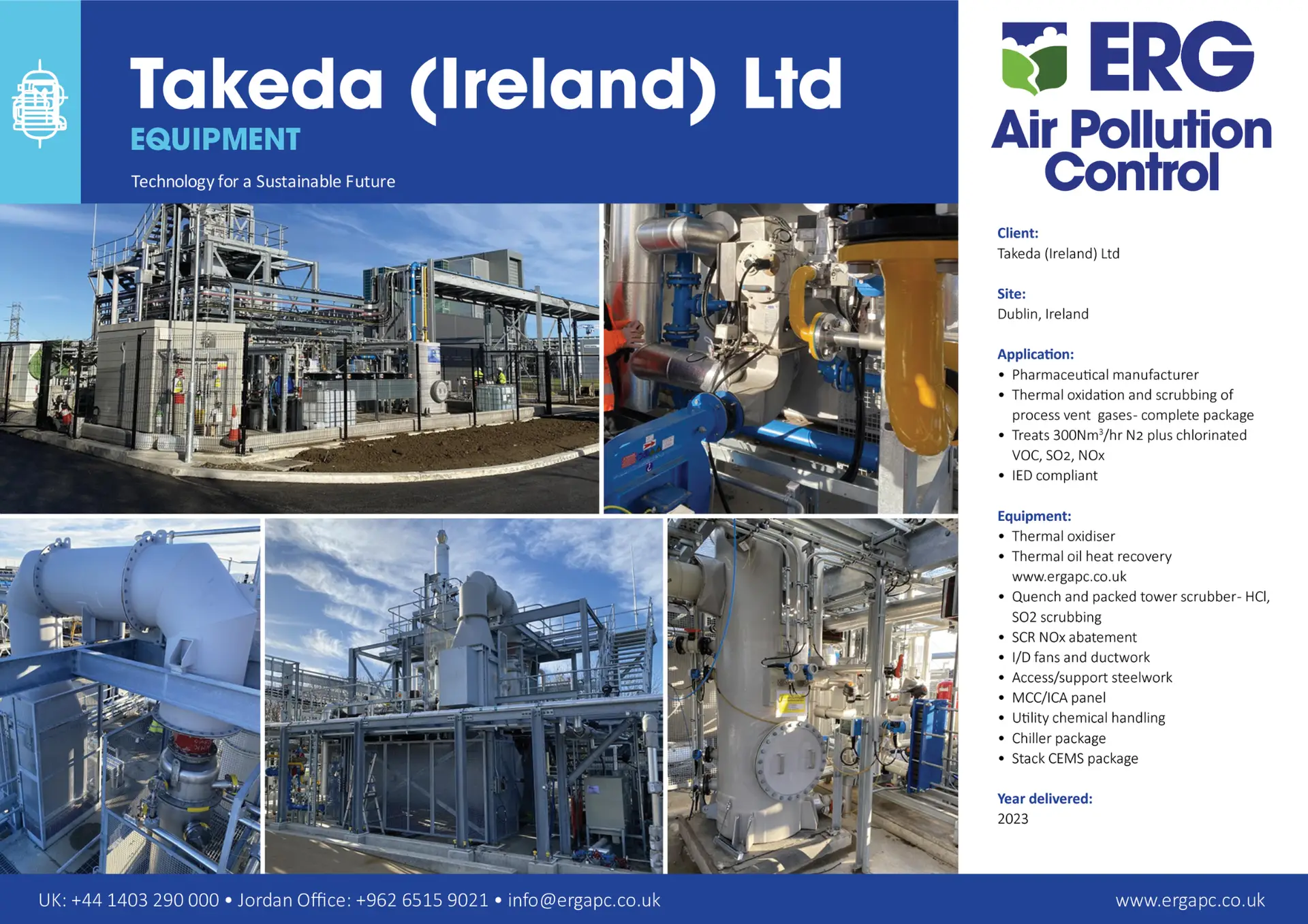
Takeda Ireland – Integrated Pharmaceutical Emissions Treatment System
Thermal Oxidation, Acid Gas Scrubbing and NOx Abatement – Dublin, Ireland
Project Overview
ERG Air Pollution Control supplied a comprehensive emissions treatment package for Takeda (Ireland) Ltd at its pharmaceutical manufacturing facility in Dublin.
Delivered in 2023, the project involved the treatment of a complex process vent stream containing chlorinated volatile organic compounds (VOCs), sulphur dioxide (SO₂) and nitrogen oxides (NOx), alongside a substantial nitrogen (N₂) component.
The system was designed to handle a gas flow rate of 300 Nm³/h and incorporated multiple treatment technologies within a single integrated package.
The treatment arrangement combined thermal oxidation, thermal oil heat recovery, quenching, packed tower acid gas scrubbing and selective catalytic reduction (SCR) for NOx abatement.
Supporting equipment included fans, ductwork, utility chemical handling systems, a chiller package, access steelwork, electrical and instrumentation controls, and a stack continuous emissions monitoring system (CEMS).
The project demonstrates ERG’s ability to provide a complete, multi-stage emissions control solution for demanding pharmaceutical manufacturing applications, designed to meet the requirements of the Industrial Emissions Directive (IED).
The Challenge
Pharmaceutical manufacturing can generate complex exhaust streams containing a combination of organic compounds, acidic contaminants and nitrogen oxides.
At Takeda’s Dublin facility, the process vent treatment requirement involved chlorinated VOCs, SO₂ and NOx, requiring an integrated approach to emissions abatement.
The presence of different contaminant groups presented a significant engineering challenge because no single treatment technology would adequately address the full range of pollutants.
Thermal oxidation provides a means of destroying organic compounds through high-temperature treatment. However, oxidation of chlorinated compounds can generate acidic combustion products, requiring downstream gas cleaning.
Similarly, nitrogen oxides require a dedicated abatement stage where the specified emissions limits cannot be achieved through the other treatment processes alone.
The treatment package therefore needed to combine several technologies in a coordinated process arrangement while managing gas temperatures, chemical handling, heat recovery and emissions monitoring.
The complete system also needed to satisfy the applicable IED compliance requirements for the pharmaceutical installation.
ERG’s Solution
ERG supplied an integrated emissions treatment system incorporating thermal oxidation, heat recovery, gas cooling, wet scrubbing and SCR technology.
The thermal oxidiser formed the principal treatment stage for the destruction of chlorinated VOCs within the pharmaceutical process vent stream.
Thermal oxidation uses elevated temperatures to break down organic contaminants, converting them into simpler combustion products.
The system incorporated thermal oil heat recovery equipment, allowing heat from the treatment process to be recovered through an integrated thermal oil circuit.
Following high-temperature treatment, the gas required conditioning before subsequent wet scrubbing.
A quench system provided rapid cooling of the process gas, preparing it for further treatment in the packed tower scrubber.
The packed tower scrubber was incorporated to treat acid gas contaminants, including hydrogen chloride (HCl) and sulphur dioxide (SO₂).
Within the packed tower, contaminated gas contacts circulating scrubbing liquid across a packed media bed, promoting the absorption and removal of soluble acidic compounds.
Selective catalytic reduction technology was also included to provide dedicated NOx abatement.
SCR uses a catalyst and a suitable reducing agent to convert nitrogen oxides into nitrogen and water under controlled operating conditions.
The overall package incorporated the necessary supporting equipment, including inlet and discharge fans, ductwork, utility chemical handling systems, a chiller package and electrical control equipment.
A motor control centre and instrumentation, control and automation (MCC/ICA) panel provided the central control infrastructure for the installation.
A stack continuous emissions monitoring system (CEMS) package was included to support emissions monitoring and demonstrate compliance with applicable environmental requirements.
The project illustrates how ERG integrates complementary abatement technologies into a complete treatment arrangement for complex industrial emissions.
Technical Highlights
| Parameter | Project specification |
|---|---|
| Client | Takeda (Ireland) Ltd |
| Site | Dublin, Ireland |
| Industry | Pharmaceutical manufacturing |
| Application | Thermal oxidation and scrubbing of process vent gases |
| Gas flow rate | 300 Nm³/h |
| Process stream | Nitrogen with chlorinated VOCs, SO₂ and NOx |
| Environmental requirement | IED compliant |
| Primary VOC treatment | Thermal oxidiser |
| Heat recovery | Thermal oil heat recovery system |
| Gas cooling | Quench system |
| Acid gas treatment | Packed tower scrubber for HCl and SO₂ |
| NOx treatment | Selective catalytic reduction (SCR) |
| Gas handling | Inlet/discharge fans and ductwork |
| Additional utilities | Chemical handling and chiller package |
| Electrical and controls | MCC/ICA panel |
| Emissions monitoring | Stack CEMS package |
| Structural scope | Access and support steelwork |
| Year delivered | 2023 |
Engineering Benefits
Integrated multi-pollutant treatment: The package combines technologies for treating chlorinated VOCs, acid gases and NOx within a coordinated emissions control system.
Thermal destruction of VOCs: The thermal oxidiser provides a dedicated high-temperature treatment stage for organic contaminants in the pharmaceutical process vent stream.
Energy recovery: The inclusion of thermal oil heat recovery provides an opportunity to recover useful heat from the thermal treatment process.
Acid gas removal: The quench and packed tower scrubber provide gas cooling and treatment of HCl and SO₂ generated or present within the process stream.
Dedicated NOx abatement: SCR technology provides a specialist treatment stage for nitrogen oxides.
Integrated process control: The MCC/ICA panel supports coordinated operation of the multiple treatment stages and associated utility equipment.
Continuous emissions monitoring: The stack CEMS package supports environmental performance monitoring and regulatory compliance.
Complete engineered package: ERG’s equipment scope extends beyond the principal abatement technologies to include fans, ductwork, chemical handling, chilling equipment and access structures.
Supporting Pharmaceutical Emissions Compliance
Pharmaceutical manufacturing facilities can face demanding environmental requirements where process emissions contain a combination of organic solvents, halogenated compounds, acid gases and nitrogen oxides.
Meeting these requirements often involves more than selecting an individual scrubber or oxidiser.
The interaction between treatment stages, gas temperatures, contaminant chemistry and supporting utilities must be considered when developing a complete emissions control solution.
The Takeda installation demonstrates the application of multiple complementary technologies within a single engineered treatment package.
By combining thermal oxidation with downstream gas conditioning and scrubbing, together with dedicated NOx treatment and emissions monitoring, ERG supplied an integrated solution for the site’s complex process vent requirements.
The project also illustrates the importance of incorporating heat recovery, process control and environmental monitoring into the overall treatment system.
ERG’s Expertise in Integrated Emissions Treatment
ERG Air Pollution Control specialises in the design and supply of industrial emissions treatment systems for pharmaceutical, chemical and other process manufacturing sectors.
Its capabilities include thermal oxidation, packed tower scrubbing, quench systems, acid gas removal, NOx abatement, heat recovery and integrated process control.
For applications involving multiple contaminant groups, ERG can develop treatment arrangements that combine different technologies to meet specific process and environmental requirements.
The Takeda project provides a reference for ERG’s ability to deliver a complete pharmaceutical emissions treatment package incorporating thermal oxidation, wet scrubbing, SCR technology and continuous emissions monitoring.
For further information about pharmaceutical emissions control, thermal oxidation, acid gas scrubbing or integrated industrial air pollution control systems, contact ERG Air Pollution Control.