Carbon Filtration for Odour Control with Dual-Speed Air Extraction
Project Overview
ERG Air Pollution Control supplied a carbon filtration and air extraction system for Greenstar Ltd., combining particulate pre-filtration, two types of carbon media and a dual-speed fan.
The system was designed for a gas flow rate of 45,000 m³/h and an inlet odour concentration of 4,000 ouE/m³. The project sheet distinguishes between a design outlet concentration below 300 ouE/m³ and a guaranteed outlet concentration below 500 ouE/m³.
A two-speed operating arrangement provided a lower night-time extraction rate, intended to minimise power consumption and running costs. The project also included separate guaranteed site boundary noise levels for daytime and night-time operation.
The recorded project value was £225,000. The original case sheet reports successful operation since 2005, providing a historical reference for the installation.
The Challenge – Balancing Odour Treatment, Extraction and Noise
An extracted-air odour control system must address several connected requirements. It needs to handle the specified airflow, treat the incoming odour and operate within the applicable acoustic criteria.
For Greenstar, the treatment design combined a substantial extraction rate with a defined inlet odour concentration. Carbon filtration was selected alongside particulate pre-treatment to address the air treatment requirement.
Odour concentration is expressed here in European odour units per cubic metre, ouE/m³. This describes the odour of the sampled mixture rather than the concentration of an individual chemical compound.
The project also required consideration of different operating periods. The source identifies lower night-time extraction as a means of reducing power consumption and running costs, while the guaranteed site boundary noise level was more stringent at night.
These requirements made the fan operating arrangement and the treatment equipment part of the same engineering task.
ERG’s Solution – Particulate Filtration and Carbon Treatment
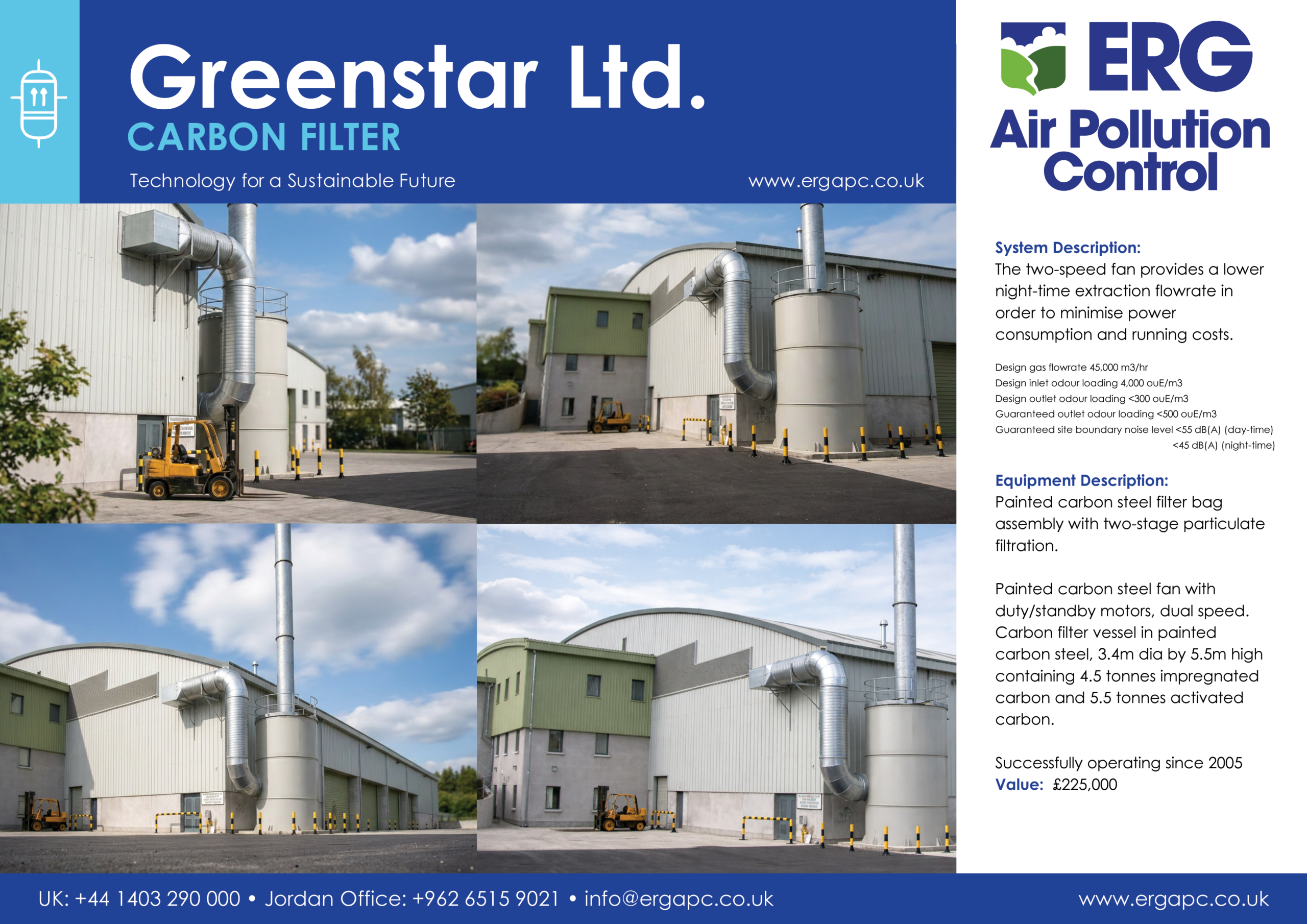
The supplied equipment combined a painted carbon steel filter bag assembly with two-stage particulate filtration, a dual-speed fan and a painted carbon steel carbon filter vessel.
The carbon vessel contained:
- 4.5 tonnes of impregnated carbon.
- 5.5 tonnes of activated carbon.
Together, these represented 10 tonnes of carbon media within a vessel measuring 3.4 m in diameter and 5.5 m high.
Particulate filtration and carbon treatment perform different functions. The upstream particulate stages address airborne solids, while the carbon media treat suitable gaseous odour compounds.
In comparable systems, removing particles before the carbon bed helps limit deposits that could obstruct gas passages or restrict access to the media surface. This supports the role of pre-filtration as part of the overall treatment arrangement.
How Carbon Odour Treatment Works
Activated carbon has an extensive internal pore structure that provides a large surface for adsorption. Suitable gas-phase compounds are retained on that surface as air passes through the media.
Impregnated carbon incorporates additional substances selected to improve treatment of particular contaminants, often through chemical reaction as well as adsorption. The appropriate impregnation depends on the compounds being treated.
Using both media types allows a treatment system to draw on complementary contaminant capture mechanisms. The Greenstar case sheet confirms the quantities of impregnated and activated carbon, without identifying the impregnation chemistry or target compounds.
Carbon performance depends on contaminant characteristics, loading, moisture, temperature and contact conditions. Media selection and vessel design must therefore be considered together rather than treating carbon as a universal solution for every odour.
Dual-Speed Extraction and Night-Time Operation
The fan was constructed from painted carbon steel and incorporated duty/standby motors with dual-speed operation.
The two-speed arrangement provided a lower night-time extraction flow rate. As described in the project sheet, this was intended to minimise power consumption and running costs.
Matching extraction to the required operating duty can avoid maintaining the maximum airflow when a lower rate is appropriate. The selected rate must still satisfy the facility’s extraction and treatment requirements.
The project separately specified guaranteed site boundary noise levels below 55 dB(A) during the day and below 45 dB(A) at night. These are boundary criteria, rather than sound levels measured immediately beside the fan.
For comparable installations, acoustic design must consider the fan, airflow through the system, equipment location and transmission paths to the site boundary.
Engineering and System Integration
The carbon vessel, fan and filter bag assembly were specified in painted carbon steel.
For this type of equipment, material and coating selection should account for the gas composition, moisture and exposure conditions. Internal protection and external weather resistance may present different requirements.
The vessel dimensions and media inventory also make access and maintenance important design considerations. Carbon replacement requires a practical method for removing spent media and introducing replacement material.
Air distribution is equally important. The gas should pass through the treatment media effectively, with the vessel and associated connections arranged to avoid bypassing or uneven use of the bed.
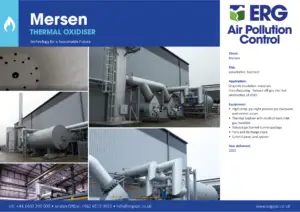
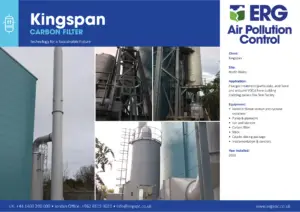
The installation photographs show the external vessel connected to building extraction ductwork and a vertical discharge stack, illustrating the relationship between the treatment equipment and the wider ventilation arrangement.
Project Technical Specifications
| Parameter | Project details |
|---|---|
| Client | Greenstar Ltd. |
| Application | Extracted-air odour control |
| Design gas flow rate | 45,000 m³/h |
| Design inlet odour concentration | 4,000 ouE/m³ |
| Design outlet odour concentration | Below 300 ouE/m³ |
| Guaranteed outlet odour concentration | Below 500 ouE/m³ |
| Guaranteed daytime site boundary noise | Below 55 dB(A) |
| Guaranteed night-time site boundary noise | Below 45 dB(A) |
| Particulate pre-treatment | Filter bag assembly with two-stage particulate filtration |
| Fan | Painted carbon steel; duty/standby motors; dual speed |
| Carbon vessel construction | Painted carbon steel |
| Carbon vessel dimensions | 3.4 m diameter × 5.5 m high |
| Impregnated carbon | 4.5 tonnes |
| Activated carbon | 5.5 tonnes |
| Night-time operation | Lower extraction flow rate |
| Historical operating reference | Reported successfully operating since 2005 |
| Project value | £225,000 |
Engineering Benefits
The Greenstar project demonstrates an approach that considered treatment, extraction and operation together:
- Complementary filtration duties: Particulate pre-treatment accompanied gas-phase carbon treatment.
- Combined media provision: The vessel contained both impregnated and activated carbon.
- Operating flexibility: Dual-speed extraction provided a lower night-time airflow.
- Defined performance requirements: Design and guaranteed outlet odour concentrations were recorded separately.
- Acoustic consideration: Different daytime and night-time boundary noise guarantees were specified.
These features describe the documented design and scope. They do not establish measured energy savings or independently verified emissions results.
ERG’s Expertise in Carbon Filtration and Odour Control
The Greenstar installation illustrates ERG’s experience combining carbon treatment with particulate filtration, fan selection and operating requirements.
Our odour control capabilities include carbon adsorption, wet scrubbing and biological treatment, with technology selection based on the air stream and required outcome. Inspection, maintenance and media replacement planning also support the ongoing management of installed equipment.
For further information about carbon odour filters, extracted-air treatment or upgrading an existing odour control system, contact ERG Air Pollution Control.