Carbon Filtration for Odour Control at Guernsey Waste Transfer Station
Project Overview
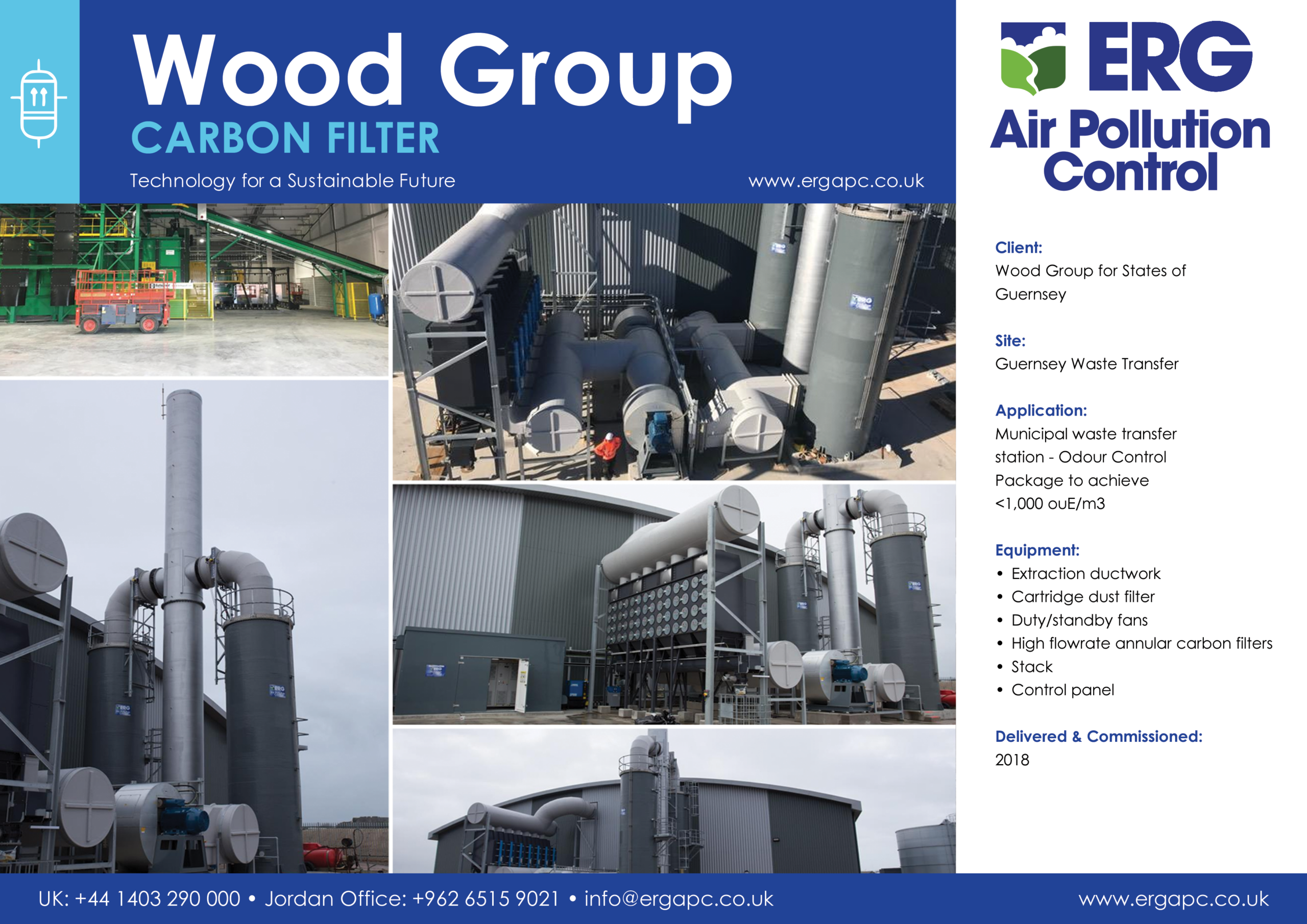
ERG Air Pollution Control delivered and commissioned an odour control package for Wood Group on behalf of the States of Guernsey. Completed in 2018, the system served the Guernsey municipal waste transfer station and was specified to achieve an odour concentration below 1,000 ouE/m³.
The package included extraction ductwork, a cartridge dust filter, duty and standby fans, high-flow annular carbon filters, a discharge stack and a control panel. The equipment addressed both airborne dust and gaseous odours, with the extraction and discharge equipment included in the same scope.
The Challenge – Managing Dust and Odour from Waste Handling
Waste transfer stations can generate dust and odorous air as waste is unloaded, moved and prepared for onward transport. The treatment duty depends on the waste handled and the activities taking place, while the extraction system determines how effectively air is collected and conveyed to the filters.
Dust and gaseous odours need different forms of treatment. A cartridge filter captures suspended particles on a physical filter surface. Carbon media adsorb suitable gas-phase compounds. Where both are present, removing dust before the carbon bed helps limit the amount of particulate matter reaching the media and the associated risk of increased airflow resistance.
The Guernsey project also had a defined odour target. European odour units per cubic metre, expressed as ouE/m³, describe the odour concentration of an air sample as a mixture. This gives the treatment package an overall odour criterion rather than a concentration limit for any individual compound.
ERG’s Solution – Cartridge Dust Filtration and Annular Carbon Filters
ERG included a cartridge dust filter and high-flow annular carbon filters in the equipment package. Cartridge filtration provides a large filtering surface within the unit. As dust collects on that surface, resistance can rise, so the extraction design needs to account for the filter’s condition during operation as well as when it is clean.
The carbon filters provided the gas-phase treatment. Carbon has an extensive internal pore structure, giving suitable odorous compounds a surface to adhere to as air passes through the media. The annular design arranges the media in a ring-shaped bed within the vessel. For a high-flow application, distributing the air across the available bed area helps make effective use of the media.
Carbon has a finite treatment capacity. The choice of media and the interval between changes depend on the compounds present, their concentrations and operating conditions such as humidity. For similar installations, those factors inform both the filter design and the space needed to inspect the vessel and replace media.
Engineering and System Integration – Fans, Ductwork and Controls
The extraction ductwork linked the air collection and treatment equipment. Fans provided the pressure needed to move air through the connected system, and a stack provided the discharge route. The fan duty must account for resistance across the full air path, including duct bends and transitions, the cartridge filter and the carbon media.
ERG supplied a duty and standby fan arrangement. This provides an installed alternative if the duty fan is unavailable. A control panel formed part of the package, bringing the controls into the same equipment scope as the fans and filters.
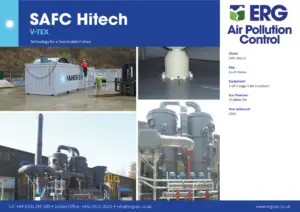
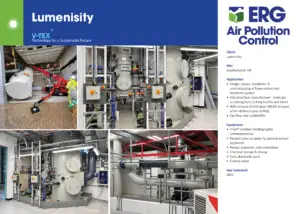
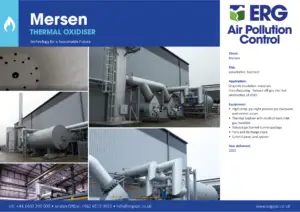
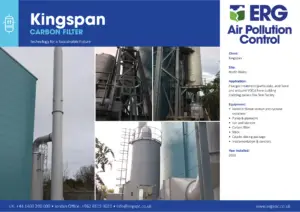
The project photographs show the cartridge filter housing and the vertical carbon vessels connected by large duct runs outside the transfer building. The layout illustrates why equipment positioning matters. Cartridge access, carbon media handling and fan servicing all need to be considered alongside the route of the ductwork and the location of the stack.
Project Technical Specifications
Parameter | Project details |
Client | Wood Group |
End user | States of Guernsey |
Site | Guernsey Waste Transfer |
Application | Municipal waste transfer station odour control |
Specified odour concentration | Below 1,000 ouE/m³ |
Particulate treatment | Cartridge dust filter |
Gas-phase treatment | High-flow annular carbon filters |
Extraction equipment | Ductwork and duty and standby fans |
Discharge equipment | Stack |
Controls | Control panel |
Delivered and commissioned | 2018 |
Engineering Benefits
- Separate treatment for dust and gaseous odour. The cartridge filter and carbon media addressed different constituents of the extracted air.
- Standby extraction provision. The fan arrangement provided an installed alternative to the duty fan.
- Delivery through commissioning. ERG delivered and commissioned the package covering extraction, filtration, controls and discharge.
ERG’s Expertise in Waste Transfer Station Odour Control
The Guernsey project demonstrates ERG’s experience integrating dust filtration and carbon adsorption into an extraction system for municipal waste handling. For comparable facilities, ERG can assess the air sources, dust burden and odour duty to select a filtration package that suits the site and gives operators practical access for servicing.
Contact ERG Air Pollution Control to discuss odour extraction, cartridge dust filtration or carbon treatment for a waste transfer station.