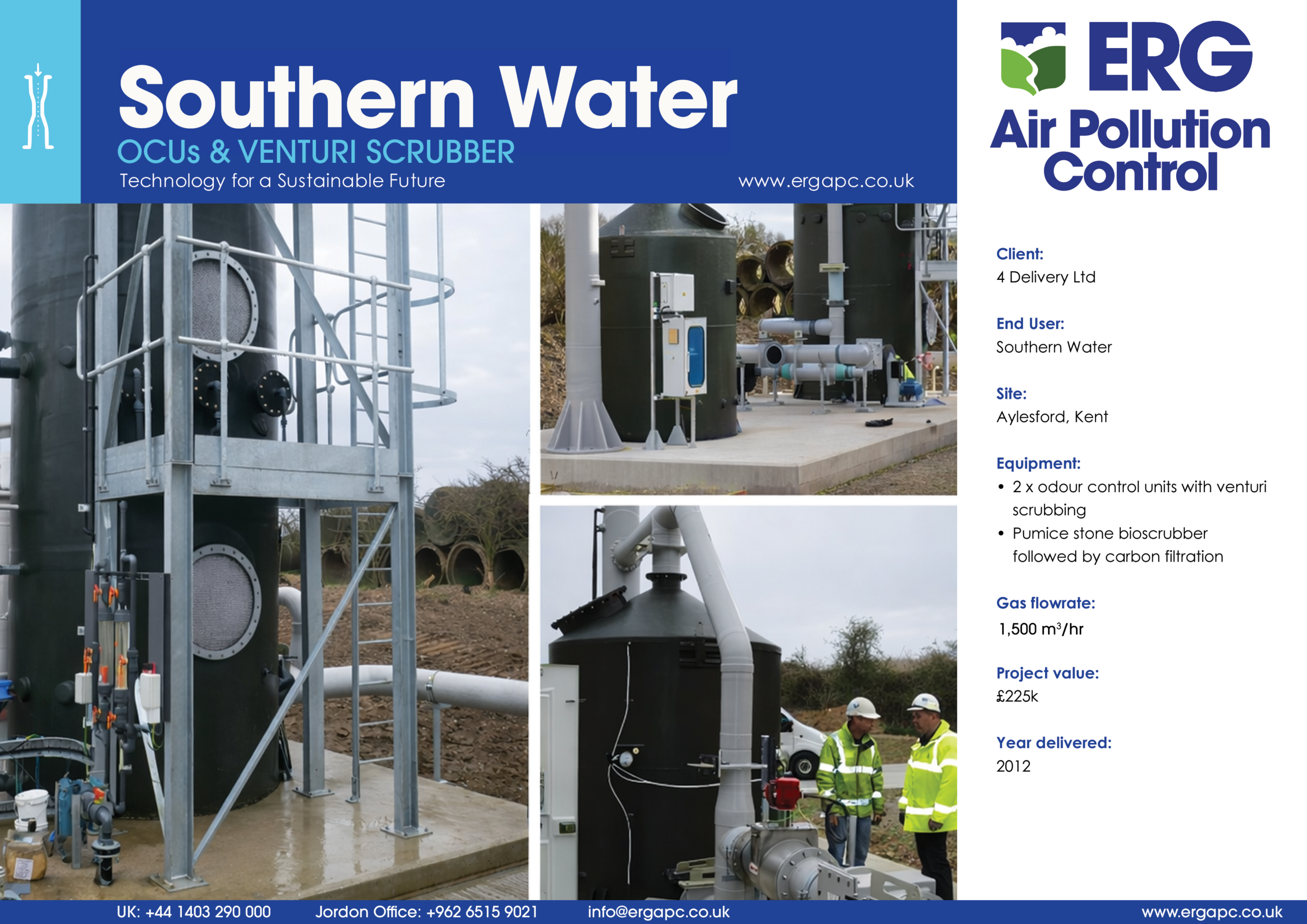
Venturi Scrubbing and Biological Odour Control at Aylesford, Kent
Project Overview
ERG Air Pollution Control supplied two odour control units (OCUs) with Venturi scrubbing for 4 Delivery Ltd, working on behalf of Southern Water at Aylesford, Kent. The £225,000 project was delivered in 2012. The case sheet records a gas flow rate of 1,500 m³/h.
The equipment included a pumice stone bioscrubber followed by carbon filtration. This sequence paired biological treatment with a downstream filter capable of capturing suitable odorous compounds that remained in the air. Venturi scrubbing provided a further means of bringing the extracted air into contact with a treatment liquid.
The Challenge – Matching Treatment to Odorous Air
An odour control unit needs to handle the extracted airflow while providing enough contact between the air and the treatment media. The appropriate design depends on which compounds are present, how readily they transfer into liquid, whether microorganisms can break them down and whether carbon can capture them.
The Aylesford project used three treatment mechanisms within the equipment scope. Venturi scrubbing created intensive contact between the gas and liquid. The bioscrubber provided a wetted surface for biological treatment, and the carbon filter treated the air leaving the bioscrubber. Each technology had a different role in the treatment package.
ERG’s Solution – Venturi Scrubbing, Pumice Media and Carbon Filtration
ERG supplied two odour control units with Venturi scrubbing. A Venturi scrubber accelerates air through a narrow section, where the moving gas disperses introduced liquid into droplets. This increases the surface area available for gas–liquid contact. The effectiveness of that contact depends on the airflow, liquid supply and properties of the compounds being treated.
The bioscrubber used pumice stone as its biological support medium. In this type of equipment, microorganisms grow on the wetted packing. Suitable compounds transfer from the air into the liquid film, where the microorganisms can break them down. The porous pumice provides a surface for that biological film to develop while allowing air and liquid to move through the bed.
Carbon filtration followed the pumice stone bioscrubber. Carbon captures suitable gas-phase compounds by adsorption, in which molecules adhere to the media’s internal surfaces. Using carbon after biological treatment provides a separate mechanism for dealing with compounds that remain in the air. The appropriate carbon grade and replacement interval depend on the composition and loading of that air.
Engineering and Equipment Integration
Combining wet scrubbing, biological treatment and carbon filtration requires attention to how air moves through the equipment. A Venturi throat, a biological media bed and a carbon filter each introduce resistance. In comparable systems, that resistance needs to be assessed across the full air path so the extraction equipment can maintain the required flow. Gas and liquid distribution also matter because uneven flow can leave parts of a treatment bed underused.
The two media types have different servicing requirements. Pumice supports a biological process, so its condition and wetting are relevant to routine operation. Carbon has a finite treatment capacity, making inspection and media replacement part of maintenance planning. Where the carbon follows a wet treatment stage, the moisture condition of the air is also relevant to media selection.
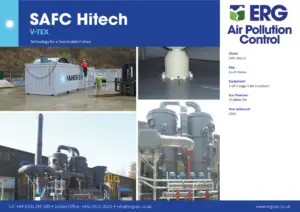
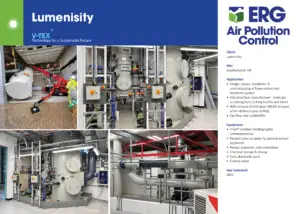
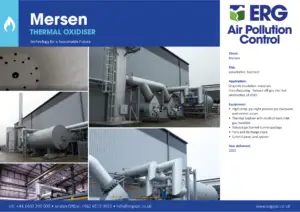
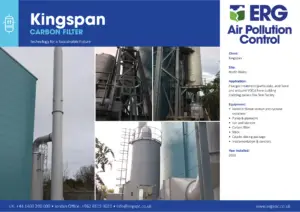
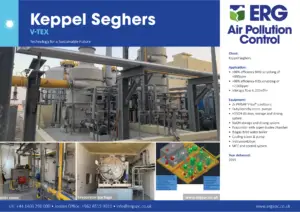
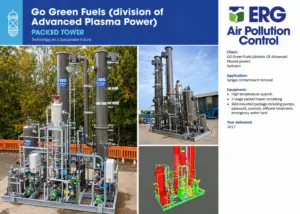
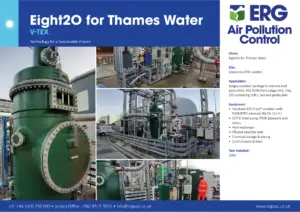
The Aylesford photographs show vertical treatment vessels with connected ductwork and a raised access platform beside one vessel. The platform illustrates a practical consideration for this type of installation: operators need a way to reach elevated inspection and service points as well as the equipment at ground level.
Project Technical Specifications
Parameter | Project details |
Client | 4 Delivery Ltd |
End user | Southern Water |
Site | Aylesford, Kent |
Application | Odour control |
Equipment supplied | Two odour control units with Venturi scrubbing |
Biological treatment | Pumice stone bioscrubber |
Downstream treatment | Carbon filtration following the bioscrubber |
Stated gas flow rate | 1,500 m³/h |
Project value | £225,000 |
Year delivered | 2012 |
Engineering Benefits
- Intensive gas–liquid contact. Venturi scrubbing provided a means of bringing the extracted air and treatment liquid into close contact.
- Biological treatment on pumice media. The stone packing provided a support surface for the microorganisms used in the bioscrubber.
- Downstream carbon treatment. The carbon filter gave the system a separate way to capture suitable odorous compounds after biological treatment.
ERG’s Expertise in Wastewater Odour Control
Aylesford is an example of ERG combining wet scrubbing, biological media and carbon filtration for a water utility. For similar applications, ERG can assess the extracted airflow and contaminant profile, then select treatment equipment and media suited to the duty and the site’s maintenance needs.
Contact ERG Air Pollution Control to discuss a new odour control unit or an upgrade to an existing extraction and treatment system.