Packaged Carbon and Biofilter Odour Control Units for Sewage Pumping Stations in Basra
Project Overview
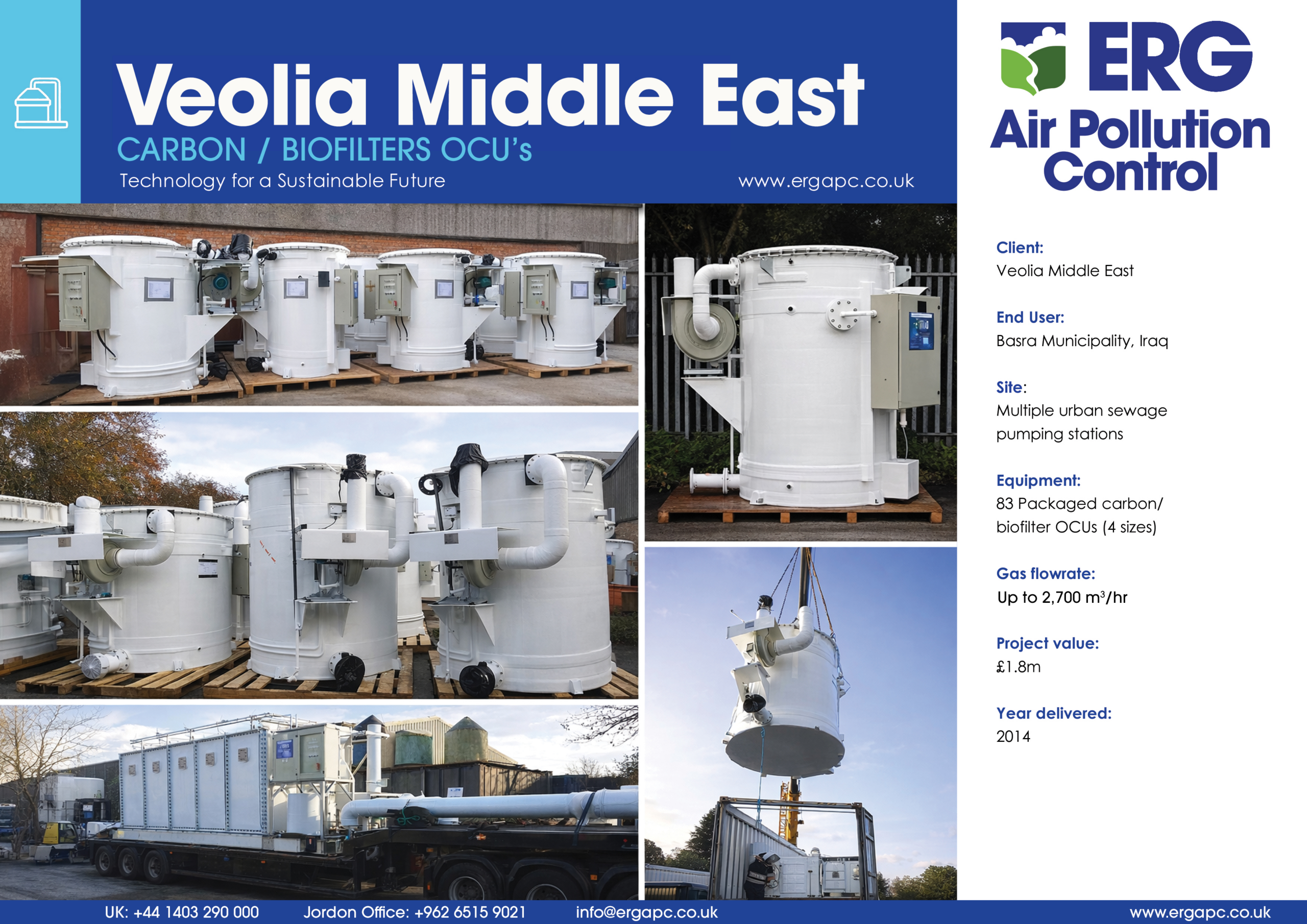
ERG Air Pollution Control supplied 83 packaged carbon/biofilter odour control units for Veolia Middle East, with Basra Municipality, Iraq, identified as the end user.
Delivered in 2014, the £1.8 million project served multiple urban sewage pumping stations. The equipment was supplied in four sizes, with the project sheet recording gas flow rates of up to 2,700 m³/h.
The scale of the supply distinguishes this project from a single-site installation. It required a range of packaged treatment equipment for deployment across a municipal pumping station network, rather than one central treatment plant.
The project demonstrates ERG’s experience supplying odour control units in quantity while providing different equipment sizes for varying treatment requirements.
The Challenge – Odour Treatment Across an Urban Pumping Station Network
Sewage pumping stations collect and transfer wastewater through a network. Odorous air can accumulate within enclosed spaces, creating a requirement for extraction and treatment.
Across multiple stations, the treatment duty may vary according to the volume of extracted air, sewage characteristics and operating conditions. A single equipment size may therefore be unsuitable for every location.
For the Basra Municipality project, the documented supply comprised 83 units in four sizes. This provided a range of equipment for the multiple urban pumping station application.
Network-wide projects also introduce practical considerations beyond the treatment process. Equipment must be transported, positioned and connected at separate locations, with suitable arrangements for operation and maintenance.
A packaged approach brings treatment equipment into a defined assembly, helping establish the interfaces between the supplied unit and the surrounding pumping station infrastructure.
ERG’s Solution – Packaged Carbon/Biofilter Odour Control Units
ERG supplied packaged carbon/biofilter odour control units, commonly abbreviated to OCUs.
The source identifies carbon and biofilter technologies within the equipment description. These use different treatment mechanisms: carbon captures suitable gas-phase contaminants at the media surface, while biological filtration uses microorganisms to break down suitable compounds.
The appropriate technology and media depend on the composition and loading of the extracted air. The equipment must also provide sufficient contact between the air and treatment media.
For this project, the units were supplied in four sizes, with stated gas flows reaching up to 2,700 m³/h. The source does not allocate individual flow rates or technologies to each size, so the equipment is described using the documented collective designation.
Carbon Filtration for Pumping Station Odours
Carbon treatment provides a means of capturing suitable odorous compounds as extracted air passes through a media bed.
Activated carbon has an extensive internal pore structure, creating a large surface for adsorption. Specialist carbon formulations can also support chemical reactions with selected contaminants.
Treatment performance depends on matching the media to the air stream. Contaminant identity, concentration, humidity and temperature can all influence capacity and service life.
For comparable pumping station applications, media selection should therefore follow an assessment of the actual treatment duty. Carbon is not equally effective for every compound, and its replacement requirements depend on the conditions under which it operates.
These principles explain the carbon treatment technology identified in the Basra project without assigning an unrecorded media formulation or service interval.
Biological Filtration for Odour Treatment
Biofilters use microorganisms supported within a media bed to treat biodegradable odorous compounds.
As air passes through the bed, suitable contaminants transfer into the moist environment surrounding the biological film. Microbial activity then converts those substances into other products.
Maintaining appropriate moisture, temperature and chemical conditions is important to the process. Air distribution also matters because uneven flow can prevent effective use of the available media.
Biological treatment differs from carbon adsorption in both its operating mechanism and maintenance requirements. A biofilter must support an active biological environment, while carbon management focuses on the media’s remaining treatment capacity and condition.
The project sheet identifies biofilters but does not specify the biological media or classify the units as bio-trickling filters. That distinction is retained in describing the installation.
Engineering and Design Considerations – Four Equipment Sizes
Providing four sizes allowed ERG’s supply to address a range of equipment duties within the municipal project.
For similar programmes, sizing must account for more than airflow alone. Media volume, contact conditions, pressure loss and contaminant loading all affect the treatment arrangement.
A range of packaged units can provide consistency in equipment form while allowing capacity to vary. This is relevant where separate pumping stations need individual treatment equipment rather than a shared central system.
The Basra project records the equipment quantity and size range, establishing a substantial supply programme. It does not provide the distribution of the 83 units between sizes or the duty assigned to each location.
Equipment Integration and Deployment
The project photographs show packaged vessels with attached fans, local electrical enclosures and connection points. Other images show equipment being lifted and prepared for transport.
These views illustrate practical aspects of supplying packaged OCUs: handling, transport and access to the assembled equipment must be considered alongside treatment design.
At the receiving site, relevant interfaces generally include the extracted-air connection, electrical supply, equipment support and maintenance access. The precise requirements depend on the unit configuration.
For operators, maintenance planning should consider access to the treatment media and serviceable mechanical components. Carbon replacement and biological media management require different procedures, making clear equipment identification and operating instructions important across a multi-site network.
Project Technical Specifications
| Parameter | Project details |
|---|---|
| Client | Veolia Middle East |
| End user | Basra Municipality, Iraq |
| Application | Odour control at urban sewage pumping stations |
| Site coverage | Multiple pumping stations |
| Equipment | Packaged carbon/biofilter odour control units |
| Quantity | 83 units |
| Equipment size range | Four sizes |
| Stated gas flow rate | Up to 2,700 m³/h |
| Project value | £1.8 million |
| Year delivered | 2014 |
Engineering Benefits
The documented project illustrates several aspects of ERG’s municipal odour control capability:
- Supply at network scale: The project comprised 83 packaged OCUs.
- Equipment size options: Four sizes were provided for the multiple-station application.
- Established treatment technologies: The equipment designation included carbon filtration and biological filtration.
- Packaged equipment provision: Treatment units were supplied as assemblies for deployment at separate locations.
- International project experience: The equipment served Basra Municipality through Veolia Middle East.
These are documented features of the supply, rather than claims of measured odour reduction, reduced maintenance costs or regulatory compliance.
ERG’s Expertise in Municipal Odour Control
The Veolia Middle East project demonstrates ERG’s experience supplying packaged odour treatment equipment for municipal sewage infrastructure.
Our capabilities include carbon adsorption, biological treatment and chemical scrubbing, with selection based on the contaminants, airflow and operating requirements of each application. For programmes covering multiple locations, equipment sizing and practical deployment requirements must be considered together.
For further information about packaged odour control units, sewage pumping station treatment or multi-site equipment supply, contact ERG Air Pollution Control.