Replacement Bio-Trickling Filter for Hydrogen Sulphide Odour Control at Camberley
Project Overview
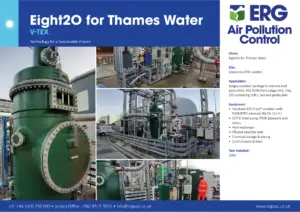
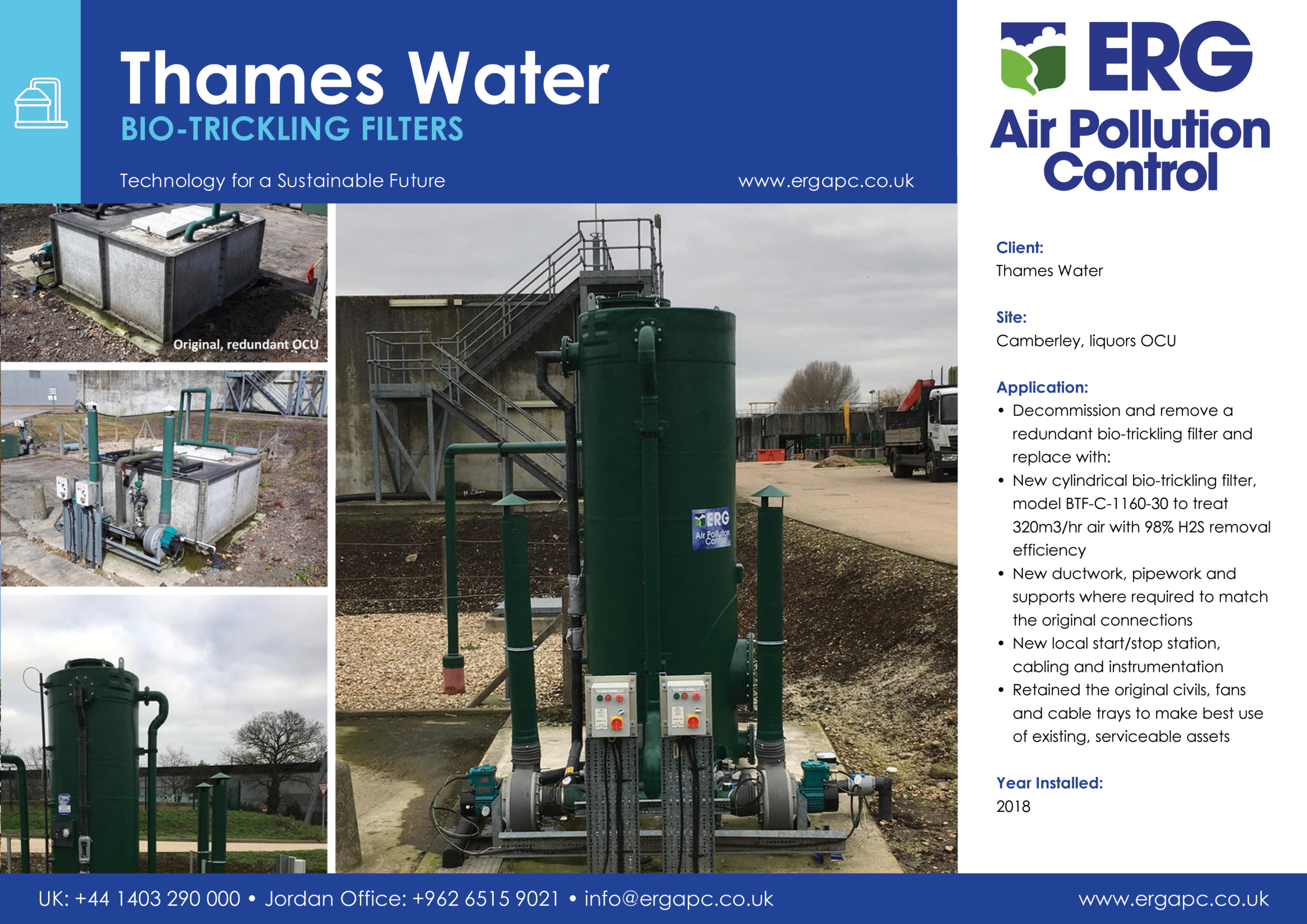
ERG Air Pollution Control replaced a redundant bio-trickling filter at Thames Water’s Camberley liquors odour control unit (OCU).
Installed in 2018, the replacement was a cylindrical bio-trickling filter, model BTF-C-1160-30, specified to treat 320 m³/h of air with 98% hydrogen sulphide (H₂S) removal efficiency.
The project extended beyond the treatment vessel. Its scope included decommissioning and removing the redundant filter, providing new ductwork and pipework connections where required, and incorporating new local controls, cabling and instrumentation.
A defining feature was the retention of existing serviceable infrastructure. The original civil works, fans and cable trays were retained, allowing the replacement treatment equipment to make use of assets already available at the site.
The Challenge – Replacing an Existing Odour Control Unit
Replacing odour treatment equipment at an established facility requires a different approach from designing an entirely new installation.
The replacement must address the treatment duty while fitting the physical and operational interfaces of the existing system. Air connections, supporting infrastructure, electrical services and equipment access all influence the engineering solution.
At Camberley, the documented requirement was to decommission and remove a redundant bio-trickling filter and replace it with a new unit for hydrogen sulphide treatment.
The project also sought to make best use of existing serviceable assets. This required distinguishing between equipment that needed replacement and infrastructure that could remain in use.
Rather than replacing the complete extraction and treatment arrangement, the scope combined a new biological treatment vessel and associated connections with retained fans, civil works and cable trays.
ERG’s Solution – A Cylindrical Bio-Trickling Filter
ERG provided a new cylindrical bio-trickling filter, model BTF-C-1160-30.
The specified treatment duty was 320 m³/h of air, with 98% H₂S removal efficiency. These figures define the recorded treatment requirement rather than independently verified operating results.
Bio-trickling filtration uses microorganisms supported on a wetted packing medium to treat suitable gaseous contaminants. As contaminated air passes through the bed, hydrogen sulphide transfers into the liquid film and is biologically oxidised.
This differs from a conventional chemical scrubber, where treatment primarily depends on absorption and reaction with a selected scrubbing reagent. In a bio-trickling filter, maintaining an appropriate biological environment is central to the process.
The Camberley replacement retained biological treatment as the core technology while introducing a new vessel and the connections needed to integrate it with the existing installation.
How Biological Hydrogen Sulphide Treatment Works
Hydrogen sulphide is a significant odorous compound in many wastewater-related air streams. Bio-trickling filters provide a treatment approach in which microorganisms use the contaminant within their metabolic processes.
The packing supports the biological film and provides contact area between the air and the wetted surface. Liquid distribution helps maintain the conditions required for treatment and carries dissolved substances through the system.
For comparable installations, important operating considerations include contaminant loading, airflow, liquid distribution, pH and nutrient availability. Biological oxidation can change the liquid chemistry, so water management and monitoring form part of the overall process design.
These principles explain the treatment technology selected for Camberley. They do not assign unrecorded operating settings, nutrient dosing arrangements or water consumption figures to the project.
Engineering and Design Considerations – Working with Existing Assets
The replacement project was shaped by its connections to the original installation.
New ductwork, pipework and supports were provided where required to match the existing connections. This addressed the transition between the new treatment equipment and the infrastructure remaining on site.
The existing fans were retained. In a replacement project, this makes the relationship between treatment airflow, equipment resistance and the available fan capability an important engineering consideration. The new vessel must be assessed as part of the gas handling system rather than as an isolated component.
Retaining the original civil works similarly places importance on equipment positioning, support arrangements and access. These considerations help determine how a replacement can be accommodated within an established layout.
At Camberley, the recorded approach combined targeted equipment renewal with continued use of serviceable infrastructure.
System Integration, Controls and Equipment Scope
The project included decommissioning and removal of the redundant bio-trickling filter before its replacement with the new cylindrical unit.
Associated works comprised:
- New ductwork, pipework and supports where required to match the original connections.
- A new local start/stop station.
- New cabling and instrumentation.
- Retention of the original civil works, fans and cable trays.
Local start/stop provision gives operators a control point at the equipment. Instrumentation provides information relevant to operation, although the source does not identify the individual measurements included.
The scope demonstrates that replacing an odour control unit involves mechanical, electrical and process interfaces alongside the treatment vessel itself.
Project Technical Specifications
| Parameter | Project details |
|---|---|
| Client | Thames Water |
| Site | Camberley, liquors OCU |
| Application | Replacement biological odour treatment |
| Target contaminant | Hydrogen sulphide (H₂S) |
| Technology | Bio-trickling filtration |
| Replacement vessel | Cylindrical bio-trickling filter |
| Model | BTF-C-1160-30 |
| Specified airflow | 320 m³/h |
| Specified H₂S removal efficiency | 98% |
| Removal scope | Decommission and remove redundant bio-trickling filter |
| Mechanical integration | New ductwork, pipework and supports where required |
| Electrical and control scope | New local start/stop station, cabling and instrumentation |
| Retained infrastructure | Original civil works, fans and cable trays |
| Year installed | 2018 |
Engineering Benefits
The Camberley project illustrates several practical benefits of a targeted replacement approach:
- Renewed treatment equipment: A new cylindrical bio-trickling filter replaced the redundant unit.
- Defined treatment duty: The replacement was specified for 320 m³/h of air and 98% H₂S removal.
- Use of serviceable assets: Existing fans, civil works and cable trays were retained.
- Adapted connections: New ductwork, pipework and supports connected the replacement to the original installation.
- Updated local controls: The scope included new start/stop provision, cabling and instrumentation.
These are documented features of the project. No quantified cost savings, downtime reductions or measured emissions outcomes are claimed.
ERG’s Expertise in Odour Control Replacement Projects
The Thames Water Camberley installation demonstrates ERG’s experience replacing biological odour treatment equipment while retaining suitable existing infrastructure.
Our capabilities include biological treatment, chemical scrubbing, carbon adsorption and the inspection, refurbishment and replacement of installed gas treatment systems. For replacement projects, the appropriate scope depends on the treatment requirement and the condition of the surrounding assets.
For further information about bio-trickling filters, hydrogen sulphide treatment or replacement odour control units, contact ERG Air Pollution Control.