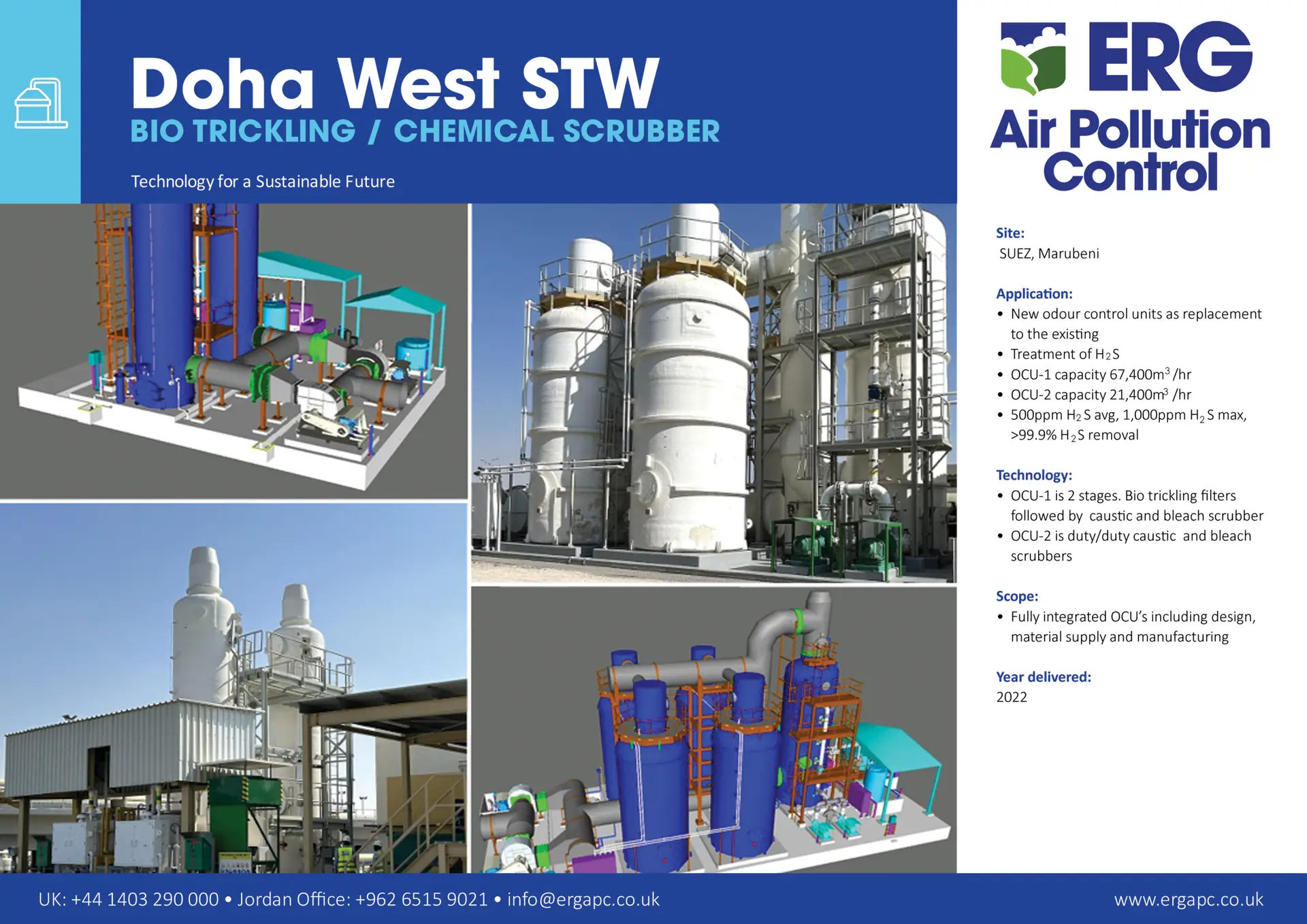
Doha West STW – Bio Trickling Filter and Chemical Scrubber Odour Control
High-Capacity Hydrogen Sulphide Removal for Sewage Treatment Works in Qatar
Project Overview
ERG Air Pollution Control supplied two fully integrated odour control units (OCUs) for the Doha West Sewage Treatment Works project in Qatar, combining biological and chemical scrubbing technologies to treat hydrogen sulphide (H₂S) emissions.
Delivered in 2022, the project involved the replacement of existing odour control equipment with new treatment systems designed for high-volume contaminated air streams associated with wastewater treatment operations.
The two units were designed for different treatment capacities and process configurations:
OCU-1: 67,400 m³/hr, incorporating bio trickling filters followed by caustic and bleach scrubbing.
OCU-2: 21,400 m³/hr, incorporating duty/duty caustic and bleach scrubbers.
Together, the two units provide a combined design treatment capacity of 88,800 m³/hr.
The systems were specified for average H₂S concentrations of 500 ppm and maximum concentrations of 1,000 ppm, with a required removal efficiency exceeding 99.9%.
ERG’s scope included the design, material supply and manufacture of the integrated odour control units.
The Challenge
Sewage treatment works generate odorous gases during wastewater collection, handling and treatment. Hydrogen sulphide is one of the most significant contaminants associated with these processes.
H₂S is produced when sulphur-containing compounds break down under anaerobic conditions. It has a characteristic rotten-egg odour and can create environmental, occupational and operational problems when released from wastewater treatment infrastructure.
At Doha West STW, the requirement was to replace existing odour control equipment with systems capable of treating substantial contaminated air volumes while achieving very high hydrogen sulphide removal efficiency.
The design conditions included average H₂S concentrations of 500 ppm and peak concentrations reaching 1,000 ppm.
These concentrations present a demanding treatment duty, particularly when combined with the large airflows involved.
The project required two separate odour control units, each configured to meet its specified process duty.
ERG’s solution combined biological and chemical treatment for the larger unit, while the second unit employed chemical scrubbing technology.
ERG’s Solution
ERG supplied two integrated odour control systems incorporating bio trickling filtration and chemical wet scrubbing.
The selection of different treatment configurations enabled the project to address the specified H₂S loading and airflow requirements through complementary treatment technologies.
OCU-1 – Bio Trickling Filtration and Chemical Scrubbing
Design airflow: 67,400 m³/hr
The larger odour control unit was configured as a two-stage treatment process, incorporating bio trickling filters followed by caustic and bleach scrubbing.
Stage 1 – Biological Treatment
Bio trickling filtration uses microorganisms growing on a suitable support medium to biologically oxidise hydrogen sulphide and other biodegradable odorous compounds.
Contaminated air passes through the biological treatment media while a circulating liquid maintains suitable conditions for microbial activity.
Hydrogen sulphide transfers from the gas stream into the wetted biofilm, where specialist microorganisms convert it into oxidised sulphur compounds.
Biological treatment can be particularly effective for wastewater odour control applications involving substantial airflow volumes and continuous H₂S loading.
By removing a proportion of the hydrogen sulphide biologically, the first treatment stage can reduce the contaminant load entering the downstream chemical scrubbing equipment.
Stage 2 – Caustic and Bleach Chemical Scrubbing
Following biological treatment, the air stream passes through chemical scrubbing equipment using caustic and bleach.
Chemical wet scrubbing provides a further treatment stage for residual hydrogen sulphide.
Caustic solution promotes the absorption of acidic H₂S into the circulating liquid, while sodium hypochlorite (bleach) provides an oxidising agent that can convert absorbed sulphide into other sulphur species.
The combination of biological treatment and chemical polishing provides a process configuration suited to demanding hydrogen sulphide abatement applications.
For Doha West STW, this two-stage arrangement was specified to achieve greater than 99.9% H₂S removal under the defined design conditions.
OCU-2 – Chemical Scrubbing System
Design airflow: 21,400 m³/hr
The second odour control unit incorporated duty/duty caustic and bleach scrubbers.
This configuration uses chemical wet scrubbing to remove hydrogen sulphide from the contaminated air stream.
Caustic and sodium hypochlorite treatment are established technologies for industrial and municipal wastewater odour control, particularly where high removal efficiencies are required.
The system was designed to treat the specified air volume while meeting the project’s hydrogen sulphide removal requirement.
The duty/duty arrangement provides two scrubbing duties within the OCU-2 treatment configuration.
Integrated Odour Control System Design
Both odour control units formed part of ERG’s integrated equipment supply.
ERG’s scope covered the design, material supply and manufacture of the treatment systems, bringing together the biological and chemical treatment equipment into coordinated odour abatement packages.
Integration is particularly important in large wastewater treatment applications, where the performance of individual treatment stages must be considered alongside the overall airflow, contaminant loading and operating requirements.
The project illustrates ERG’s capability to combine different treatment technologies within a single wastewater odour control scheme.
Technical Highlights
| Parameter | Project details |
|---|---|
| Project | Doha West Sewage Treatment Works |
| Location | Qatar |
| Project parties identified | SUEZ, Marubeni |
| Application | Replacement odour control units for wastewater treatment |
| Principal contaminant | Hydrogen sulphide (H₂S) |
| Number of OCUs | 2 |
| OCU-1 airflow | 67,400 m³/hr |
| OCU-2 airflow | 21,400 m³/hr |
| Combined design airflow | 88,800 m³/hr |
| Average inlet H₂S | 500 ppm |
| Maximum inlet H₂S | 1,000 ppm |
| Specified H₂S removal | >99.9% |
| OCU-1 technology | Bio trickling filters followed by caustic and bleach scrubbing |
| OCU-2 technology | Duty/duty caustic and bleach scrubbers |
| ERG scope | Design, material supply and manufacture |
| Year delivered | 2022 |
Benefits of the Integrated Treatment Systems
High-capacity odour control: The two units provide a combined design treatment capacity of 88,800 m³/hr.
High hydrogen sulphide removal: The systems were specified to achieve greater than 99.9% H₂S removal.
Treatment of concentrated odorous air: The design accommodates average H₂S concentrations of 500 ppm and maximum concentrations of 1,000 ppm.
Combined biological and chemical treatment: OCU-1 uses bio trickling filtration followed by chemical scrubbing to provide complementary removal mechanisms.
Dedicated chemical scrubbing: OCU-2 incorporates caustic and bleach treatment for its specified airflow duty.
Replacement of existing equipment: The project provided new odour control units to replace the site’s existing treatment systems.
Integrated engineering: ERG supplied the design, materials and manufacture of the coordinated odour control equipment packages.
Bio Trickling Filters and Chemical Scrubbers for Wastewater Odour Control
Wastewater treatment facilities require reliable odour control systems capable of treating air streams containing hydrogen sulphide and other odorous compounds.
Technology selection depends on several factors, including airflow, contaminant concentration, required removal efficiency, available space and operational requirements.
Bio trickling filters provide biological treatment through the action of microorganisms growing on wetted support media. They are widely used for hydrogen sulphide removal in municipal wastewater applications.
Chemical scrubbers offer an alternative or complementary treatment method, using liquid absorption and chemical reaction to remove contaminants from the gas stream.
For applications requiring particularly high removal efficiencies, biological and chemical technologies can be combined in a multi-stage treatment process.
The Doha West STW project demonstrates this approach, using biological treatment followed by chemical scrubbing for the larger OCU and dedicated chemical treatment for the second unit.
The project also highlights the scale of odour control engineering required at major wastewater treatment facilities, where individual treatment systems can handle tens of thousands of cubic metres of contaminated air per hour.
ERG’s Experience in Municipal Wastewater Odour Control
ERG Air Pollution Control designs and supplies specialist odour abatement systems for municipal wastewater treatment works, sewage pumping stations and industrial wastewater applications.
Its technology portfolio includes bio trickling filters, biological filters, packed tower chemical scrubbers, activated carbon systems and integrated multi-stage odour control units.
The Doha West STW project demonstrates ERG’s ability to engineer large-capacity treatment packages combining biological and chemical processes for demanding hydrogen sulphide removal applications.
With extensive experience in wastewater odour control, ERG supports projects requiring new installations, replacement treatment equipment and upgrades to existing abatement systems.
Contact ERG Air Pollution Control to discuss bio trickling filtration, chemical scrubbing or integrated odour control solutions for wastewater treatment facilities.