Thames Water
Bio-Trickling Filter and Carbon Odour Control System at East Hyde
Project Overview
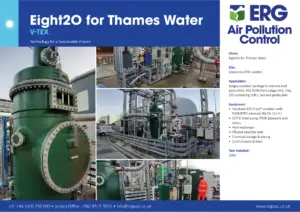
ERG Air Pollution Control supplied a biological odour control system for Thames Water at East Hyde in 2019, incorporating a bio-trickling filter and activated carbon filtration.
The installation was designed to provide odour control for upgraded sludge tanks and imported sludge screens, supporting the management of odorous air associated with wastewater sludge handling operations.
The treatment package included a bio-trickling filter with staircase access, carbon filters, fans, ductwork and a discharge stack, together with instrumentation, a motor control centre (MCC), control panel and kiosk.
The project demonstrates ERG’s experience in supplying integrated odour control equipment for wastewater treatment infrastructure, combining biological treatment and carbon filtration within a single engineered system.
The Challenge – Odour Control for Sludge Handling Operations
Sludge storage and handling activities at wastewater treatment facilities can generate odorous air requiring controlled extraction and treatment.
Sludge tanks and imported sludge screening equipment may release odorous compounds as wastewater solids are stored, transferred or processed.
Depending on the process conditions, these emissions can contain hydrogen sulphide (H₂S), reduced sulphur compounds and other biodegradable odorous substances.
For Thames Water’s East Hyde facility, the project required an odour control plant serving upgraded sludge tanks and imported sludge screens.
The system needed to integrate extraction, treatment and discharge equipment with the existing wastewater infrastructure.
The original case study does not specify the design air flow, inlet contaminant concentrations, outlet odour limits or required removal efficiencies.
ERG’s Solution – Biological Treatment and Carbon Filtration
ERG supplied an odour control system incorporating a bio-trickling filter and carbon filters.
These technologies offer complementary approaches to treating suitable odorous compounds.
Bio-Trickling Filtration
The bio-trickling filter provides a biological treatment stage in which contaminated air passes through a wetted packing medium supporting microbial activity.
Suitable gaseous contaminants transfer into the liquid film and can be broken down by microorganisms within the biofilm.
Bio-trickling filters are commonly applied to wastewater odour control because biological treatment can be effective for certain biodegradable compounds.
The treatment process depends on maintaining appropriate conditions for microbial activity, including moisture, pH, nutrient availability and contact time.
The East Hyde installation included staircase access to the bio-trickling filter, providing access to the elevated equipment and associated operating areas.
Activated Carbon Filtration
The system also incorporated carbon filters.
Activated carbon filtration uses porous media to adsorb suitable gaseous contaminants from an air stream.
In wastewater odour control systems, carbon filters can provide additional treatment for compounds remaining after upstream processes.
The combination of biological treatment and carbon filtration allows different treatment mechanisms to be incorporated within one installation.
The original case study confirms both technologies were supplied but does not specify the detailed process sequence or individual treatment performance.
Extraction, Ductwork and Discharge
The equipment package included fans and a ductwork system to convey extracted air through the odour control plant.
Effective air extraction is an important part of managing odour emissions from sludge tanks and screening operations.
Ductwork provides the connection between designated extraction points and the treatment equipment, while fans generate the airflow required to move contaminated air through the system.
The East Hyde installation also included a discharge stack for the treated air.
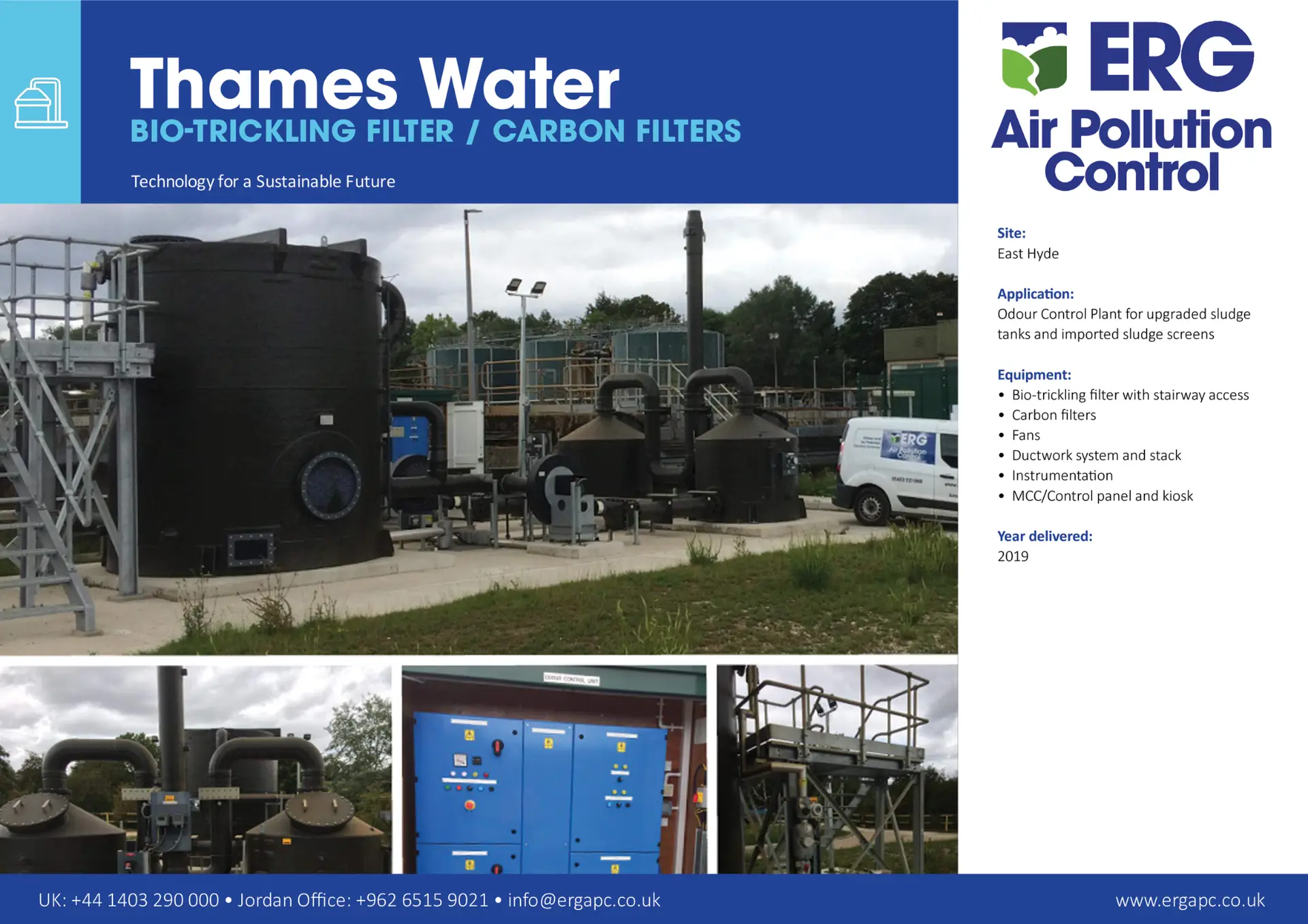
The original project photographs show the main biological treatment vessel, smaller carbon filtration vessels, associated ductwork, fans and access structures.
Together, these components illustrate the integration of air extraction and odour treatment equipment within a wastewater treatment environment.
Instrumentation and Control Systems
ERG’s documented equipment scope included instrumentation, an MCC, control panel and kiosk.
Instrumentation and control equipment support the operation of an odour control installation by providing the electrical and operational interfaces required for the treatment plant.
An MCC provides electrical motor control functions for equipment such as fans and pumps, where fitted.
The control panel and kiosk provide a dedicated location for the system’s electrical and control equipment.
The original case study does not specify the control philosophy, monitoring parameters or automation functions.
Project Specifications
| Parameter | Project detail |
|---|---|
| Client | Thames Water |
| Site | East Hyde |
| Industry | Wastewater treatment |
| Application | Odour control for upgraded sludge tanks and imported sludge screens |
| Primary technology | Bio-trickling filter |
| Additional treatment | Carbon filters |
| Access | Staircase access to bio-trickling filter |
| Air movement | Fans |
| Air conveyance | Ductwork system |
| Discharge | Stack |
| Electrical and controls | Instrumentation, MCC, control panel and kiosk |
| Year delivered | 2019 |
Biological Odour Control for Wastewater Sludge Treatment
Wastewater sludge handling presents particular odour control challenges because the characteristics of the extracted air can vary with sludge composition, storage conditions and processing activities.
Biological treatment technologies are used where the contaminant characteristics are suitable for microbial degradation.
Bio-trickling filters provide a controlled environment in which microorganisms can treat biodegradable gaseous contaminants.
Activated carbon filtration offers a complementary treatment mechanism based on adsorption.
Combining treatment technologies can provide flexibility when designing odour control systems for complex wastewater applications.
The East Hyde project illustrates the application of these technologies to sludge storage and screening infrastructure.
ERG’s Experience in Wastewater Odour Control
ERG Air Pollution Control designs and supplies engineered odour control systems for wastewater treatment plants, sludge handling facilities and industrial applications.
Its technology portfolio includes bio-trickling filters, biological filters, chemical scrubbers and activated carbon filtration systems.
The Thames Water East Hyde project demonstrates ERG’s ability to supply an integrated odour control package incorporating biological treatment, carbon filtration, air extraction, discharge equipment and electrical controls.
Delivered in 2019, the installation provides a reference for odour control associated with upgraded sludge tanks and imported sludge screens.
For further information about bio-trickling filters, activated carbon odour control or wastewater sludge treatment applications, contact ERG Air Pollution Control.