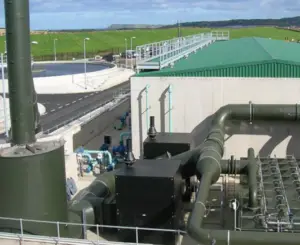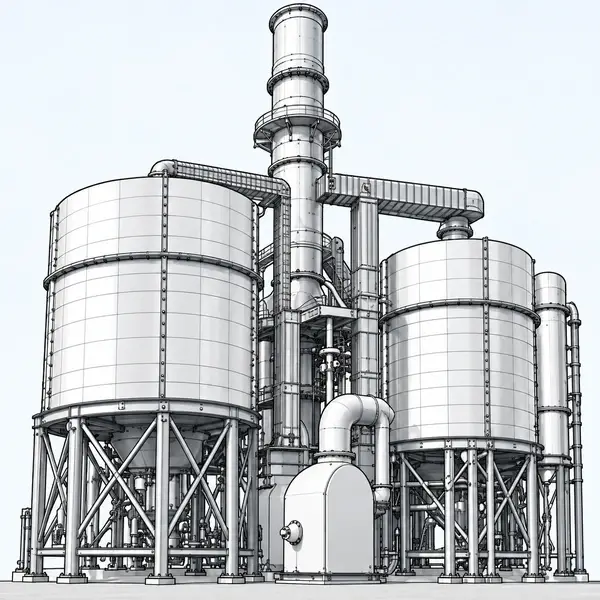
What Is a Regenerative Thermal Oxidiser (RTO)?
A Regenerative Thermal Oxidiser (RTO) is an air pollution control system that destroys volatile organic compounds (VOCs) and hazardous air pollutants by heating contaminated air to a high temperature so they oxidise into harmless carbon dioxide and water vapour — while recovering most of that heat to reuse on the next cycle. This heat recovery, achieved by alternating airflow through beds of ceramic media, is what makes an RTO far more energy-efficient than a standard thermal oxidiser, with thermal efficiencies up to 97%.
RTOs are one of the most widely used VOC abatement technologies in industry, prized for combining very high destruction efficiency – commonly up to 99.5% – with low ongoing fuel costs.
How Does a Regenerative Thermal Oxidiser Work?
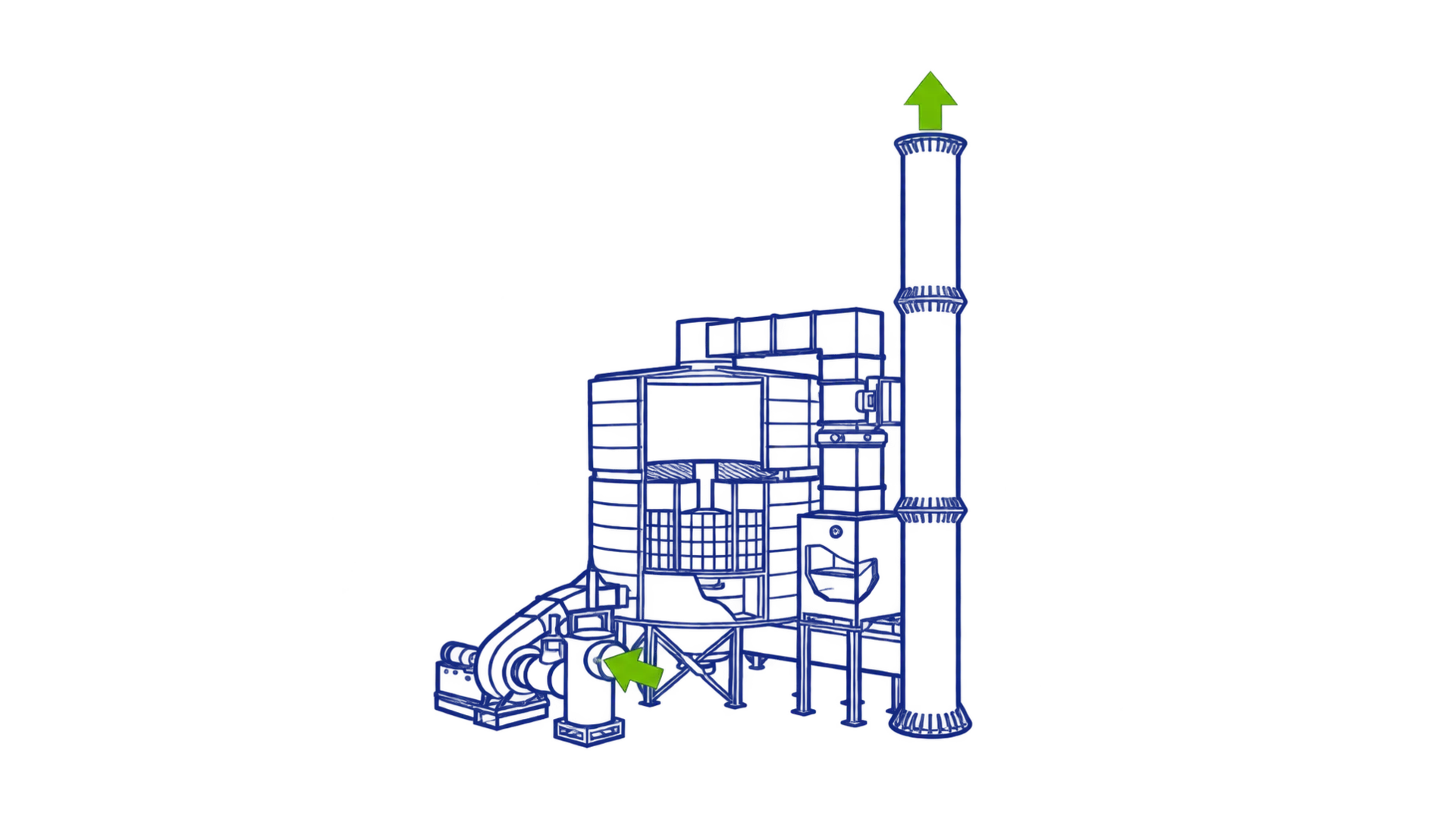
An RTO uses at least two chambers packed with ceramic heat-exchange media, plus a common combustion chamber, and works on a continuously alternating cycle:
1. Contaminated air enters a hot ceramic bed. VOC-laden process air is drawn through one of the ceramic media beds, which is still hot from the previous cycle, pre-heating the air as it passes through.
2. The pre-heated air is oxidised. The now-hot air enters the central combustion chamber, where it’s raised to the required oxidation temperature — typically 750–850°C — destroying the VOCs and converting them into CO₂ and water vapour.
3. Heat is captured for reuse. The clean, hot air then passes through a second ceramic bed, giving up most of its heat to the media before being released to atmosphere. That bed is now hot and ready to pre-heat the next batch of incoming air.
4. Airflow direction reverses. After a short cycle (typically a few minutes), valves switch the airflow direction, so the bed that just captured heat now pre-heats incoming contaminated air, and vice versa. This continuous reversal is what makes the process “regenerative.”
Because the incoming air is pre-heated by the outgoing clean air’s own recovered heat, an RTO needs far less auxiliary fuel to reach oxidation temperature than a system without heat recovery — and at sufficiently high VOC concentrations it can even run without any additional fuel at all.
What Does an RTO Remove?
RTOs are primarily used to destroy:
– Volatile organic compounds (VOCs) — solvents, hydrocarbons and similar organic emissions
– Hazardous air pollutants (HAPs)
– Odour-causing organic compounds
Because destruction relies on combustion rather than absorption or adsorption, an RTO works regardless of how soluble or reactive a compound is — but it isn’t suited to particulate, acid gases or other inorganic pollutants, which need a different technology (such as a venturi scrubber or chemical scrubber) either instead of or alongside an RTO.
How Has RTO Technology Evolved?
– First-generation – Two-bed RTOs
Traditional two-bed systems use two regenerative ceramic chambers, alternating the direction of airflow between them. While simple and well established, the momentary changeover between beds can allow a small quantity of untreated process air to pass through the system, limiting maximum destruction efficiency.
– Second-generation – Three-bed RTOs
Three-bed systems introduced an additional chamber and purge stage. This allows residual untreated air to be purged and re-treated during flow reversal, increasing destruction efficiency and thermal performance compared with conventional two-bed designs.
– Third-generation – Rotary RTOs
ERG Yurcent offers third-generation rotary RTO technology. Instead of switching the process flow between two or three large beds, the system uses 8 or 12 regenerative ceramic chambers arranged around a continuously rotating distribution valve. The valve progressively directs process air through the regenerative chambers, incorporating dedicated inlet, outlet, cleaning and isolation functions.
– This multi-chamber rotary arrangement can achieve purification efficiencies of up to 99.5% and thermal efficiency of up to 97%, while providing a more compact footprint and reducing heat loss and energy consumption.
– For applications requiring high VOC destruction efficiency, energy efficiency and a compact installation, the third-generation rotary RTO represents the latest evolution of regenerative thermal oxidation technology.
Where Are RTOs Used?
RTOs are used across a wide range of industries with VOC or solvent emissions, including:
– Chemical and pharmaceutical manufacturing — destroying solvent vapours from reactor and process vents
– Coatings, printing and surface finishing — treating solvent-laden exhaust from drying and curing processes
– Food and packaging — controlling odour and VOCs from certain production processes
– Waste and wastewater treatment — destroying odour compounds where a very high removal standard is required or to treat VOCs (eg methane) not removed by normal OCU.
They are particularly well suited to large, continuous gas flows with low-to-moderate VOC concentrations, where the fuel savings from heat recovery have the biggest impact on running costs.
RTOs vs. Other Air Pollution Control Technologies
– Standard (non-regenerative) thermal oxidisers destroy VOCs the same way, through high-temperature combustion, but without the ceramic bed heat exchange — meaning higher, ongoing fuel costs. An RTO is generally the more economical choice for continuous, higher-flow applications, while a simpler oxidiser may suit lower-flow or intermittent duties.
– Carbon filters physically adsorb VOCs rather than destroying them, and don’t require combustion — better suited to lower concentrations where the cost of continuous heating isn’t justified, but they need periodic carbon replacement rather than destroying pollutants outright.
– Chemical scrubbers and bio-trickling filters target acid/basic gases and biodegradable odour compounds respectively, rather than the broad range of VOCs an RTO can destroy through combustion.
Benefits and Limitations
Benefits:
– Very high destruction efficiency, typically 97%+ and up to 99.5%+ with a three-bed design and 3rd generation.
– Up to 97% heat recovery, significantly reducing fuel costs versus non-regenerative oxidation
– Can become largely self-sustaining (autothermal) at higher VOC concentrations, needing little or no auxiliary fuel
– Handles a broad range of organic compounds regardless of solubility
Limitations:
– Higher capital cost than simpler technologies such as carbon filters
– Requires careful control of temperature, residence time and turbulence to guarantee destruction efficiency
– Not suited to particulate, acid gases or other inorganic pollutants on its own
– A short pollutant “spike” can occur at each flow-reversal moment, particularly in two-bed systems, which is why three-bed designs and 3rd generation are used where this matters.
When is an RTO an energy-efficient option for VOC abatement?
A regenerative thermal oxidiser can be an energy-efficient option for continuous industrial VOC treatment because ceramic media recover heat from the outgoing gas to preheat the incoming air. The benefit is greatest when the process duty makes good use of that recovered heat. Fuel consumption still depends on airflow, VOC concentration, operating temperature and hours of operation.
Heat recovery efficiency is not the same as a percentage saving on the site’s total energy bill. An RTO also requires fan electricity, and start-up or low VOC loading may require auxiliary fuel. At sufficient VOC loading, heat released by oxidation can reduce or remove the need for auxiliary fuel during steady operation, but this must be established by a process heat balance.
- Compare annual consumption: request estimated fuel and electricity use for normal operation, start-up, shutdown and low-load periods.
- Check pressure drop: account for the fan power needed to move the specified airflow through the complete treatment system.
- Assess the alternatives: intermittent or low-load duties may justify another oxidation configuration or a suitable adsorption system.
- Confirm performance together: compare energy demand and the required outlet emissions under the same inlet conditions.
See ERG Yurcent RTO technology for the available system design, and the thermal oxidiser guide for a wider comparison. Contact ERG with the process data for an application-specific assessment.
Guide updated 26 October 2026: added practical guidance on treatment selection and supplier assessment.
Frequently Asked Questions
What is a Regenerative Thermal Oxidiser used for?
An RTO is used to destroy volatile organic compounds, hazardous air pollutants and odour-causing organic compounds from industrial exhaust air by heating them to oxidation temperature, while recovering most of the heat generated for reuse.
What does “regenerative” mean in a regenerative thermal oxidiser?
“Regenerative” refers to the ceramic heat-exchange beds, which alternately capture heat from the outgoing clean air and release it to pre-heat the incoming contaminated air. Reversing this airflow on a continuous cycle “regenerates” the heat rather than losing it, which is what gives an RTO its high energy efficiency.
What’s the difference between a two-bed and three-bed RTO? A two-bed RTO is the standard configuration, typically achieving around 98% destruction efficiency. A three-bed RTO and 3rd generation adds a purge stage to capture untreated air at the moment of flow reversal, pushing destruction efficiency to 99.5%+ — often used where odour or emission limits are especially strict.
How is an RTO different from a standard thermal oxidiser?
Both destroy VOCs through high-temperature combustion, but an RTO recovers heat from the outgoing clean air using ceramic media beds, cutting fuel costs significantly. A standard (non-regenerative) thermal oxidiser doesn’t recover heat this way, so it typically costs more to run continuously.
Explore ERG’s Thermal Oxidation Technology
ERG designs and manufactures thermal oxidation systems — including regenerative, recuperative and direct-fired configurations — engineered to meet IED emission limits for VOC and hazardous air pollutant destruction.
– See ERG’s full technical thermal oxidiser range, including RTO configurations: Thermal Oxidisers – Read the companion guide on the wider thermal oxidiser family: Thermal Oxidisers Guide (to be published) – Explore the physical alternative for lower-concentration VOC removal: Carbon Filters Guide
Talk to our team about a regenerative thermal oxidiser solution for your site’s VOC or odour destruction needs.